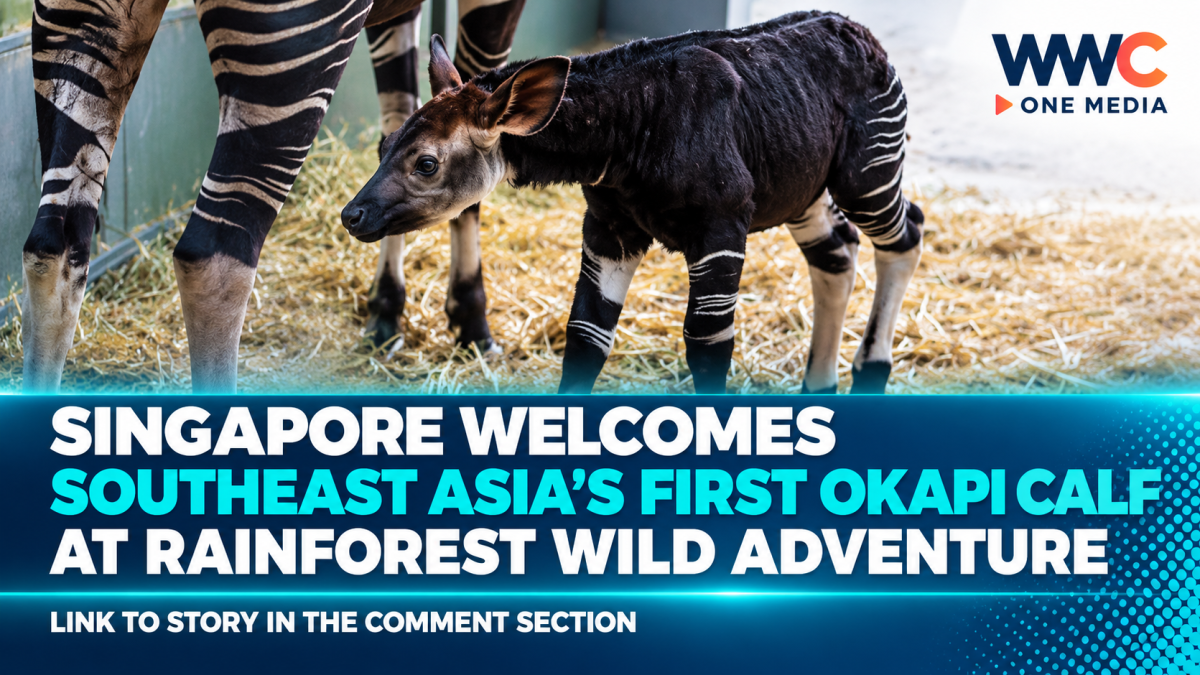
Singapore’s Rainforest Wild Adventure has welcomed a rare milestone for wildlife conservation with the birth of the first okapi calf in Southeast Asia.
The male calf was born on July 27 to first-time parents Kisala, 7, and Xandor, 4. Nearly two months later, the calf has grown from about 20 kilograms at birth to 48 kilograms and is gaining close to 1 kilogram a day, according to Mandai Wildlife Group.
The calf and its mother are being cared for at the Hidden Forest in Rainforest Wild Adventure East. The pair have recently been given access to an outdoor habitat, but visitors may not always be able to see the young okapi because it is still becoming accustomed to its surroundings.
A live “baby monitor” has been made available so visitors can watch the calf when it retreats to its secluded den. Daily Okapi Ranger Talks at 10:30 a.m. and 3 p.m. also give visitors an opportunity to learn more about the species and its unusual behaviour.
Okapis are native to the northeastern Democratic Republic of the Congo and are classified as Endangered on the International Union for Conservation of Nature Red List. Although they have zebra-like markings on their legs, okapis are actually the closest living relatives of giraffes and share characteristics such as long, flexible tongues and ossicones in males.
The birth is particularly significant because okapis have an exceptionally long gestation period of about 440 days, or roughly 14 to 15 months. Newborn okapis also have distinctive survival behaviours: they naturally remain hidden and relatively still during their early months, while their mothers return periodically to nurse them.
To support those instincts, Mandai’s animal-care team created a quiet, secluded calving box where the calf can rest and nurse with minimal disturbance. The team also drew on husbandry experience from other zoological institutions that have successfully bred okapis.
Kisala and Xandor arrived in Singapore under the European Association of Zoos and Aquaria’s Ex situ Programme, a coordinated breeding programme for threatened species. Keepers noticed changes in Kisala’s appetite and physical condition after the pair were introduced, prompting preparations for a possible pregnancy. An ultrasound in July confirmed that she was expecting.
Now the public is being invited to become part of the calf’s story by helping choose its name. Three options have been offered: Imara, meaning “strong” in Swahili; Mayaka, meaning “pearl” in Lingala; and Kiah, associated with dawn, new beginnings or the start of a season in Swahili. Voting is being conducted through Mandai Wildlife Reserve’s social-media platforms.
The okapi is not the only new attraction coming to the park. Rainforest Wild Adventure is also welcoming the sitatunga, a swamp-dwelling antelope, while two additional lemur species—the crowned lemur and red-bellied lemur—are expected to debut at Lemur Land by November 2026. Their arrival would bring the total number of lemur species in the area to four.
Okapi-themed food and merchandise will also be introduced as part of the celebration, including a special cake at selected Mandai dining outlets from October and souvenirs such as plush toys, tumblers and lanyards.
The birth gives Singapore another opportunity to highlight the challenges facing one of the world’s most elusive and threatened mammals while giving visitors a rare chance to observe its early development.
The bigger question now is whether this historic birth can help bring greater public attention to okapi conservation—and what other breakthroughs could follow as international breeding programmes work to protect endangered species.