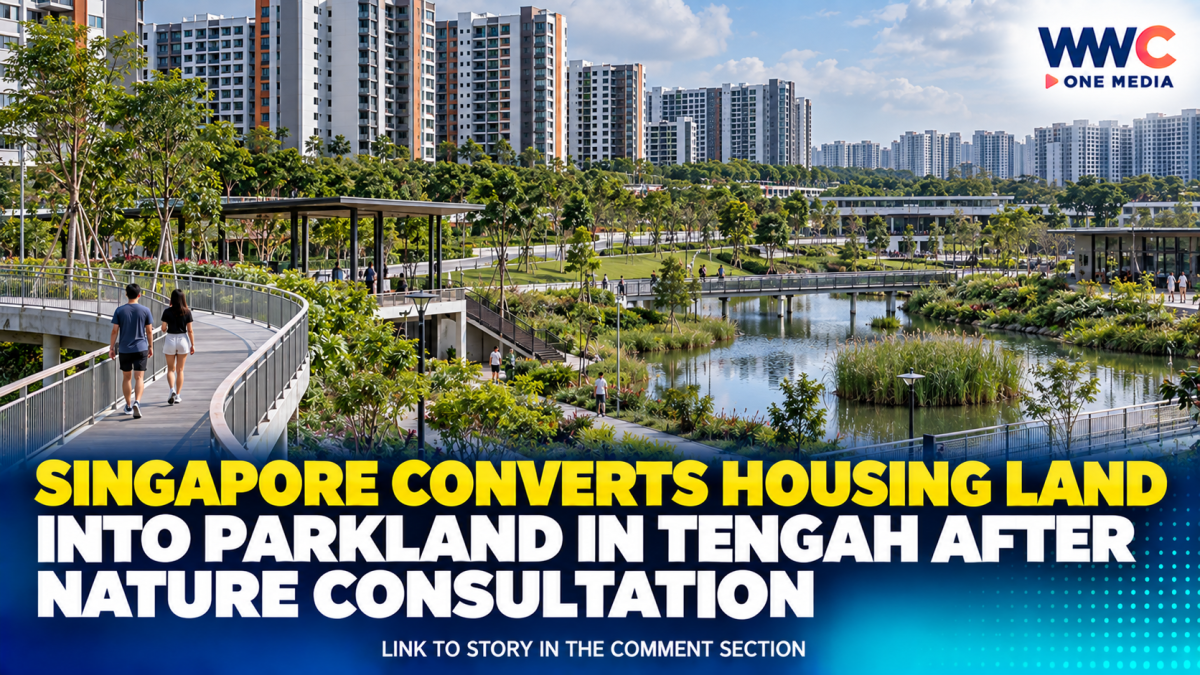
SINGAPORE — A piece of land in Singapore’s rapidly developing Tengah town that was once planned for housing has been converted into parkland, following environmental studies and consultations with nature groups.
The 5.4-hectare site, located near the existing Tengah Service Reservoir, is roughly the size of eight football fields. The Housing & Development Board (HDB) said the land will be retained to provide additional habitat for wildlife and strengthen ecological connectivity in the area.
The change comes as Singapore continues developing Tengah, its first new HDB town in about two decades, while trying to balance demand for new homes with the protection of biodiversity and green corridors.
From Housing Site to Wildlife Habitat
The site was originally part of land intended for development but was subsequently rezoned to expand a future park.
Government gazette records checked by The Straits Times indicate that the rezoning was approved in May 2025.
The decision followed an environmental impact assessment for the planned Tengah Town Centre, which will occupy about 16.7 hectares and is being developed around a future station on the Jurong Region Line.
The environmental study found that the area provides important connections between different ecosystems and supports species with conservation significance.
Among the wildlife recorded in Tengah are the Sunda pangolin, leopard cat and harlequin butterfly, species that conservation assessments identify as requiring particular protection.
Nature Groups Had a Role in the Review
The change followed public consultation on the environmental impact assessment.
HDB received 142 responses relating to the Tengah Town Centre assessment, with concerns including the loss of greenery and the effects of development on wildlife and the surrounding ecosystem.
HDB said it had taken the feedback into consideration as it weighed different land-use requirements.
The agency has described Tengah as a place where housing, infrastructure and environmental considerations have to be balanced because the town is being developed on land that previously included secondary forest.
Tengah Is Being Built as a ‘Forest’ Town
Tengah covers about 700 hectares and has been planned as an eco-friendly, car-lite town.
Its location between Singapore’s western and central catchment forests makes the area particularly important for ecological connectivity, allowing wildlife to move between different vegetated areas.
The town is being developed in stages across five districts: Plantation, Garden, Park, Brickland and Forest Hill.
More than 12,000 households had collected their keys in Tengah as of December 2025, showing the scale of the town’s ongoing development.
About 140 Hectares of Green and Park Areas Safeguarded
HDB said that, overall, about 140 hectares of natural green and park areas in Tengah have been safeguarded.
The agency said the approach is intended to provide residents with more green spaces while supporting biodiversity.
HDB also said it would continue reviewing Tengah’s plans and consider ways to support or enhance biodiversity as development progresses.
The move reflects a broader approach in Singapore, where authorities are increasingly using environmental impact assessments and consultation with nature groups to adjust development plans in ecologically sensitive areas.
Sembawang Faces a Similar Balancing Act
The Tengah decision came alongside HDB’s response to environmental feedback on a separate 21-hectare forested site in Sembawang planned for housing and community development.
There, HDB decided to reduce the development footprint and retain about 6 hectares of forest, grassland and scrubland because of the area’s ecological value.
An environmental study recorded 148 animal species and 198 plant species at the Sembawang site, including the critically endangered Sunda pangolin.
HDB said the Sembawang development remains necessary as part of Singapore’s overall housing plans for the North, while mitigation measures will be used to reduce environmental impacts.
Singapore’s Housing Challenge Meets Its Green Challenge
The changes in Tengah and Sembawang highlight a difficult planning equation for Singapore: the country has limited land, but it also needs homes, transport infrastructure, community facilities and spaces for nature.
HDB said it will take a “calibrated and considered approach” to these competing land uses, guided by scientific studies and feedback from nature groups and the public.
For Tengah, one thing is already clear: some land once intended for homes will instead remain part of the town’s green landscape.
As Singapore’s newest major housing town continues to take shape, the decision could become another example of how the city-state is trying to fit homes, infrastructure and wildlife into the same increasingly valuable piece of land.
WWC ONE MEDIA G,A