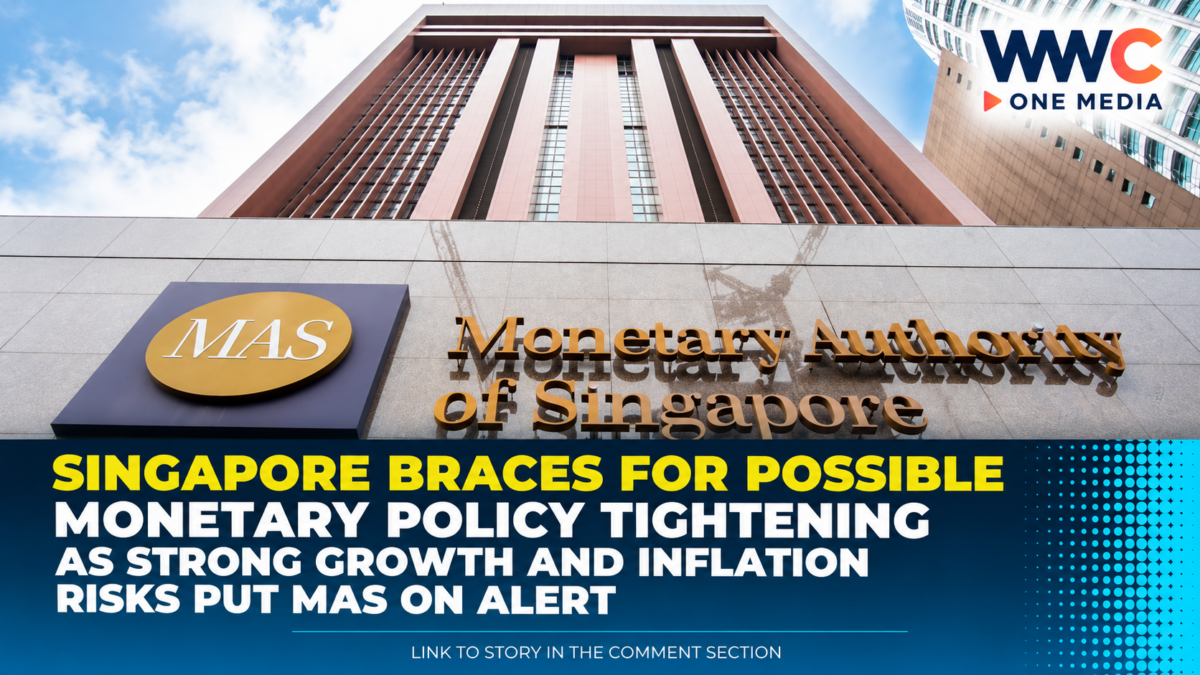
Singapore could tighten its monetary policy again next week as robust economic growth and rising inflation risks strengthen the case for further action by the Monetary Authority of Singapore (MAS).
All 10 economists surveyed by Reuters expect MAS to tighten policy at its Oct 14 review, signalling growing concern that external price pressures could become more persistent even as the economy continues to perform strongly.
The expected move follows two rounds of tightening in April and July, with the July adjustment coming as a surprise to many market observers.
The latest outlook comes as escalating tensions in the Middle East threaten to push up global oil prices, while the risk of an intense El Niño weather pattern could put additional pressure on food supplies and prices.
Strong Economic Growth Gives MAS Room to Act
Singapore’s economy has benefited from resilient global demand, particularly investment linked to artificial intelligence and technology-related products.
According to advance estimates from the Ministry of Trade and Industry, gross domestic product grew 5.7 per cent year on year in the second quarter of 2026.
The strong performance has supported expectations that economic activity will remain firm in the second half of the year, even as uncertainty over global trade and energy supplies persists.
In its July policy statement, MAS said the economy was expected to grow at a firm pace for the year, potentially widening the gap between actual output and the economy’s sustainable capacity.
Such conditions can increase inflationary pressure, giving the central bank a reason to maintain a tighter monetary stance.
Rising Oil and Food Costs Raise Inflation Concerns
External price pressures remain a major concern for Singapore, which relies heavily on imports for energy, food and many other essential goods.
The widening Middle East conflict has raised uncertainty over oil supplies and shipping routes. If energy prices remain elevated, businesses could face higher transportation, production and operating costs, some of which may eventually be passed on to consumers.
Weather risks could add to the pressure. A severe El Niño event could disrupt agricultural production in key food-exporting countries, potentially increasing the cost of imported food.
Singapore’s core inflation, which excludes accommodation and private transport costs, reached 2.2 per cent in August 2026. Headline inflation, which measures overall consumer prices, stood at 2.3 per cent.
MAS had forecast both measures to average between 1.5 and 2.5 per cent for 2026, but renewed external shocks could make the outlook more challenging.
How Would Another Tightening Move Work?
Unlike many central banks, MAS primarily manages monetary policy through the exchange rate rather than by setting a domestic policy interest rate.
It guides the Singapore dollar’s nominal effective exchange rate, or S$NEER, within a policy band. A steeper appreciation path allows the Singapore dollar to strengthen more quickly against a basket of trading-partner currencies.
A stronger currency can help moderate imported inflation by making foreign goods and services less expensive in Singapore dollar terms.
Economists expect any further move to be modest, with a slight increase in the slope of the policy band among the possibilities. However, the final decision will depend on MAS’s assessment of growth, inflation and global risks.
What It Could Mean for Households and Businesses
Further monetary tightening could help contain price increases over time, particularly for imported goods. However, the effect would not be immediate, and consumers may still face higher costs if global oil, food and transport prices continue rising.
Businesses that depend on imported materials could also face cost pressures, while a stronger Singapore dollar may help cushion some of those increases.
The overall impact will depend on how global conditions develop and how much of the higher costs businesses pass on to customers.
October Decision in Focus
MAS is scheduled to announce its next monetary policy decision on Oct 14, alongside its latest Macroeconomic Review.
With economic growth remaining strong and inflation risks tilted to the upside, markets are watching closely for signs of another adjustment to the Singapore dollar policy band.
Although economists widely expect tightening, the decision has not yet been announced. The scale of any move — and whether it will be sufficient to contain imported price pressures — will depend on the central bank’s latest assessment of Singapore’s economic outlook.