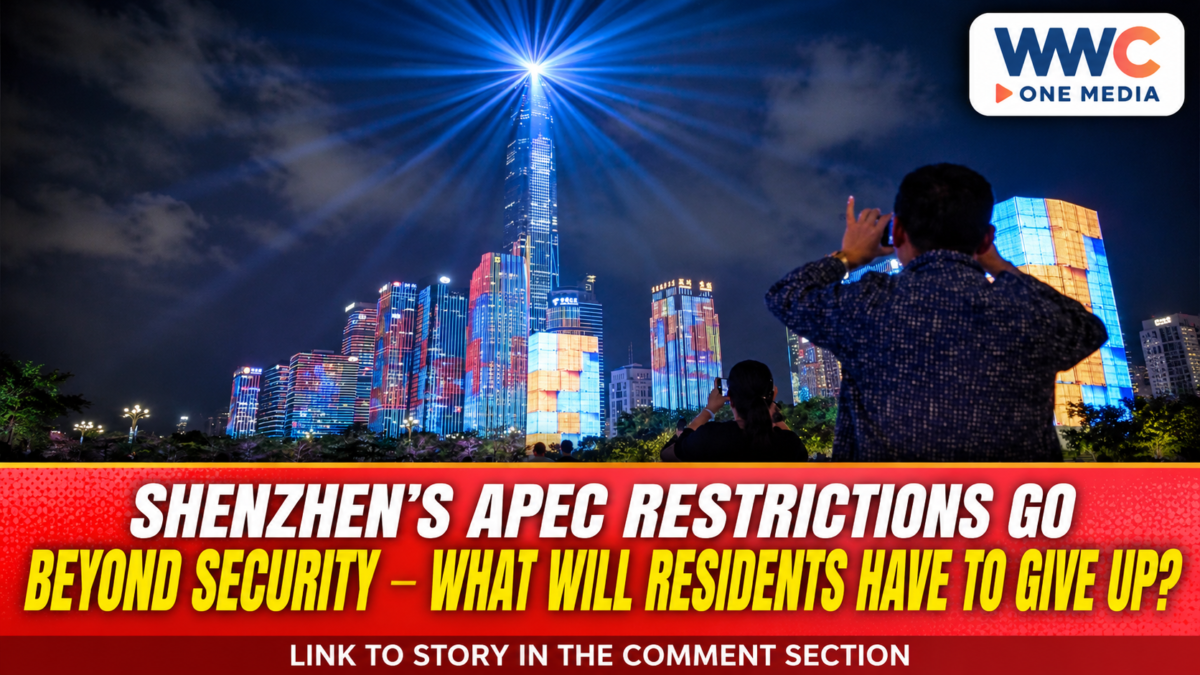
Shenzhen is introducing a series of temporary restrictions and workplace adjustments as it hosts the 33rd Asia-Pacific Economic Cooperation (APEC) Economic Leaders’ Meeting on Nov. 18–19. The measures cover low-altitude flights, vehicles entering major districts and working arrangements, while a separate citywide rule restricts unnecessary horn use.
The restrictions show the scale of preparation required to host a gathering of international leaders in a major commercial centre. But they also affect ordinary residents, commuters, delivery services and businesses — making the challenge one of balancing event security with the city’s daily operations.
Drone restrictions cover almost the entire city
One of the most significant measures concerns drones and other objects that can fly at low altitude.
A Shenzhen government notice issued on Nov. 3 established a phased restriction. From Nov. 7 through Nov. 10, the controlled area covered Futian and Nanshan districts. From Nov. 11 through Nov. 21, the restriction expanded across Shenzhen, excluding the Shenzhen-Shanwei Special Cooperation Zone.
The notice covers unmanned aircraft, general aviation aircraft, model aircraft, balloons, kites and sky lanterns. Individuals and organisations are prohibited from conducting flights with these objects in the designated areas during the restricted periods. Shenzhen Municipal Government
The restriction is not absolute for every possible operation. Flights required for security protection, emergency rescue and police duties may proceed after obtaining approval from the relevant authorities.
That distinction is important for Shenzhen’s technology and logistics industries. The city has developed a significant low-altitude economy, including commercial drone operations. Temporary flight controls therefore need to protect the summit without treating every authorised aviation activity as an ordinary recreational flight.
Foreign-registered cars face daytime restrictions
Traffic controls are another major part of the summit preparations.
A Shenzhen municipal government decision dated Nov. 3 restricts passenger vehicles carrying licence plates issued outside Shenzhen from using roads in six districts: Futian, Luohu, Nanshan, Bao’an, Longgang and Longhua.
The restriction runs from Nov. 17 to Nov. 20, daily from 6 a.m. to 10 p.m. It does not apply to every road in the city. Specific highways north of the Shenhai Expressway and designated roads leading to Shenzhen Bao’an International Airport are exempt. Shenzhen Municipal Government
The decision also identifies exempt vehicle categories, including emergency vehicles, vehicles carrying special APEC credentials, qualifying passenger transport vehicles and certain Hong Kong, Macau and consular-plate vehicles.
This is a targeted traffic measure rather than a complete shutdown of outside-registered vehicles. Its practical effect will depend on where motorists need to travel and whether their routes fall within the designated districts and hours.
For visitors and businesses, checking the official restrictions before travelling is essential. A route that remains available during the evening may be restricted during the daytime.
Shenzhen’s horn restriction is not simply an APEC rule
The car-horn restriction requires a separate explanation.
Shenzhen’s environmental and traffic authorities issued a citywide notice prohibiting motor vehicles from sounding horns on roads throughout the city, effective Nov. 1, 2026. The notice is valid for five years.
However, it includes exceptions. Drivers may use their horns when approaching dangerous bends or the tops of slopes where visibility is limited, when overtaking under the applicable road-safety rules, or when warning others about an emergency. Certain emergency and rescue vehicles also have specific exemptions. Shenzhen Municipal Government+1
This means the horn restriction should not be described as a temporary silence order created solely for the APEC meeting. It is a broader citywide traffic-noise measure that took effect shortly before the summit.
The distinction matters because it changes how residents should understand the rule: it is not scheduled to disappear when the visiting leaders leave Shenzhen.
Businesses are being encouraged to adjust working arrangements
The city has also asked employers to consider flexible working arrangements during the summit week.
A notice from Shenzhen’s human resources and social security authority encouraged businesses to adopt flexible arrangements from Nov. 16 to Nov. 20. Options include working from home, staggered working hours, flexible schedules and, where appropriate, paid annual leave.
The guidance recognises that some jobs cannot be performed remotely. For employees who must work on-site, employers are encouraged to discuss practical arrangements with staff and consider public transport or adjusted commuting times. hrss.sz.gov.cn+1
Importantly, the notice does not establish a compulsory citywide work-from-home order.
It also tells employers to respect labour protections. Flexible arrangements must not be used to unlawfully extend working hours, avoid overtime payments, reduce wages or undermine other employee rights.
For companies, this makes the summit a logistical exercise as well as a diplomatic event. Businesses must consider how to maintain operations while employees face altered travel conditions.
The wider APEC agenda extends beyond security
The summit itself is part of a broader regional economic programme.
APEC’s official calendar places the CEO Summit on Nov. 17–18 and the Economic Leaders’ Meeting on Nov. 18–19 in Shenzhen. The forum brings together 21 member economies and operates as a platform for economic cooperation rather than a military alliance. APEC+1
The 2026 host theme is “Building an Asia-Pacific Community to Prosper Together,” with priorities including openness, innovation and cooperation.
The APEC Secretariat has identified trade, artificial intelligence, digital transformation, supply-chain resilience, energy security and food systems as important areas of regional discussion. APEC+1
These priorities give the summit a practical economic dimension. Decisions and cooperation on trade procedures, technology and supply chains can affect companies operating across the Asia-Pacific, including Philippine exporters and manufacturers.
For the Philippines, the significance is not limited to which leaders meet privately. The broader question is whether the discussions produce practical commitments that improve regional trade and economic cooperation.
What happens next?
The most restrictive measures have defined timeframes.
The citywide low-altitude flight restrictions run through Nov. 21, while the daytime restrictions on non-Shenzhen passenger vehicle plates run through Nov. 20. The flexible-work guidance covers Nov. 16–20.
The horn notice, by contrast, remains in force for five years from Nov. 1, subject to its stated exceptions.
The summit’s success will be judged internationally by the discussions and commitments reached by participating economies. For Shenzhen residents, another measure will matter just as much: whether the city can maintain essential services, business activity and everyday mobility while hosting a major international gathering.
The restrictions are temporary in several important areas, but the coordination behind them is a test of how a global business city manages security without bringing normal life to a standstill.