
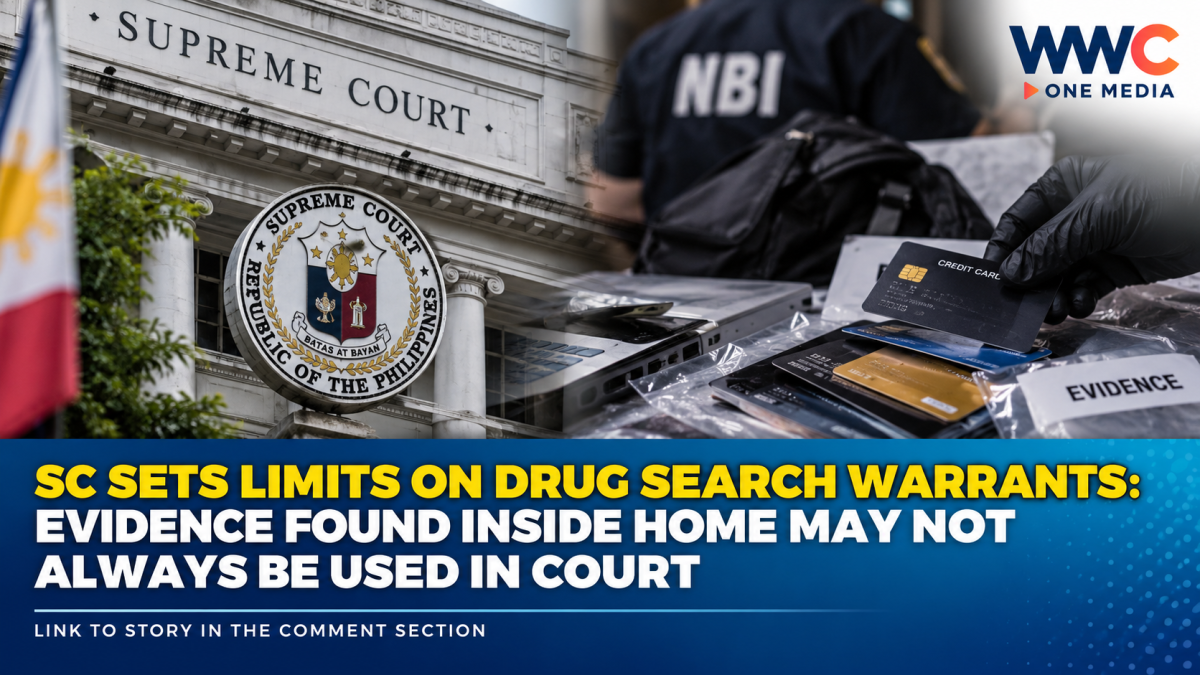
MANILA, Philippines — A Supreme Court ruling is drawing renewed attention to the limits of police searches after the high court ruled that credit cards seized during a search authorized only for illegal drugs could not be used as evidence in a separate credit-card fraud case.
The ruling, involving Edgar Silvano, reinforces a fundamental constitutional protection: law enforcement officers generally may seize only the items specifically covered by a valid search warrant, unless a recognized exception applies.
The Supreme Court’s Third Division, in a decision penned by Associate Justice Japar B. Dimaampao and dated February 12, 2026, acquitted Silvano of violating Republic Act No. 8484, or the Access Devices Regulation Act of 1998. The decision was subsequently made public by the Court.
The case began with a drug investigation
The National Bureau of Investigation had received information alleging that Silvano was involved in illegal drugs as well as computer hacking and credit-card fraud.
To verify the drug allegation, an NBI informant purchased methamphetamine hydrochloride, commonly known as shabu, from Silvano. Laboratory testing subsequently confirmed that the substance was shabu.
The NBI then secured a search warrant under Republic Act No. 9165, the Comprehensive Dangerous Drugs Act, authorizing the search for shabu and drug-related items.
When agents searched Silvano’s residence, however, they encountered more than suspected drug-related evidence.
Among the items recovered were computers, laptops, ATM cards, a money counter, a dry seal and a card-skimming device.
The agents also recovered two American Express credit cards bearing the name “V S Tan.”
That discovery eventually became the center of the legal battle.
The credit cards were later found to be counterfeit
An American Express manager subsequently confirmed that the cards were counterfeit because their numbers did not correspond with the records of the legitimate account holder.
Silvano was later prosecuted under RA 8484, which penalizes, among other acts, possession of counterfeit access devices such as fake credit cards.
The Regional Trial Court convicted him, and the Court of Appeals upheld the conviction.
The appellate court accepted the argument that the cards could be seized under the plain-view doctrine, even though they were not specifically listed in the drug search warrant.
But the Supreme Court disagreed.
SC: A drug warrant does not become a blank check
The high court stressed that a search warrant must particularly describe the place to be searched and the things to be seized.
In general, officers cannot simply expand the scope of a warrant because they encounter another potentially incriminating item during a lawful search.
There is, however, an important exception: the plain-view doctrine.
Under that doctrine, officers may seize an item not specifically listed in a warrant when the legal requirements for plain-view seizure are satisfied.
The Supreme Court explained that the doctrine requires, among other things, that officers be lawfully present where the item is discovered, that the discovery be inadvertent, and that the item’s incriminating character be immediately apparent.
The Court found those requirements were not satisfied in Silvano’s case.
Why the “plain view” argument failed
One of the crucial issues was that the credit cards were not simply lying openly in plain sight.
According to the court’s ruling as reported by multiple outlets, the cards were inside a non-transparent bag and therefore could not be seen until the bag was opened.
Even after the cards were found, they did not appear counterfeit merely from their appearance.
Their alleged fraudulent nature became clear only after they were subsequently verified with American Express.
That distinction proved decisive.
The Supreme Court also considered the fact that the NBI already possessed information linking Silvano to alleged credit-card fraud and hacking.
Because investigators had prior information about those alleged offenses, the Court found that the discovery of the cards could not simply be treated as an accidental discovery of evidence unrelated to the investigation.
In effect, the investigators had reason to investigate the alleged credit-card offenses separately but obtained a warrant that authorized a search for drugs and drug-related items, not counterfeit access devices.
Evidence obtained outside the warrant cannot simply be used
The Supreme Court consequently ruled that the credit cards were unlawfully seized and therefore inadmissible as evidence against Silvano under RA 8484.
With the cards excluded, the prosecution could no longer establish the elements necessary to sustain his conviction for possessing counterfeit access devices.
The Supreme Court therefore reversed the conviction and acquitted Silvano.
What the ruling does—and does not—mean
The decision should not be interpreted as saying that anything found during a lawful search is automatically protected from seizure.
Rather, the ruling emphasizes that exceptions to the warrant requirement have specific legal conditions.
Police officers can still seize evidence under recognized exceptions, including circumstances covered by the plain-view doctrine. But those exceptions cannot simply be invoked after the fact when the requirements have not been met.
The case therefore highlights the importance of keeping a search tied to the specific authority granted by the court.
Why the ruling matters beyond this case
The decision comes against the backdrop of several recent Supreme Court rulings emphasizing the importance of proper search procedures and the preservation of evidence in criminal cases.
The Court has repeatedly underscored that constitutional protections against unreasonable searches and seizures are not technicalities that law enforcement can disregard.
In an earlier drug-related ruling, for example, the Supreme Court stressed the importance of proper procedures in handling seized narcotics, including the inventory and photographing of evidence and preservation of the chain of custody.
Another Supreme Court ruling has also addressed the scope of warrantless searches, emphasizing that the validity of a search depends on the specific legal circumstances supporting it.
The broader message is straightforward: successful law enforcement does not eliminate the requirement to follow constitutional and procedural safeguards.
The bigger issue: protecting evidence—and rights
The Silvano case illustrates a difficult balance faced by law enforcement.
Authorities need effective tools to investigate crimes, particularly illegal drugs and organized criminal activity. But evidence gathered through a search must still comply with constitutional requirements if prosecutors expect it to survive judicial scrutiny.
The Supreme Court’s ruling sends a clear warning that a warrant issued for one alleged offense cannot automatically be treated as authorization to search for evidence of every other suspected crime.
For prosecutors and investigators, that distinction can determine whether evidence ultimately stands—or falls—in court.
And for defendants, it reinforces the constitutional protection against unreasonable searches and seizures.
In this case, the question was not simply what investigators found inside the residence. The decisive question was whether the law allowed them to seize and use it.
WWC ONE MEDIA M.J.E
Leave a Reply