
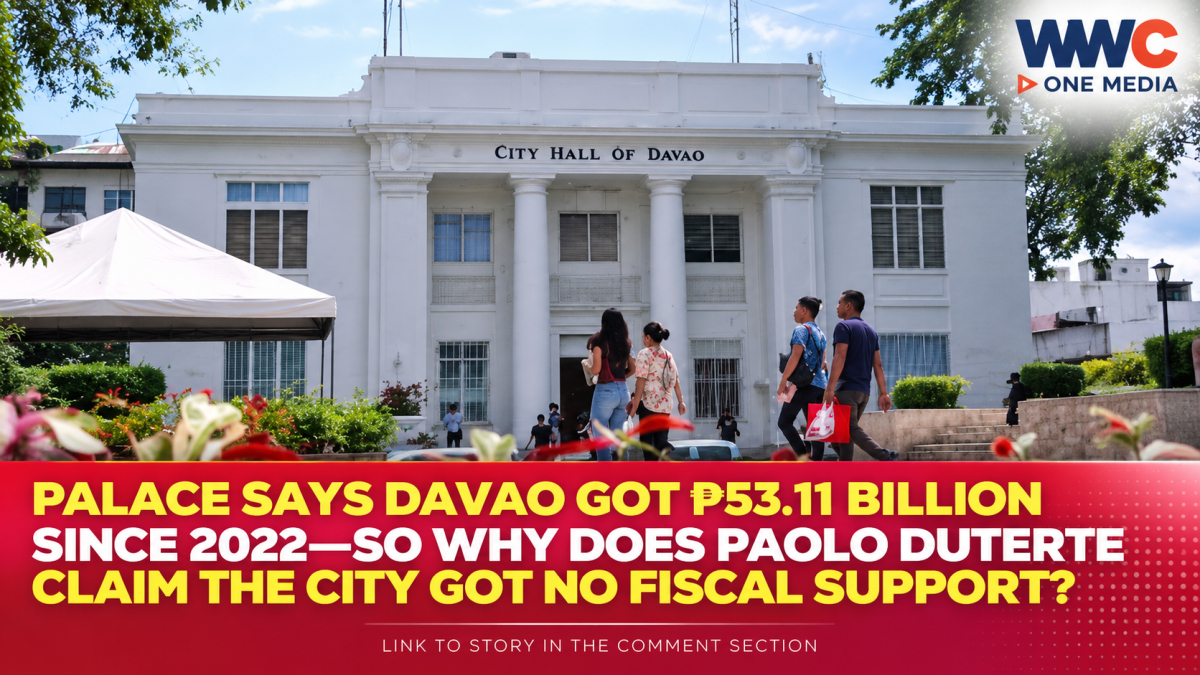
MANILA, Philippines — Malacañang has pushed back against claims that Davao City received little or no financial support from the national government, citing government records showing that the city and its barangays received approximately ₱53.11 billion in national funds from 2022 through 2026.
The Palace’s response came after Davao City 1st District Rep. Paolo “Pulong” Duterte questioned the level of national government funding received by Davao City under the Marcos administration.
Palace Press Officer and Presidential Communications Office Undersecretary Claire Castro said the records tell a different story.
According to figures presented by the Palace, Davao City and its barangays received ₱52.80 billion in National Tax Allotment (NTA) during fiscal years 2022 to 2026. An additional ₱314.48 million came from other releases under the General Appropriations Act, bringing the combined figure to roughly ₱53.11 billion.
Where did the ₱53.11 billion go?
The Palace said ₱41.63 billion of the NTA went to the Davao City government itself, while ₱11.17 billion represented the combined NTA of the city’s barangays.
The additional ₱314.48 million cited by Castro included:
- ₱175.50 million — Local Government Support Fund financial assistance to LGUs
- ₱79.55 million — LGU shares from Fire Code fees
- ₱25.14 million — share from incremental VAT collections
- ₱18.61 million — Barangay Development Program support
- ₱10.65 million — participatory budgeting support
- ₱4.92 million — share from the utilization and development of national wealth
Castro stressed that the ₱53.11-billion figure does not include individual programs and projects implemented directly by national government agencies in Davao City.
Those agencies include the Department of Public Works and Highways, Department of Social Welfare and Development, Department of Transportation and Department of Agriculture.
But there is an important distinction
The dispute is partly about what is meant by “government funding” or “fiscal support.”
A large portion of the ₱53.11 billion is the National Tax Allotment, formerly known as the Internal Revenue Allotment. The NTA is not simply a discretionary amount that Malacañang can choose to give or withhold from a particular city.
It is the legally mandated share of national revenues distributed to local government units under the Constitution and the Local Government Code.
GMA News reported that the NTA is an automatic, formula-based source of funding for LGUs, and that the national government fully released the ₱1.19-trillion 2026 NTA to LGUs in January.
That means the Palace’s ₱52.80-billion NTA figure demonstrates that Davao City and its barangays received their statutory national revenue shares—but it does not necessarily answer every possible interpretation of whether the city received particular discretionary, project-specific or infrastructure allocations sought by local officials.
That distinction is crucial to understanding the political argument.
The Palace has made the same rebuttal before
This is not the first time Malacañang has disputed the “zero budget” narrative.
In May, the Palace cited Department of Budget and Management records showing that Davao City had received at least ₱7.856 billion in national government support from fiscal years 2023 to 2026, including NTA, special shares, Fire Code fees and other programs.
At the time, the Palace said the amount also included funding for projects involving farm-to-market roads, health facilities, justice and civil-defense facilities, Philippine Red Cross infrastructure, DPWH programs, basic education facilities, the DSWD XI Learning Institute and the Davao Public Transport Modernization Project.
Another ₱146.21 million was identified under the Local Government Support Fund.
The latest Palace figures are considerably larger because they cover both Davao City and its barangays from 2022 through 2026, and include the broader NTA allocation.
The controversy comes amid a larger Davao funding fight
The argument over national funding has unfolded alongside an increasingly heated debate over flood-control and infrastructure projects in Davao City.
Davao City officials have defended major infrastructure investments in the city, while critics have called for scrutiny of some flood-control contracts.
In May, House Deputy Minority Leader Antonio Tinio asked the Office of the Ombudsman to investigate as much as ₱4.4 billion worth of flood-control projects in Davao City’s first district, alleging possible irregularities including overlapping contracts, double funding and missing project details.
Tinio said his review covered 121 DPWH flood-control contracts from 2019 to 2022, with 80 allegedly presenting potential red flags.
Duterte rejected the allegations and pointed to DPWH Region XI records showing approximately ₱49.84 billion in infrastructure projects completed in Davao City from 2020 to 2022, including roads, drainage systems, bridges and other public works.
The accusations remain allegations, not established findings of wrongdoing.
Ombudsman adds another layer to the dispute
The issue gained additional political weight in August when Ombudsman Jesus Crispin Remulla described Davao City as the “epicenter” of flood-control projects before the Marcos administration and said investigators were facing an entrenched “ecosystem” that made the probe difficult.
Duterte subsequently challenged that characterization and called for investigators to examine DPWH records.
The competing narratives have therefore become broader than a simple question of whether Davao City received money from the national government.
They now involve how much funding was provided, what type of funding it was, which projects received it, who implemented them and whether the resulting infrastructure delivered value to taxpayers.
Duterte’s side remains part of the story
The latest Palace statement directly challenged Duterte’s claim, but GMA News reported that Duterte had not yet responded to its request for comment when the report was published.
That makes it important not to portray the Palace’s ₱53.11-billion figure as the end of the political dispute.
Rather, it establishes what the government says its records show.
The next question is what exactly Duterte meant by “no fiscal support”—whether he was referring to the legally mandated NTA, additional discretionary assistance, specific infrastructure allocations, or another category of funding.
The bigger question for Davao taxpayers
For residents, the debate ultimately goes beyond competing political statements.
If billions of pesos in national and local resources have flowed into Davao, taxpayers have a legitimate interest in knowing where the money went, which projects were completed, how they performed and whether they addressed the city’s persistent infrastructure problems—including flooding.
The Palace now has put a concrete number on its side of the argument: ₱53.11 billion from 2022 to 2026, excluding direct national-agency projects.
But the political battle over Davao’s funding—and the scrutiny surrounding its infrastructure projects—is clearly far from finished.
WWC ONE MEDIA M.J.E



Leave a Reply