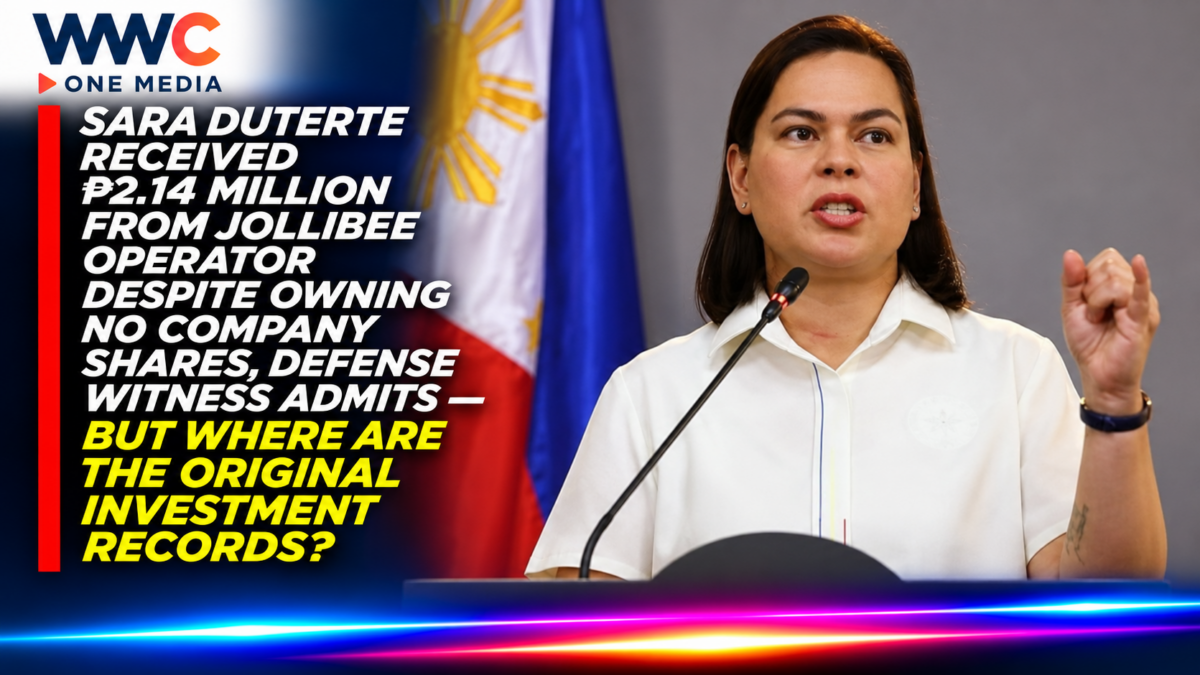
MANILA, Philippines — November 11, 2026 — Vice President Sara Duterte received more than ₱2.14 million from a company operating Jollibee franchises in Davao City between 2022 and 2025, despite holding no shares in the corporation, according to testimony from her own defense witness during Wednesday’s Senate impeachment trial.
The disclosure has intensified scrutiny of Duterte’s business interests, financial declarations and the documentation supporting payments she received while serving as vice president.
Lawyer Suzette Balucanag-Punay, corporate counsel of GenCorp Industries Inc. and Metro City Chow Foods Corporation, confirmed that Duterte received a total of ₱2,142,369.14 from GenCorp over four years.
Punay maintained that the payments represented a return of capital from an earlier investment connected to the Jollibee Times Square branch in Davao City, rather than dividends from shares in GenCorp.
But the testimony took a significant turn when Senate impeachment court Presiding Officer Francis “Chiz” Escudero questioned the basis for the payments.
Punay acknowledged that she could not verify the amount Duterte originally invested because she had no written records documenting the transaction.
The admission has placed renewed attention on one of the central questions in Duterte’s impeachment proceedings: Can the defense adequately explain the vice president’s financial interests and transactions using verifiable corporate records?
Defense Witness Confirms ₱2.14 Million in Payments to Sara Duterte
During the 42nd day of Duterte’s impeachment trial, Punay appeared before the Senate court as a witness for the vice president’s defense.
Questioned by defense lawyer Justin Nicol Gular, she presented information from GenCorp’s accounting records detailing payments made to Duterte.
According to Bilyonaryo News Channel, GMA News and other reports covering the proceedings, the transactions were as follows:
| Year | Amount received |
|---|---|
| 2022 | ₱337,500.00 |
| 2023 | ₱555,750.00 |
| 2024 | ₱612,419.14 |
| 2025 | ₱636,700.00 |
| Total | ₱2,142,369.14 |
The witness said the payments were issued through checks and recorded in transaction summaries prepared by the company’s accountant.
Although the disbursements were confirmed in testimony, their legal and accounting classification remains contested.
Punay characterized them as returns of capital, while acknowledging under questioning that the payments could also be considered income.
The distinction matters because repayment of an investment is not necessarily equivalent to profit, and the classification can affect how transactions are assessed for taxation and public-official disclosure requirements.
No GenCorp Shares, But an Investment in a Jollibee Branch?
One of the most closely examined aspects of Punay’s testimony concerned Duterte’s ownership status.
The defense witness said the vice president did not appear as a GenCorp shareholder in the company’s General Information Sheets covering 2022 to 2025.
She also testified that Duterte was not a corporate officer or director during those years and had not received dividends declared by GenCorp.
However, the witness acknowledged that Duterte had what she called a “loose investment” linked to the Jollibee Times Square branch.
According to Punay, the investment originated with Davao Bounty Times Food Corporation, a business in which Duterte previously held an interest.
The original company reportedly failed to secure the relevant franchise, but the investment was subsequently carried over through succeeding business arrangements until it became associated with GenCorp.
Punay argued that Duterte’s financial interest related specifically to one restaurant branch, rather than ownership of GenCorp itself.
That distinction is central to the defense’s explanation.
A person can potentially hold a contractual or other financial interest connected to a business without owning shares in the corporation operating it.
However, the absence of recorded shares does not, by itself, resolve questions about the existence, nature or disclosure of a financial interest.
Escudero Questions Missing Records Behind Investment
The most significant development came when Escudero pressed the witness to explain the original investment.
If Duterte received repeated payments characterized as returns of capital, the presiding officer wanted to establish how much capital had actually been contributed.
Punay acknowledged that she could not verify the original investment amount.
According to GMA News, she also admitted that she had not seen a written document establishing Duterte’s investment.
This raised further questions about the accounting basis used to classify the payments.
Without documentation establishing the initial capital contribution, it may be difficult to determine how much of the amount received represents repayment of principal and whether any portion represents earnings or another type of benefit.
The defense witness maintained that the payments were associated with the Jollibee Times Square branch and supported by the company’s transaction summary and checks.
But checks documenting payments do not necessarily establish the original terms of an investment.
For the impeachment court, the issue is therefore not limited to whether Duterte received the money.
It also concerns the nature of the underlying financial arrangement and the records available to substantiate it.
₱2.14 Million Versus ₱212.63 Million: Why the Figures Matter
The witness’s testimony also directly challenged financial estimates previously presented by the House prosecution.
Forensic accounting expert Alexander Cabrera had attributed approximately ₱212.63 million in alleged undeclared income to Duterte’s supposed interest in GenCorp between 2023 and 2025.
The reported estimates included:
- 2023: ₱55.71 million
- 2024: ₱74.06 million
- 2025: ₱82.86 million
Those amounts were significantly higher than the approximately ₱1.80 million in payments that Punay identified for the same three-year period.
The defense witness disputed the assumption that Duterte owned 20% of GenCorp and said the company’s corporate records did not support that ownership finding.
During the hearing, she also challenged the forensic report’s calculations concerning the corporation’s paid-up capital.
Her testimony prompted a procedural dispute after she described aspects of the prosecution’s findings as absurd.
Escudero subsequently ordered the disputed characterization stricken from the record.
However, the difference between the prosecution’s estimates and the actual payments cited by Punay does not automatically establish that either side’s entire financial analysis is correct.
The forensic estimate concerns alleged income attributable to a claimed ownership interest, while the witness’s transaction summary concerns identified payments.
The court must evaluate the methods, documents and assumptions underlying each figure.
House Prosecutors Say Defense Testimony Raises More Questions
The House prosecution responded by arguing that Punay’s testimony supported its position that Duterte had a financial interest in GenCorp-related operations despite the absence of registered shareholdings.
House prosecution spokesperson and Lanao del Sur Representative Zia Alonto Adiong pointed to the confirmed payments as evidence of a business interest requiring further examination.
Prosecutors argued that the defense witness’s admission reinforced their concern about the nature of Duterte’s corporate relationships.
However, this remains the prosecution’s interpretation of the evidence.
The defense maintains that Duterte did not own GenCorp shares and disputes the prosecution’s calculations and allegations.
Whether the financial arrangement violated constitutional restrictions or disclosure requirements has not been established by the witness’s testimony alone.
The Senate impeachment court must determine the relevant facts and legal consequences.
SALN Disclosures Become an Important Part of the Dispute
The testimony also draws attention to Duterte’s Statements of Assets, Liabilities and Net Worth, commonly known as SALNs.
GMA News reported that corporate interests associated with GenCorp appeared in the vice president’s SALNs for 2024 and 2025, while earlier declarations identified a former company name, Timesquare Bee Foods Corp.
This creates an important question about how the business arrangement was represented in Duterte’s financial disclosures.
A registered shareholding, a contractual investment, a receivable and a right to receive payments may involve different legal classifications.
The court must therefore examine the actual financial arrangement before deciding what disclosure requirements applied.
The issue is particularly relevant because the remaining impeachment article includes allegations of unexplained wealth, inaccurate financial declarations and prohibited business interests.
As previously covered by WWC ONE MEDIA in its report on the defense’s 24 witnesses and the ₱817.87-million wealth allegations, the prosecution’s broader financial case involves disputed interpretations of corporate documents, bank transactions and asset declarations.
The prosecution’s estimates have not been established as findings of guilt.
Duterte continues to deny wrongdoing.
GenCorp Also Faces Questions Over Government Contracts
Beyond the investment payments, GenCorp has been discussed during the impeachment proceedings in connection with contracts awarded by the Davao City government.
According to GMA News, Davao City Mayor Sebastian Duterte, the vice president’s brother, previously testified that GenCorp had received approximately ₱33 million in city government contracts.
He also said he had not known that his sister had a business interest in the company.
These details add another dimension to questions about Duterte’s business connections.
However, the existence of a government contract and a financial relationship with an official do not automatically prove corruption, prohibited participation or an unlawful conflict of interest.
Determining whether any law was violated would require evidence addressing ownership, control, relevant official actions, the applicable rules and the timing of the transactions.
These issues remain subject to examination.
Sara Duterte’s Impeachment Trial Enters a Critical Stage
The November 11 testimony comes after the defense began presenting witnesses in response to the remaining impeachment charge.
The House prosecution has alleged that Duterte and her husband, lawyer Manases Carpio, accumulated or failed to properly account for at least ₱817.87 million in wealth and assets.
The defense disputes those allegations and has challenged the prosecution’s financial analysis.
The Senate impeachment court previously admitted significant portions of the prosecution’s documentary evidence, while excluding certain records and calculations.
Admission of evidence, however, is not equivalent to a finding that the allegations are true.
As WWC ONE MEDIA reported in its coverage of the tense November 9 witness examination, the defense’s presentation has already produced contentious questioning about property records and witness credibility.
The latest testimony shifts attention to corporate interests and the treatment of financial transactions.
The question now is whether the defense can produce sufficiently reliable documentation to explain those transactions and rebut the prosecution’s findings.
Political Stakes Rise as the Senate Examines Financial Evidence
The impeachment proceedings carry significant political consequences.
A conviction could result in Duterte’s removal from office and potentially disqualification from holding future public office, subject to the applicable constitutional provisions and the court’s judgment.
An acquittal would mean the Senate had not found sufficient grounds for conviction under the impeachment process.
The outcome remains uncertain.
The case also involves procedural disputes concerning the duration of the defense’s presentation and the evidence the Senate will consider.
As discussed in WWC ONE MEDIA’s report on prosecutors seeking to shorten Duterte’s defense presentation, the proceedings have faced questions about scheduling, efficiency and procedural fairness.
The financial testimony may intensify those debates because the senator-judges must distinguish between transactions that have been documented, financial interests that remain disputed, and allegations requiring further proof.
The vice president retains the right to contest the evidence against her.
Why the ₱2.14-Million Disclosure Matters
The latest development illustrates a fundamental challenge in cases involving business ownership and financial disclosures.
Corporate shareholding records provide one important form of evidence, but they may not capture every possible financial arrangement involving a company or its operations.
At the same time, payments made by a corporation do not automatically prove hidden ownership or unlawful income.
The origin, purpose, documentation and legal classification of those payments matter.
Punay’s testimony offers the defense a basis for challenging the prosecution’s much larger financial estimates.
But it also leaves questions about Duterte’s original contribution and the supporting investment documents.
The wider controversy over financial transparency has already attracted attention to the Duterte family’s private transactions.
In a separate WWC ONE MEDIA report on Manases Carpio’s explanations of disputed credit-card spending, Carpio’s representatives contested attempts to connect his personal expenses to the vice president.
Those separate allegations should not be treated as evidence that the GenCorp payments were unlawful.
They nevertheless illustrate the broader public debate surrounding financial accountability and the impeachment proceedings.
What Happens Next?
The Senate impeachment court may need to examine the company’s transaction summaries, payment checks, original investment records if any can be produced, and other relevant evidence.
Questions remain over when Duterte made the investment, how much she contributed, what contractual rights she obtained, and why the payments continued from 2022 through 2025.
The distinction between corporate ownership and a separate branch-level investment will likely remain central to the dispute.
For the defense, Punay’s testimony offers an explanation for payments that were considerably smaller than the prosecution’s forensic estimates.
For the prosecution, the same testimony confirms a financial relationship requiring scrutiny.
Neither interpretation alone resolves the impeachment charge.
The bottom line: Sara Duterte’s own defense witness has confirmed ₱2.14 million in payments from a Jollibee franchise operator despite the vice president holding no recorded shares in the company. But with the original investment amount still unverified and no written investment agreement produced during the testimony, the most consequential question remains unanswered.
If the payments were returns of capital, can the defense establish the underlying investment—and will the missing records become a decisive issue in one of the Philippines’ most politically consequential impeachment trials?