KYIV, Ukraine — Russia launched one of its largest aerial assaults on Ukraine in months on Wednesday (Oct. 7), sending missiles and drones across Kyiv and a dozen other regions in an attack that Ukrainian officials said had been anticipated but could not be fully stopped.
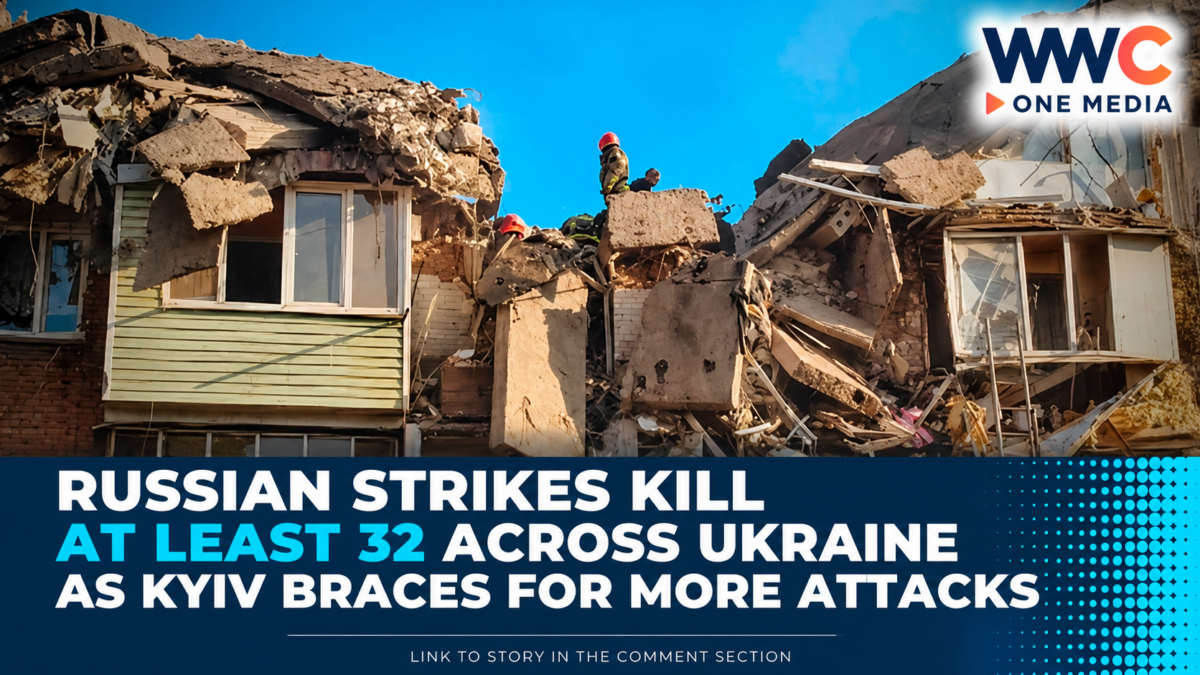
At least 32 people were killed and about 100 wounded nationwide, according to updated figures from Ukrainian authorities. The deadliest strike hit the northern city of Pryluky, where a Russian missile destroyed part of a five-storey residential building. The death toll there rose to 22, including five children, as rescuers continued searching the rubble on Thursday.
The attack also killed people in Kyiv and the central cities of Kremenchuk and Oleksandriia, while damaging residential buildings, industrial sites and energy infrastructure.
Ukraine had warned that a major attack was coming
The assault came after Ukrainian intelligence warned that Russia was preparing a large-scale strike.
President Volodymyr Zelenskyy said the country’s intelligence services had identified preparations for a major bombardment before the attacks began. Many residents of Kyiv responded by taking shelter in underground Metro stations as explosions were heard across the capital.
Despite the warning, Ukrainian officials said the country’s air defences were unable to prevent all of the incoming weapons.
Zelenskyy said Russia launched 70 missiles, many of them high-speed ballistic weapons, together with dozens of Shahed-type attack drones.
The Ukrainian Air Force said it intercepted more than 80% of Russia’s newer jet-powered drones, an improvement from interception rates reported in previous weeks. However, ballistic missiles remain a major challenge for Ukraine’s air-defence network.
Pryluky residential building suffers heaviest losses
The greatest loss of life occurred in Pryluky, in Ukraine’s Chernihiv region.
A Russian missile struck a five-storey residential building, collapsing several sections of the structure while families were inside.
Ukraine’s State Emergency Service said 22 people had died, including five children, and another 54 people were injured. Emergency crews rescued 15 people from the damaged building as they worked through the rubble.
The attack also damaged a gas pipeline, temporarily leaving more than 18,000 residents without gas, according to local officials.
The destruction has left rescuers working with excavators and hand tools to search collapsed apartments for survivors and victims.
Kyiv also hit during overnight barrage
The capital was among the areas targeted during the overnight assault.
Two people were initially reported killed in Kyiv, while further bodies were discovered in a damaged apartment building, bringing the reported death toll in the capital to four.
Drone debris also caused deaths in a suburb of Kyiv, according to Ukrainian officials.
Residents spent part of the night underground as air-raid warnings sounded.
The attacks came as Russia has increasingly relied on large-scale combinations of missiles and drones to strike Ukrainian cities and critical infrastructure.
Russia says it targeted military facilities
Russia’s Defence Ministry said its forces carried out a “massive strike” against military-industrial facilities in Kyiv and other Ukrainian regions.
Moscow said it used high-precision weapons launched from land, sea and air, as well as drones.
Russian authorities also said they targeted facilities connected to the production and storage of Ukrainian missiles and drones, as well as port and ship-repair infrastructure in the Odesa region. Those claims could not be independently verified.
Ukraine, meanwhile, said civilian residential areas and energy infrastructure had been hit.
The competing accounts reflect the wider information battle surrounding the war, where the military purpose and circumstances of individual strikes can be difficult to independently establish.
Ballistic missiles remain Ukraine’s biggest air-defence problem
The latest attack has renewed attention on Ukraine’s shortage of air-defence interceptors, particularly Patriot missiles supplied by the United States.
Zelenskyy has repeatedly called on allies to provide additional Patriot systems, saying ballistic missiles remain the most difficult threat for Ukrainian forces to stop.
The challenge has become more serious as global air-defence supplies have been stretched by the war in Ukraine and other conflicts, including the war involving Iran.
Ukraine has also been developing and deploying its own weapons as it attempts to offset Russia’s advantage in long-range missile capabilities.
The government said it received a new €1.2 billion tranche from the European Union on Wednesday and planned to direct the funds towards defence needs.
Ukraine strikes back inside Russia
Ukraine responded to the Russian bombardment with its own long-range attacks.
Zelenskyy said Ukrainian forces targeted two Russian oil facilities and a training ground in the Perm, Samara and Astrakhan regions.
Russian officials did not immediately comment on those claims.
Zelenskyy also released images he said showed an oil tanker burning near the Russian Black Sea resort city of Sochi. The images and reports surrounding the vessel could not be independently verified.
The exchange illustrates how the conflict has increasingly become a long-range aerial war, with both sides seeking to damage military, energy and industrial infrastructure far from the front lines.
Attack coincided with Putin’s birthday
The Russian assault also coincided with President Vladimir Putin’s 74th birthday.
Zelenskyy pointed to the timing when condemning the attack, accusing Russia of deliberately targeting civilians and describing the assault as intended to inflict fear.
Russian authorities have not acknowledged that the timing of the operation was connected to Putin’s birthday.
The Kremlin has continued to present Russia’s military campaign as focused on military and strategic objectives rather than civilians.
A war still without an immediate breakthrough
The latest bombardment comes as diplomatic efforts to end the war have yet to produce a lasting ceasefire.
More than four years after Russia’s full-scale invasion, the two sides remain engaged in fighting on the ground while simultaneously conducting increasingly sophisticated long-range strikes.
For Ukraine, the attacks underline the continuing importance of air-defence supplies from its Western allies. For Russia, the repeated missile and drone campaigns demonstrate its ability to continue striking Ukrainian infrastructure despite Ukrainian efforts to intercept the weapons.
The latest casualties also show the continuing civilian cost of the conflict.
As rescue workers clear the rubble in Pryluky and other affected areas, Ukrainian authorities are bracing for further attacks while pressing allies for additional air-defence capabilities.
The immediate priority remains finding survivors, restoring damaged infrastructure and protecting Ukrainian cities from the next wave of missiles and drones.