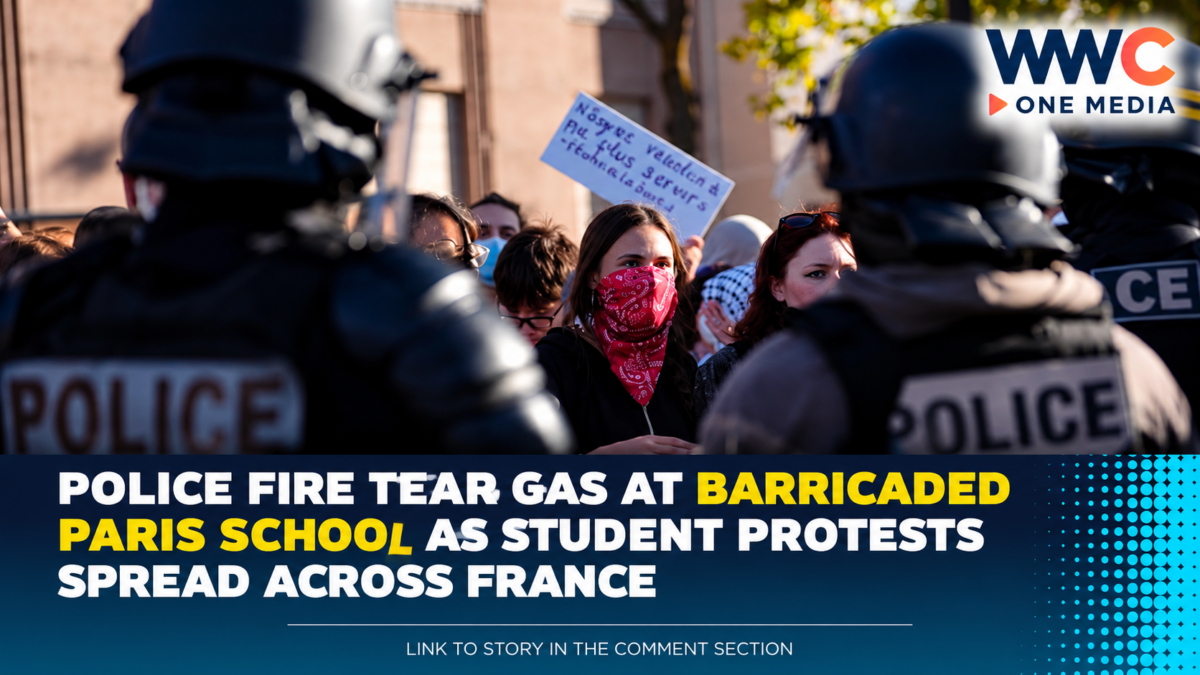
PARIS, France — French police fired tear gas at students who barricaded a high school in northeastern Paris on Thursday (Oct. 8), as nationwide demonstrations over underfunded schools, deteriorating facilities and shortages of teachers continued to disrupt education across the country.
Students used rubbish bins to block access to Hélène Boucher High School, a focal point of the growing protest movement. Riot police gathered in nearby streets before moving against demonstrators, while separate rallies in Paris also saw the use of tear gas and water cannons.
The demonstrations, which began in September, have expanded beyond individual school blockades into a wider campaign demanding better conditions for students and increased investment in France’s public education system. The unrest has also intensified debate over police tactics, particularly when officers confront protesters who are mostly minors.
Hundreds of schools disrupted as protests continue
The Hélène Boucher school was among hundreds of French schools affected by demonstrations on Thursday. The Education Ministry said 375 schools were fully or partially closed that day, although the number of closures was lower than during earlier protests in the week.
Students gathered outside schools in Paris and other cities, with many wearing hoodies or surgical masks. At least a dozen demonstrations in support of the movement were planned across France, including a rally at Place de la Bastille in Paris.
The protests have drawn students from different backgrounds, along with teachers, parents and other supporters. Demonstrators have called for more funding, improved school buildings and sufficient staffing to ensure students receive the education they are entitled to.
The Interior Ministry said police had made more than 6,600 arrests since the protests escalated in late September. Most of those involved in the movement are under 18, according to authorities.
Students cite leaking roofs, overcrowded classrooms and teacher shortages
At the heart of the demonstrations are complaints about deteriorating school infrastructure and insufficient resources.
Students have described problems including water leaks, inadequate insulation, overcrowded classrooms and rodent infestations. They have also demanded better staffing arrangements, saying the absence of teachers can leave classes without adequate instruction.
Some protesters argue that the government’s response has focused too heavily on restoring order instead of addressing the problems that prompted the demonstrations.
A student at Hélène Boucher High School told the Associated Press that she was concerned about police violence and wanted authorities to focus on students’ demands. She described witnessing problems with insulation and water leaks at the school, as well as rats.
The movement has also become a platform for broader frustration over unequal educational opportunities and the condition of public services.
Students and supporters have called for a substantial increase in education spending. However, the government faces pressure to control public debt and reduce its budget deficit, complicating efforts to commit additional funds.
Police response comes under mounting scrutiny
The use of tear gas has become one of the most contentious aspects of the protests, following reports of serious injuries among teenagers and allegations that police have used excessive force.
One 14-year-old boy sustained severe facial injuries after being struck by a tear-gas grenade during a protest near Paris. His mother told the Associated Press that the projectile shattered his jaw and damaged or dislodged numerous teeth.
The officer who fired the grenade was subsequently placed under investigation and charged with violence by a public official causing mutilation or permanent disability, according to the prosecutor’s office. The officer reportedly said he acted quickly to protect a colleague during a confrontation.
In another incident in the northern French town of Lens, a 15-year-old lost a hand after an explosion involving a police stun grenade. Authorities said they were investigating the circumstances surrounding the injury.
These incidents have intensified criticism from students, parents and rights advocates, who argue that the use of crowd-control weapons against young demonstrators can cause lasting harm.
Interior Minister Laurent Nuñez announced that a particular model of stun grenade suspected of being involved in the Lens incident would no longer be used against high school students while authorities examined what happened.
The minister has also defended police actions in many cases, arguing that officers have had to respond to vandalism, violence and confrontations during some demonstrations. The government maintains that the protests have not remained peaceful everywhere.
The allegations against individual officers remain subject to investigation, and not every confrontation has resulted in a finding of misconduct.
Prime minister promises proposals to address students’ concerns
Prime Minister Sébastien Lecornu has acknowledged the scale of the unrest and instructed ministers to develop proposals addressing the leading complaints.
The issues under consideration include ensuring absent teachers are replaced, reviewing the length of the school day and examining the condition of ageing school buildings.
Lecornu has also condemned attacks on students, school staff and police officers, as well as schools being set on fire or vandalised. He has warned that the disruption has resulted in thousands of lost classroom hours.
The government faces a difficult balancing act: it must respond to students’ concerns while also restoring normal school operations and managing pressure on public finances.
For protesters, however, promises of further discussion have not yet provided a clear assurance that conditions will improve. Student groups have said they intend to continue demonstrating until the government makes more concrete commitments.
The coming weeks may prove important in determining whether proposed measures are sufficient to ease tensions or whether the movement continues to grow.
Protests spread beyond France
The unrest has also inspired demonstrations beyond France’s borders, with students in Belgium organising rallies over school conditions, staffing and education reforms.
In the Belgian city of Liège, authorities imposed a temporary ban on public gatherings through Oct. 16, citing concerns about further clashes and vandalism. Police used tear gas and water cannons during demonstrations there, and dozens of people were arrested.
Although the protests in Belgium have their own local grievances, the developments illustrate how the French movement has resonated with students facing similar concerns about education systems and public services.
The spread of demonstrations has added to pressure on officials to distinguish between peaceful protest and violence while ensuring that young people can raise concerns without facing unnecessary risks.
A growing test for France’s education system
The latest confrontation at Hélène Boucher High School underscores the challenges facing French authorities as they attempt to contain a protest movement rooted in complaints about public education.
For students, the demands centre on practical concerns: functioning school buildings, sufficient teachers, manageable class sizes and better learning conditions. For the government, the challenge is to address those demands while dealing with incidents of violence and disruption.
The growing scrutiny of police tactics has added another dimension to the crisis, with serious injuries prompting questions about how authorities should manage demonstrations involving minors.
With students pledging to continue their actions and ministers still working on proposals, the protests show few signs of ending immediately. The government’s next steps will be closely watched by students, parents and educators seeking evidence that their concerns will lead to tangible changes.
For now, the clash in northeastern Paris reflects a wider national dispute over school funding, public services and the balance between maintaining order and protecting the right to protest.