
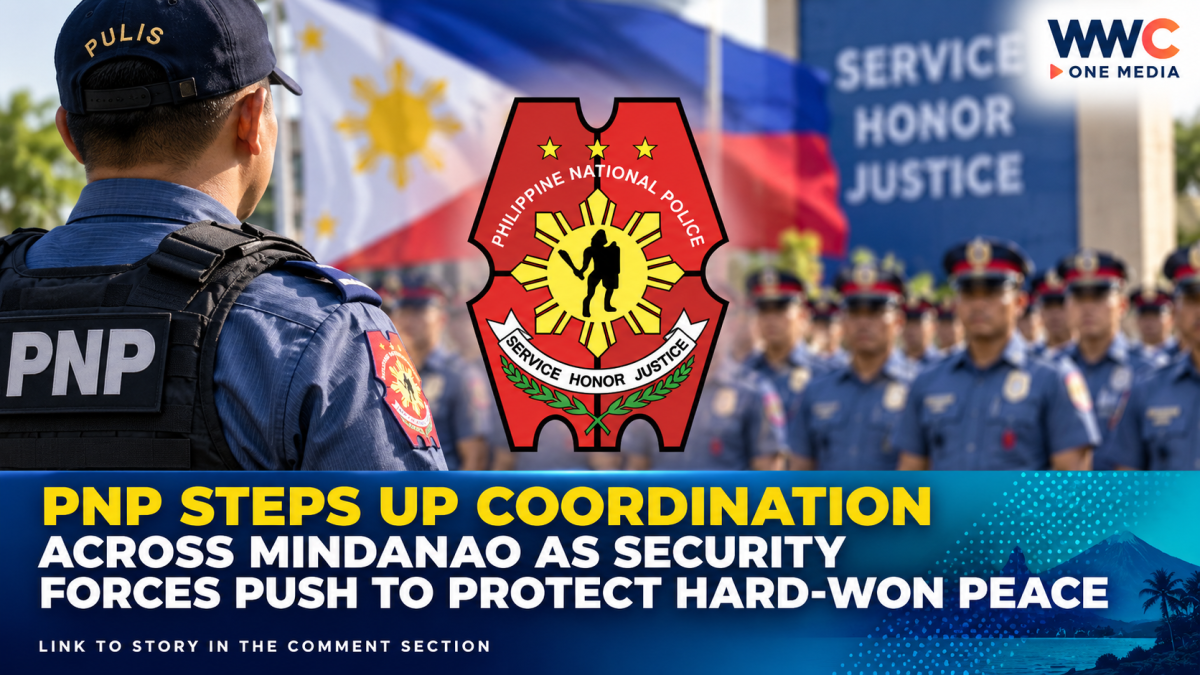
MANILA — The Philippine National Police is strengthening coordination with security forces, local governments and peace stakeholders across Mindanao as authorities work to preserve stability and prevent renewed violence in the region.
The move comes at a particularly important moment for the Bangsamoro, with the first regular Bangsamoro parliamentary elections scheduled for September 14, 2026 and security preparations already involving the PNP, Armed Forces of the Philippines, Commission on Elections and other government institutions.
The PNP’s latest push highlights a broader shift in Mindanao: maintaining peace is no longer simply about responding to armed incidents, but also about coordinating security, local governance and peace-building efforts before tensions escalate.
Coordination becomes the key
The Philippine News Agency reported that the PNP has intensified coordination with security forces, local authorities and peace mechanisms to sustain peace in Mindanao.
That approach is particularly significant in a region where security conditions can vary considerably from one community to another.
Rather than relying solely on police operations, authorities increasingly emphasize coordination among national agencies, local governments, communities and organizations involved in the Bangsamoro peace process.
The objective is straightforward: prevent localized tensions from developing into larger security problems while protecting communities that have experienced years of conflict.
BARMM elections raise the stakes
The timing of the PNP’s renewed coordination is significant.
The first regular Bangsamoro Autonomous Region in Muslim Mindanao parliamentary elections are scheduled for September 14, following years of transition under the Bangsamoro government. The elections are considered an important part of implementing the 2014 Comprehensive Agreement on the Bangsamoro between the Philippine government and the Moro Islamic Liberation Front.
Authorities have been preparing extensively.
According to the Office of the Presidential Adviser on Peace, Reconciliation and Unity, the AFP is set to deploy five joint task forces, while the PNP plans to deploy nearly 9,000 police officers, including augmentation from neighboring regions.
The Philippine Coast Guard has also announced intensified maritime patrols and coastline monitoring, with 36,000 personnel ready for deployment in support of election security.
That coordinated security posture reflects how seriously authorities are treating the upcoming polls.
Police are already watching areas of concern
The PNP’s preparations have been underway for weeks.
In August, ABS-CBN News reported that police planned to tighten security in 108 areas of concern across BARMM ahead of the elections.
The focus is not limited to conventional crime.
Election-related violence, armed groups, political rivalries and localized disputes can pose challenges in areas with complicated security histories. That makes intelligence-sharing and coordination between police, military and local officials particularly important.
A separate August command conference brought together Comelec, PNP, AFP and other stakeholders as officials finalized security preparations for the historic BARMM elections.
Peace requires more than police presence
Security operations are only one part of the longer-term picture.
The Bangsamoro peace process has increasingly emphasized normalization, reintegration, governance and economic development alongside security.
The government has continued programs aimed at supporting former combatants and communities affected by decades of conflict.
For example, the Department of Social Welfare and Development began a new social case-management initiative in August for members of the Moro National Liberation Front in Marawi City. The program is intended to help address their social and economic needs as part of broader peace and development efforts.
Such programs illustrate an important reality: lasting peace cannot be maintained through security operations alone.
Communities also need functioning institutions, livelihoods, education, social services and mechanisms for resolving disputes without violence.
Local communities remain crucial
Peace-building organizations and institutions working in Mindanao have repeatedly emphasized the importance of local participation.
The Mindanao State University–Marawi, for example, has expanded peace education, conflict-resolution research and community engagement programs, describing peace as an ongoing process requiring continued application of conflict-resolution skills.
This community dimension matters because many of Mindanao’s security challenges are deeply local.
Clan disputes, political rivalries, armed-group activity and extremist recruitment can intersect in ways that cannot always be addressed through a single national security policy.
That makes cooperation between police, military personnel, local leaders, educators and communities increasingly important.
A historic moment for the Bangsamoro
The upcoming elections represent more than another electoral exercise.
The peace office has described the parliamentary elections as a major milestone in the implementation of the Bangsamoro peace agreement and the political track of the peace process.
The vote will cover the five BARMM provinces of Basilan, Lanao del Sur, Maguindanao del Norte, Maguindanao del Sur and Tawi-Tawi, as well as the region’s designated special geographic areas.
The electoral preparations involve approximately 2.4 million registered voters, according to government figures.
With so much at stake, preventing violence and ensuring that voters can participate safely has become a central component of the peace process itself.
The bigger picture
The PNP’s stronger coordination effort comes as Mindanao enters a potentially defining phase.
The region has made significant progress since the establishment of BARMM, but maintaining those gains requires more than the absence of fighting.
It requires effective governance, credible elections, community trust, economic opportunity and sustained cooperation among institutions that once stood on opposite sides of the conflict.
The coming weeks will therefore test whether those mechanisms can work together when political competition intensifies.
For police and security officials, the challenge is to maintain order without undermining the democratic process.
For local leaders and communities, the challenge is to resolve disputes peacefully.
And for the Bangsamoro peace process, the stakes could hardly be higher.
The goal is no longer simply to stop conflict—it is to make peace durable enough that another generation of Mindanaoans does not have to inherit it.


Leave a Reply