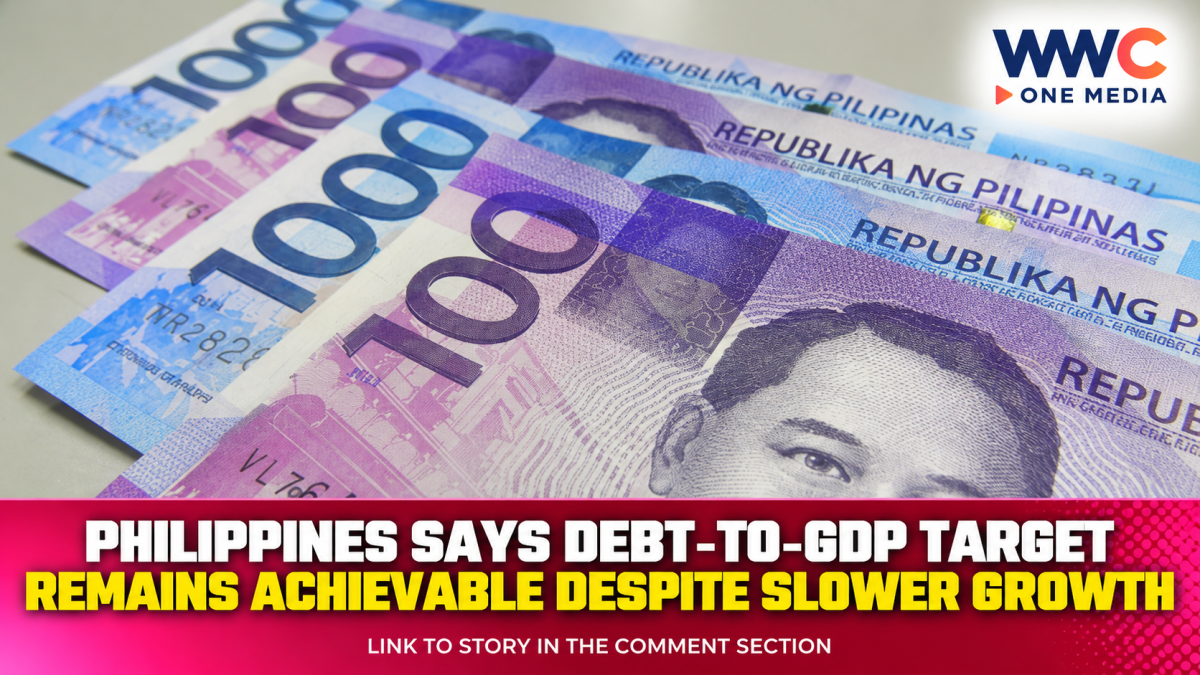
The Philippine government still expects to bring its debt-to-gross domestic product ratio down toward its medium-term target despite weaker economic growth, with officials pointing to fiscal consolidation and continued economic expansion as key factors.
The assurance comes after the country’s debt-to-GDP ratio climbed to 66% in the second quarter of 2026, its highest level in more than two decades. The increase reflected both higher government debt and slower GDP growth, which makes debt larger relative to the size of the economy.
Despite the recent increase, the government maintains that its debt objectives remain achievable. The Department of Budget and Management has said the government is continuing to narrow the fiscal deficit while protecting spending on infrastructure, human capital and essential public services.
The proposed 2027 national budget reflects that approach. Capital outlays are programmed to rise by 13.8% to about ₱1.16 trillion, while financial expenses are projected to increase by 17.3% to ₱1.114 trillion, largely because of higher interest payments.
The government expects the deficit to decline gradually rather than pursue an abrupt reduction in spending. Officials have projected a 5.45% deficit-to-GDP ratio for 2026, describing the continued decline as part of a longer-term fiscal consolidation program.
The challenge is that economic growth has weakened considerably. The Philippine economy expanded by only 2.3% year on year in the second quarter, making the debt burden larger relative to GDP. The slowdown also complicates efforts to reduce the ratio because faster economic growth would normally help expand the denominator of the debt-to-GDP calculation.
The International Monetary Fund has subsequently lowered its Philippine growth forecast for 2026 to 3.4%, from an earlier projection of 3.9%. It also cut its 2027 forecast to 5.1% from 5.5%, citing weaker public investment, softer confidence and the economic effects of the Middle East conflict.
The IMF nevertheless said the Philippines’ medium-term fiscal consolidation path remains appropriate, while calling for greater emphasis on revenue mobilization. It has urged the government to strengthen tax collection, broaden the value-added tax base and improve the design of tax incentives.
The country’s debt position therefore depends on more than the amount the government borrows in any particular month. Debt sustainability is also affected by interest rates, economic growth, government revenues, the fiscal deficit and the pace at which existing obligations are refinanced.
Recent borrowing data illustrate that point. Philippine gross government borrowings plunged in August compared with a year earlier, but monthly borrowing can fluctuate substantially depending on the timing of large bond issues and other financing requirements. A single month’s decline does not by itself determine the direction of the country’s overall debt ratio.
The government’s fiscal strategy is consequently trying to balance two objectives: reducing the deficit and keeping enough public investment to support economic activity. Cutting spending too aggressively could weaken growth, while prolonged deficits could keep debt elevated.
The debt-to-GDP ratio also remains above the government’s longer-term objective of bringing public debt below 60% of GDP. The OECD has noted that the Philippines’ fiscal framework now targets getting public debt below 60% of GDP by 2028, after earlier targets were revised because of weaker-than-expected growth.
For now, Philippine officials continue to argue that the debt target remains within reach, but the path has become more challenging as growth forecasts are repeatedly revised downward. The combination of slower GDP expansion, elevated interest costs and the need to maintain public investment will determine how quickly the ratio can decline.
The next test will be whether the government can continue reducing its fiscal deficit while restoring stronger economic growth — the combination needed to bring the country’s debt burden down over time.