
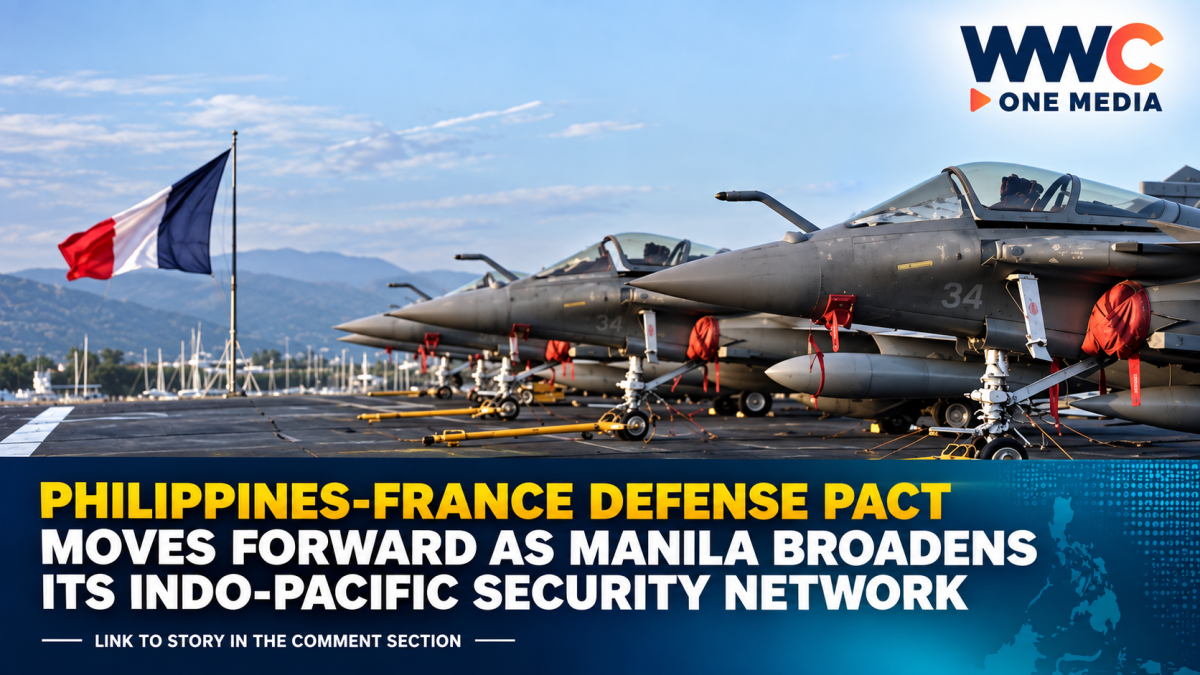
MANILA, Philippines — The Philippines is moving closer to formalizing a landmark defense agreement with France, strengthening Manila’s network of security partnerships as tensions continue to shape the Indo-Pacific.
The Philippine Senate Foreign Relations Committee has approved the Philippines-France Status of Visiting Forces Agreement (SOVFA), a significant step toward Senate consideration of the pact. The agreement was originally signed by Philippine Defense Secretary Gilberto Teodoro Jr. and French Armed Forces Minister Catherine Vautrin in Paris on March 26, 2026.
The deal is notable because it is the Philippines’ first Status of Visiting Forces Agreement with a European country, giving France a more structured framework for defense activities with Manila.
A New European Dimension to Philippine Defense
The agreement allows the two countries to establish clearer legal arrangements for military personnel involved in authorized activities, including exercises, training and other forms of defense cooperation.
That matters because France is not simply an outside European power with interests in Asia.
France maintains territories and military forces in the Indo-Pacific, giving Paris a permanent strategic presence in the region. Analysts have therefore described the agreement as part of Manila’s effort to diversify its security partnerships beyond its traditional alliances.
The pact follows several years of steadily expanding Philippine-French military cooperation.
The two countries have conducted naval activities, port visits, military exchanges and disaster-response cooperation, while French forces have also participated in Philippine-led multinational exercises.
Why Manila Wants More Security Partners
The Philippines already has extensive defense arrangements with the United States, Australia, Japan, New Zealand and Canada, while negotiations with the United Kingdom have also been pursued.
The French agreement adds another major partner to that growing network.
Philippine Defense Secretary Gilberto Teodoro recently told Reuters that Manila is continuing to expand bilateral and multilateral military cooperation despite changes in the wider U.S. military posture in Asia. He said there had been no reduction in U.S.-Philippine military activities and that Washington had provided assurances that its commitments under the Mutual Defense Treaty remain unchanged.
That diversification is increasingly important for Manila as it faces a more complicated regional security environment.
The South China Sea Factor
Although the Philippines and France have not presented the agreement as an alliance directed against any particular country, the pact comes against the backdrop of continuing tensions in the South China Sea.
During the March signing, the two governments reaffirmed their commitment to the 1982 United Nations Convention on the Law of the Sea (UNCLOS) and the Philippines’ 2016 arbitral ruling concerning the South China Sea.
The two sides also discussed developments in the Indo-Pacific and emphasized peaceful dispute resolution and resilience in critical supply chains.
France has repeatedly expressed interest in maintaining a free and open Indo-Pacific and in upholding international maritime law.
For Manila, having another major military power willing to conduct exercises and security cooperation in the region could strengthen its ability to work with partners on maritime awareness, interoperability and disaster response.
France Is Already Increasing Its Military Engagement
The agreement did not appear out of nowhere.
France has been steadily increasing its military engagement with the Philippines.
French forces participated in Balikatan 2026, the Philippines-U.S.-led multinational exercise, alongside other partner nations. The French government described its participation as part of its broader Indo-Pacific defense engagement.
French naval deployments have also brought the two countries’ militaries into closer contact.
These activities provide opportunities for Philippine and French forces to develop familiarity and interoperability before the new legal framework is fully operational.
What the Pact Does—and Does Not Do
The SOVFA should not be confused with a mutual-defense treaty.
It does not automatically obligate France to defend the Philippines in the event of an armed attack, nor does it create a permanent French military base in the country.
Instead, the agreement establishes rules governing the presence and activities of visiting military personnel.
That distinction is important.
The practical value of the pact lies in making bilateral exercises, training and other approved defense activities easier to organize while providing participating personnel with a clearer legal framework.
Analysts cited by Fulcrum describe the agreement as an important element of Manila’s effort to diversify its security relationships and strengthen cooperation with partners that share interests in maritime security and international law.
A Wider Indo-Pacific Security Network
The Philippines is increasingly becoming a hub for defense cooperation involving several countries.
Japan has its own military access agreement with Manila. Australia maintains extensive defense cooperation with the Philippines. Canada and New Zealand have also entered into visiting-forces arrangements.
The emerging pattern is significant.
Rather than relying exclusively on one major ally, Manila is building a network of overlapping security relationships.
That approach could give the Philippines more options for training, intelligence cooperation, maritime security and humanitarian assistance.
It also reflects the reality that regional security is becoming increasingly interconnected.
China Is Watching the Bigger Picture
China is not specifically named as the target of the Philippines-France agreement, but the pact is unfolding during a period of heightened competition and strategic rivalry across the Indo-Pacific.
Teodoro recently warned Reuters that changes in U.S. military activities elsewhere in Asia could create opportunities for China to expand its influence. He said Manila was consequently broadening its security relationships with countries including France, Canada and New Zealand.
That means the French agreement is part of a much larger strategic picture.
For Manila, the objective is increasingly to ensure that the Philippines has multiple capable partners rather than depending on a single security relationship.
The Next Test Is in the Philippine Senate
The Senate Foreign Relations Committee’s approval marks an important procedural milestone, but the agreement still faces the remaining constitutional and legislative steps required before it can fully take effect.
If approved, the pact would give Manila and Paris a stronger institutional foundation for military cooperation.
For France, it would deepen its security presence and partnerships in a strategically important part of the Indo-Pacific.
For the Philippines, it would add another European partner to an increasingly broad defense network.
And for the wider region, it sends a clear signal that Manila is not standing still as the Indo-Pacific security environment changes.
The question now is no longer whether France and the Philippines want closer defense ties—they have already demonstrated that they do.
The bigger question is how far this partnership can go, and whether Manila’s growing network of security partners will change the strategic balance in the Indo-Pacific.


Leave a Reply