
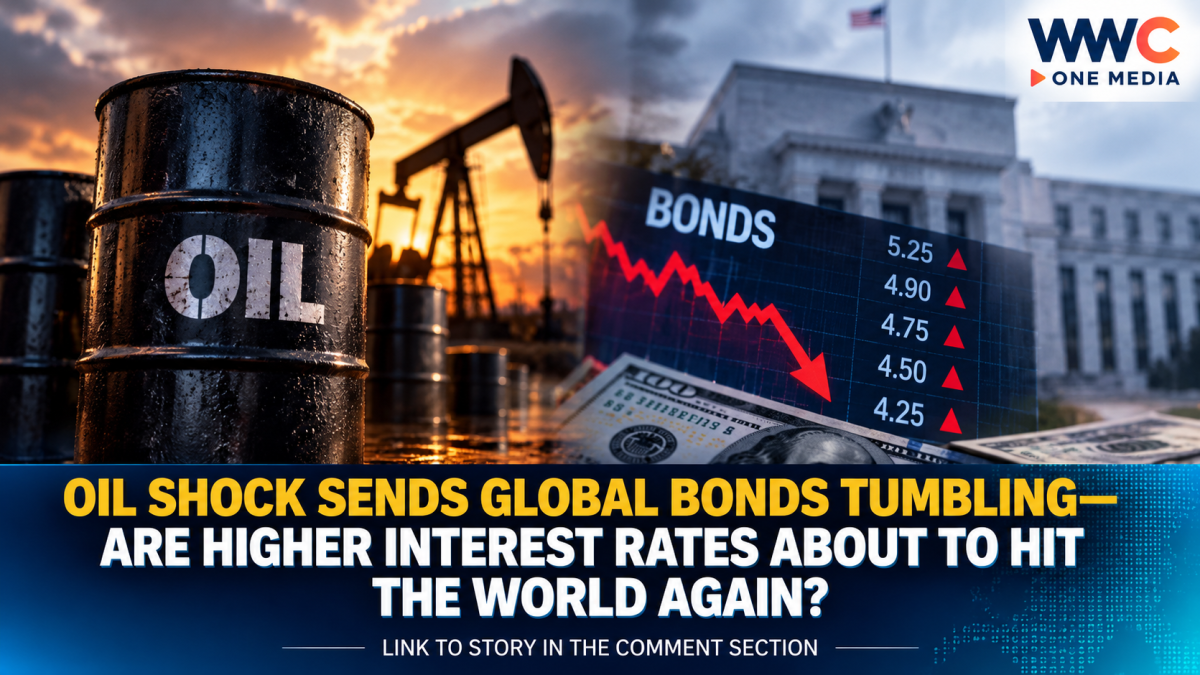
Global bond markets suffered another sharp sell-off as soaring oil prices reignited fears of persistent inflation, sending government borrowing costs higher across major economies and putting investors on alert for more aggressive interest-rate action.
The latest market turmoil came as Brent crude surged to around $110 a barrel, reaching a four-month high amid escalating tensions in the Middle East and growing concerns over potential disruptions to global energy supplies.
Oil Shock Triggers Global Bond Sell-Off
Investors sold government bonds as rising energy prices threatened to push inflation higher and force central banks to keep monetary policy tight—or raise interest rates further.
When bond prices fall, yields rise, increasing borrowing costs for governments, businesses and households.
The impact was felt across global markets:
- The U.S. 10-year Treasury yield moved closer to 5%, a level closely watched by investors.
- The U.S. 30-year Treasury yield climbed to its highest level since 2007.
- Bond yields in Japan and Australia also reached multi-year highs.
- European government bonds remained under heavy pressure following fresh concerns about inflation and tighter monetary policy.
The Financial Times reported that the 30-year U.S. Treasury yield climbed to around 5.37%, underscoring how rapidly borrowing costs have risen as investors reassess the outlook for inflation and interest rates.
Why Are Oil Prices Sending Markets Into Panic?
The connection is straightforward: higher oil prices can make almost everything more expensive.
More expensive crude raises transportation and manufacturing costs, which can eventually feed into consumer prices. That creates a major problem for central banks trying to keep inflation under control.
Reuters reported that Brent crude surged about 6% to a four-month high near $110 a barrel as conflict involving the United States, Iran and Yemen heightened concerns over oil exports and shipping routes. Analysts at RBC Capital Markets warned that Brent could climb even further, potentially approaching $122 in the fourth quarter.
Earlier this week, Reuters also reported that the conflict had already exposed the vulnerability of global oil supplies, with an estimated 10 million barrels per day affected and emergency stockpiles offering a smaller cushion than markets previously enjoyed.
That means investors are increasingly worried that the latest oil surge may not be a short-lived market shock.
Inflation Could Force Central Banks to Stay Tough
The biggest concern for investors is that expensive energy could delay the return of inflation to central-bank targets.
Markets are now reassessing the likelihood of further interest-rate increases across major economies. Reuters reported that JPMorgan expects eight of nine developed-market central banks, including the U.S. Federal Reserve and Bank of Japan, to raise rates before the end of the year.
In Europe, the pressure has already translated into action. The European Central Bank raised its key interest rate to 2.5%, while revising its inflation outlook upward and signaling that price pressures could remain above target for longer than previously expected.
The combination of higher oil prices and tighter monetary policy creates what investors fear most: slower economic growth combined with stubborn inflation.
Stocks Also Feel the Pressure
The bond-market turmoil is not staying confined to government debt.
Higher Treasury and government bond yields raise financing costs throughout the economy, from mortgages and corporate loans to government spending. They can also make bonds more attractive compared with riskier investments such as stocks.
The Associated Press reported that Wall Street came under pressure as oil prices climbed and inflation concerns intensified, while rising yields pushed mortgage rates higher and added pressure to interest-rate-sensitive sectors.
Reuters likewise reported that stock markets in Australia, Japan and South Korea fell as the latest bond sell-off accelerated.
Government Debt Adds Another Layer of Risk
Oil is not the only reason investors are selling bonds.
Markets are also becoming increasingly concerned about the enormous amount of government debt accumulated by major economies.
Higher interest rates mean governments must spend more money servicing existing debt and issuing new bonds. That can create a difficult cycle: governments need to borrow more, markets demand higher yields, and borrowing becomes even more expensive.
Reuters has repeatedly identified rising public debt and prolonged inflation as two of the biggest risks confronting global markets this September.
The latest sell-off suggests investors are no longer focusing on just one problem.
They are now facing a dangerous combination of:
✔ Surging oil prices
✔ Persistent inflation risks
✔ Higher interest rates
✔ Rising government debt
✔ Geopolitical conflict
✔ Increasing borrowing costs
What Investors Are Watching Next
Attention is now turning to U.S. inflation data, particularly the Consumer Price Index, which could significantly influence expectations for the Federal Reserve’s next move.
Markets will also closely watch developments in the Middle East and whether oil prices continue climbing.
A further surge in crude could intensify inflation expectations and potentially push bond yields even higher. Conversely, any signs of easing geopolitical tensions or stabilizing energy supplies could provide temporary relief.
For now, however, the message from global markets is becoming increasingly clear:
The world may be entering a new phase where expensive energy, rising debt and stubborn inflation collide—and investors are bracing for what comes next.
The Bottom Line
The global bond sell-off is more than a routine market correction. It is becoming a warning signal about the broader economy.
With oil prices surging, inflation fears returning and borrowing costs already near multi-year highs, central banks face an increasingly difficult choice: protect economic growth or fight inflation aggressively.
And if oil continues to rise, the biggest question may no longer be whether interest rates stay high—but just how much higher they could go.



Leave a Reply