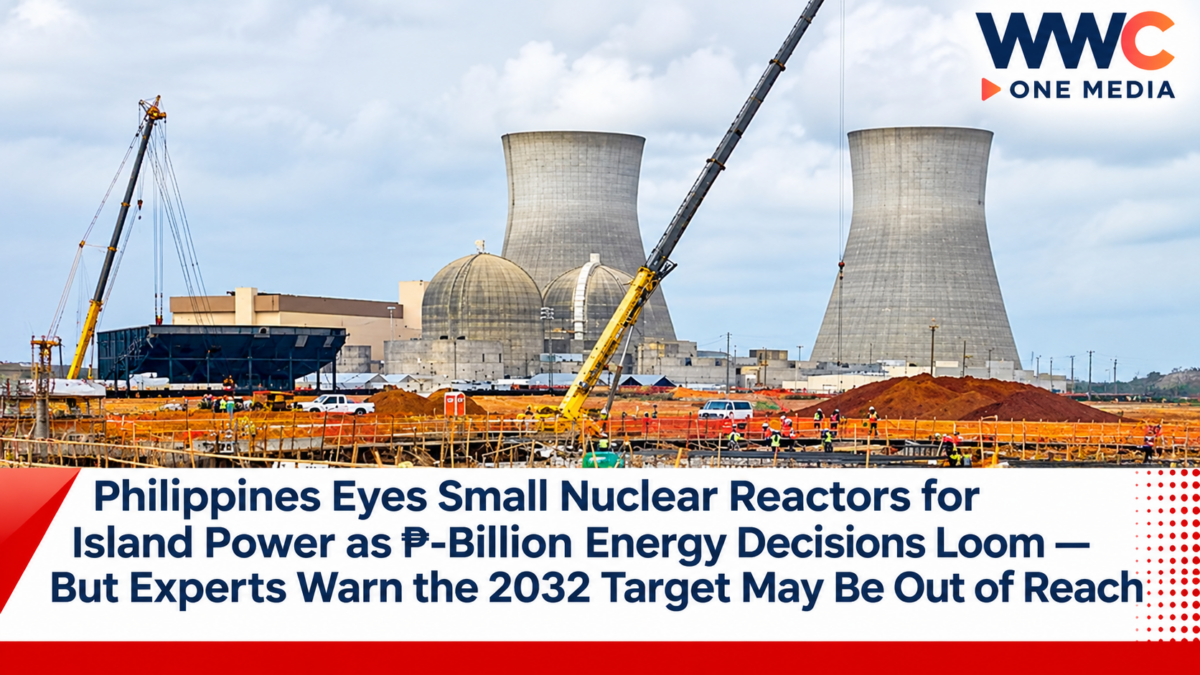
MANILA, PHILIPPINES — November 10, 2026 — The Philippines is considering a smaller but potentially transformative solution to its long-standing electricity challenges: nuclear reactors capable of generating reliable power without requiring the massive electricity networks associated with conventional nuclear plants.
Small modular reactors, or SMRs, are emerging as a possible option for an archipelago where electricity demand varies sharply between Luzon, the Visayas and smaller island grids.
At an energy industry roundtable held on November 9, nuclear specialists and energy executives argued that the Philippines should not rely on a single reactor technology for the entire country.
Instead, developers should choose nuclear technologies according to local electricity demand, transmission infrastructure, project costs and community acceptance.
Lino Bernardo, head of strategic energy transition at Meralco PowerGen Corp. (MGEN), said large nuclear reactors may be better suited to Luzon’s extensive electricity network, while smaller reactors could potentially serve islands with more limited demand.
However, the proposal faces significant obstacles.
The government wants to introduce 1,200 megawatts of nuclear generation capacity by 2032, but international experts have warned that the timetable may be unrealistic.
Meanwhile, MGEN is conducting an SMR feasibility study supported by a $2.8-million grant from the US Trade and Development Agency, with completion expected in the fourth quarter of 2027.
US-based EōS Organization is also exploring potential nuclear partnerships and reactor technologies for Philippine industrial developments.
But none of these initiatives amounts to an approved, financed and operating commercial nuclear plant.
With rising electricity demand, expensive imported fuels and growing pressure to diversify the nation’s energy supply, could small nuclear reactors become a practical solution—or will financing, safety requirements and regulatory delays push the country’s nuclear ambitions years into the future?
Why Small Nuclear Reactors Could Be Better Suited to Philippine Islands
The Philippines faces an electricity challenge that differs significantly from those of many continental economies.
Its islands are geographically separated, and not every local power grid can accommodate an extremely large generating station.
A conventional commercial nuclear reactor may produce more than 1,000 MW of electricity.
Connecting a plant of that scale to a small island grid could create operational problems if local demand is relatively low or transmission infrastructure is insufficient.
SMRs generally have an electrical generating capacity of up to 300 MW per module.
Their smaller size could allow developers to match electricity production more closely to regional requirements.
Bernardo explained that Luzon could potentially accommodate a large nuclear reactor, while some smaller islands would require different technologies.
The approach suggests that the country may eventually need a combination of large reactors and smaller facilities.
But the technical suitability of SMRs does not automatically establish that they are financially viable.
Developers must still determine whether local consumers can afford the electricity and whether enough demand exists to justify construction.
What Exactly Is a Small Modular Reactor?
Small modular reactors are nuclear power systems designed to produce smaller amounts of electricity than conventional large nuclear plants.
The term modular refers to designs intended to allow major components to be manufactured in factories and assembled or installed at project sites.
Supporters argue that this approach could reduce some construction complexities and allow capacity to be added in stages.
For example, developers might initially install one reactor module and expand later if electricity demand increases.
However, the economic benefits depend on the technology, supply chain, manufacturing scale and project location.
Factory production does not guarantee that a plant will be cheaper to build.
First-of-a-kind reactors can face high engineering, licensing and construction costs.
Costs per megawatt may also be higher than for larger plants if smaller reactors cannot benefit from economies of scale.
SMRs are a potentially useful technology, not a guaranteed shortcut to cheap electricity.
The Philippines Wants 1,200 MW of Nuclear Power by 2032
The Department of Energy has established long-term nuclear capacity targets as part of its energy planning.
The roadmap currently envisions the following milestones:
| Target year | Planned total nuclear capacity |
|---|---|
| 2032 | 1,200 MW |
| 2035 | 2,400 MW |
| 2050 | 4,800 MW |
These targets reflect the government’s ambition to introduce nuclear generation into a more diversified energy mix.
Nuclear plants can provide large volumes of low-carbon electricity without requiring continuous sunlight or wind.
That could help support industrial activity and complement renewable energy.
But the targets remain aspirational.
The Philippines has not commissioned its first commercial nuclear reactor, nor has it finalized the technology, site, financing and operating arrangements for a first new plant.
That distinction has become increasingly important as the proposed 2032 deadline approaches.
International Experts Warn 2032 May Be Too Soon
One of the most important developments came on November 5.
William Magwood IV, director-general of the OECD Nuclear Energy Agency, warned that the Philippines was unlikely to have an operating nuclear reactor within six years.
He emphasized that nuclear projects require extensive preparation and coordination.
The warning was reported by The Philippine Star and BusinessMirror.
DOE Director Patrick Aquino subsequently acknowledged that the latest version of the government’s draft nuclear capacity tender contemplated the beginning of electricity deliveries around 2038.
However, Aquino said the government was not officially abandoning its existing nuclear policy targets.
This creates a significant distinction between the country’s long-term ambition and the more cautious delivery schedule reflected in recent planning documents.
The 2032 target is still part of government policy.
But the 2038 date signals that authorities are considering a substantially longer development period.
Neither date should be presented as a guaranteed commercial operating date.
MGEN Receives $2.8-Million Support for Nuclear Feasibility Study
Meralco PowerGen is among the companies studying the technology.
Its SMR feasibility assessment is supported by a $2.8-million grant from the US Trade and Development Agency.
The study is expected to be completed during the fourth quarter of 2027.
The project will help determine whether SMRs could be suitable for selected Philippine locations and electricity requirements.
A feasibility study generally evaluates technical, economic and operational considerations before a company decides whether to proceed.
These may include grid integration, project costs, technology options, infrastructure requirements and commercial risks.
But the grant is funding for a study, not the construction budget for a nuclear reactor.
Similarly, completion of the assessment would not automatically authorize MGEN to construct or operate a nuclear facility.
Licensing, financing, environmental reviews and other approvals would still be necessary.
EōS Organization Explores Advanced Reactor Technology
US-based EōS Organization is also examining opportunities in the Philippine nuclear energy market.
Its president and CEO, Aaron Green, said developers must first identify where electricity is needed and what consumers can afford.
The company is exploring factory-built, high-temperature gas-cooled reactors that use TRISO fuel and helium cooling.
TRISO fuel consists of coated fuel particles engineered to help retain radioactive fission products.
High-temperature gas-cooled reactor designs use different cooling and safety arrangements from conventional water-cooled nuclear reactors.
These technologies could offer potential advantages in certain industrial applications.
However, their actual performance and costs must be assessed for each proposed deployment.
EōS has also discussed possible cooperation involving the Bases Conversion and Development Authority.
The development pathway refers to a potential 100-MW power requirement by 2028.
That figure describes an anticipated electricity requirement, not a verified commitment to deliver an operating 100-MW nuclear reactor by that year.
No such commercial reactor has been confirmed as commissioned.
Nuclear Energy Could Support Industrial Parks and Data Centers
One reason nuclear energy is receiving renewed attention is the potential growth of electricity-intensive industries.
Advanced manufacturing facilities, data centers and technology parks require dependable electricity.
Some operate continuously and can be particularly sensitive to interruptions.
Nuclear generation may eventually help supply such customers.
But the economic case depends on how much power a facility requires, how consistently it uses electricity and whether nuclear generation is competitive with alternatives.
For example, a proposed industrial zone requiring 100 MW cannot simply be assumed to need a dedicated nuclear reactor.
Its electricity supply could involve grid purchases, renewable energy, storage, conventional generation or combinations of technologies.
As previously reported by WWC ONE MEDIA, the proposed Pax Silica development in New Clark City has prompted debate about foreign-backed energy infrastructure and the possible role of small modular reactors.
Related WWC ONE MEDIA coverage: Tinio Questions the Philippines’ Nuclear Power Push — But the Bigger Battle May Be About Foreign Control
The debate reflects questions about who would finance, own, regulate and operate future facilities.
Those issues have not been resolved by the recent roundtable.
Nuclear Power Could Reduce Dependence on Imported Fuel
The Department of Energy has argued that greater energy diversification could improve Philippine energy security.
According to government figures released in October, imported energy accounts for approximately 51.5% of the country’s total primary energy supply.
The Philippines also relies heavily on imports for coal and diesel.
That exposure creates vulnerability to global commodity-price movements and supply disruptions.
A domestic nuclear power industry could potentially reduce reliance on certain fossil fuels over time.
Nuclear generation also produces low direct operational greenhouse-gas emissions.
However, nuclear power is not entirely free from international supply dependencies.
The Philippines would still need appropriate arrangements for reactor equipment, fuel procurement, specialist services and potentially waste-management technologies.
The financial and security benefits therefore depend on how the program is structured.
The country must evaluate nuclear power alongside renewable generation, storage, transmission investment and other sources of electricity.
Why Singapore Is Also Studying Smaller Nuclear Technologies
The Philippines is not alone in considering advanced nuclear systems.
Singapore has been examining the potential role of nuclear energy in its future electricity supply.
In August 2026, Singapore and China signed a cooperation agreement covering peaceful uses of nuclear technology.
Singapore has also developed partnerships involving South Korea and international nuclear organizations.
As previously reported by WWC ONE MEDIA, Singapore is building regulatory and technical knowledge before making a decision on whether to develop nuclear generation.
Related WWC ONE MEDIA coverage: Singapore and China Sign Nuclear Technology Pact as City-State Steps Up Energy Push
Singapore’s circumstances differ from those of the Philippines.
It is a densely populated city-state with limited land, while the Philippines has multiple island grids and a more geographically distributed electricity system.
Nevertheless, both countries are examining whether newer nuclear technologies could offer useful power-supply options.
Neither country’s exploratory cooperation should be confused with a confirmed commitment to build an SMR.
The Philippines Must Solve Its Grid Problem
Building nuclear generation is only one part of the challenge.
Electricity must also move from generating stations to consumers.
Power-grid stability depends on generation capacity, transmission infrastructure, operating reserves and the ability to respond to outages.
In a small island network, the sudden shutdown of a large power plant could create serious operational difficulties.
That makes reactor size and grid compatibility especially important.
The Philippine government is considering several ways to strengthen electricity security, including regional interconnections.
In October, the Philippines and Singapore exchanged letters of intent exploring closer energy cooperation and a possible future electricity connection.
As WWC ONE MEDIA reported, the proposal could eventually support regional electricity trading, although substantial technical and financial work remains.
Related WWC ONE MEDIA coverage: Philippines and Singapore Explore a New Electricity Connection — Could This Finally Strengthen the Country’s Power Security?
The interconnection proposal is separate from SMR development.
But both initiatives demonstrate that reliable electricity depends on the wider power system, not just the construction of generating facilities.
Nuclear Regulation Becomes a Critical Test
Safety regulation remains one of the country’s largest challenges.
In 2025, Republic Act No. 12305 established the legal foundation for the Philippine Atomic Energy Regulatory Authority, or PhilATOM.
The agency is intended to serve as an independent nuclear regulator.
Its responsibilities include licensing, inspection and oversight related to nuclear and radiation safety.
However, establishing an agency through legislation is not the same as having every regulatory system fully operational.
The DOE has identified several outstanding requirements.
These include appointing leadership, implementing regulations, developing nuclear-specific licensing procedures and building technical expertise.
On November 6, the department announced further cooperation with the OECD Nuclear Energy Agency to strengthen Philippine regulatory readiness.
The joint work covers reactor licensing, inspections, emergency preparedness, radioactive waste management and nuclear safety culture.
For the Philippines, these systems must be credible before any commercial nuclear plant begins operating.
Radioactive Waste Remains an Unresolved Question
One of the most difficult aspects of nuclear development is the management of radioactive waste and spent nuclear fuel.
At the industry roundtable, former Philippine Nuclear Research Institute director Carlo Arcilla discussed the potential use of deep borehole disposal.
The concept involves placing certain radioactive waste materials in suitable deep geological formations.
Arcilla noted that the Philippines has experience with deep drilling through its geothermal industry.
But experience in geothermal drilling does not establish that a particular geological site is suitable for nuclear waste disposal.
Any proposed disposal system would require extensive assessments covering geological stability, groundwater, containment, long-term monitoring and regulatory compliance.
Deep borehole disposal also remains an area requiring further development and evaluation.
The country has not established that such a facility is ready to receive commercial nuclear waste.
Public confidence will depend partly on how clearly authorities address these long-term responsibilities.
Would Small Nuclear Reactors Lower Electricity Bills?
One of the most important questions for Filipino consumers is whether SMRs could eventually reduce electricity prices.
Supporters argue that modular manufacturing and phased development may reduce some construction risks.
Smaller units might also allow developers to begin generating revenue before an entire multireactor project is complete.
However, there is no guaranteed cost advantage.
Nuclear projects require substantial upfront spending, specialized equipment, financing and long-term operating arrangements.
The cost of capital can be particularly significant.
Delays may increase the total cost of a project and ultimately affect the electricity price required to recover the investment.
Consumers would also need to consider transmission costs, system services, decommissioning and waste management.
The government must compare realistic SMR costs with alternatives, including renewable generation, storage and conventional power.
No credible basis exists yet to promise that Philippine electricity bills will fall by a specific amount because of the proposed reactors.
The Bataan Nuclear Power Plant Remains a Warning From History
The Philippines has attempted nuclear development before.
Construction of the Bataan Nuclear Power Plant began during the administration of Ferdinand Marcos Sr.
The facility was completed in the 1980s but never entered commercial operation.
The approximately 620-MW plant has never supplied electricity to the grid.
Its history remains politically and financially significant.
The government spent heavily on a project that did not deliver the electricity originally anticipated.
Today, officials are considering whether the existing facility could be rehabilitated, while also evaluating new nuclear technologies and sites.
But there is no final decision to reopen Bataan.
The lesson is that large infrastructure investments require credible technical assessments, governance, financing arrangements and public confidence.
Announcing a reactor is only the beginning.
Delivering affordable, safe electricity is the real measure of success.
Global Technology Companies Are Also Returning to Nuclear Power
The renewed interest in nuclear energy extends well beyond the Philippines.
Technology companies are seeking dependable electricity for artificial intelligence infrastructure and data centers.
Google, for example, has entered major electricity arrangements with Constellation Energy in the United States.
One part of the agreement involves upgrading existing nuclear reactors to increase generating capacity.
As previously reported by WWC ONE MEDIA, the strategy seeks to obtain additional reliable electricity without relying entirely on the development of completely new nuclear facilities.
Related WWC ONE MEDIA coverage: Google Signs Massive 3.6-GW Power Deal With Constellation — But the Real AI Bottleneck Is No Longer Chips
That project uses existing US nuclear infrastructure and differs substantially from building the Philippines’ first commercial reactor.
Nevertheless, it illustrates why nuclear technology is attracting attention from large electricity consumers.
Reliability is becoming increasingly valuable as demand for computing and industrial capacity grows.
Workforce Development Could Determine Nuclear Readiness
A functioning nuclear industry requires more than engineers who can build power plants.
The Philippines would also need personnel trained in reactor operations, maintenance, emergency management, radiation protection, cybersecurity and nuclear regulation.
EōS Organization has been exploring workforce-development cooperation with Fulbright Philippines.
Such programs may contribute to the long-term preparation needed for nuclear deployment.
However, training initiatives do not amount to approval of a power plant.
The country will need institutions capable of educating and retaining specialized professionals over decades.
Nuclear operations also require continuous oversight and a culture that prioritizes safety.
These obligations continue throughout a plant’s operating life and eventual decommissioning.
What Must Happen Before the First SMR Can Operate?
The Philippines must complete several major steps before commercial nuclear electricity becomes a reality.
First, the regulatory authority must become fully capable of licensing and supervising nuclear facilities.
Second, developers must select appropriate reactor technology and demonstrate its safety and commercial readiness.
Third, proposed sites must undergo thorough engineering, geological, environmental and community assessments.
Fourth, project sponsors need financing and electricity-purchase arrangements that establish how costs will be recovered.
Fifth, the transmission grid must be capable of safely absorbing the plant’s output.
Finally, authorities must establish credible emergency-response, fuel-management and radioactive-waste plans.
These tasks explain why international experts are skeptical about the 2032 operating target.
Even a smaller reactor requires extensive preparation.
The technology may reduce some construction challenges, but it does not eliminate regulatory or safety obligations.
The Bigger Picture: Is Nuclear Power the Philippines’ Next Energy Breakthrough?
The latest industry discussion highlights an increasingly important reality.
The Philippines needs more reliable electricity to support households, industry, digital services and future economic growth.
Its archipelagic geography also makes power planning unusually complicated.
Small modular reactors could eventually provide another option for locations where conventional large nuclear plants would be impractical.
MGEN’s feasibility study and EōS Organization’s exploration of advanced technologies demonstrate growing private-sector interest.
The government’s nuclear policy framework has also progressed, including the creation of PhilATOM and continued international cooperation.
But major questions remain.
How much would nuclear electricity cost?
Which reactor technology would be appropriate?
Where could plants be developed safely?
Who would finance construction and long-term waste management?
And when could the first project realistically begin producing electricity?
The government’s 2032 target remains in place, but international nuclear specialists have warned that the first operating reactor may take longer.
The promise of SMRs is that the Philippines could develop nuclear capacity in stages and potentially adapt it to local electricity needs. The risk is committing to expensive technology before its safety, economics and institutional requirements are sufficiently established.
And as the Philippines searches for ways to strengthen electricity security, one question could shape the country’s energy future for decades: Will small nuclear reactors finally bring dependable power to more islands—or will high costs, regulatory hurdles and the looming 2032 deadline prove too difficult to overcome?