
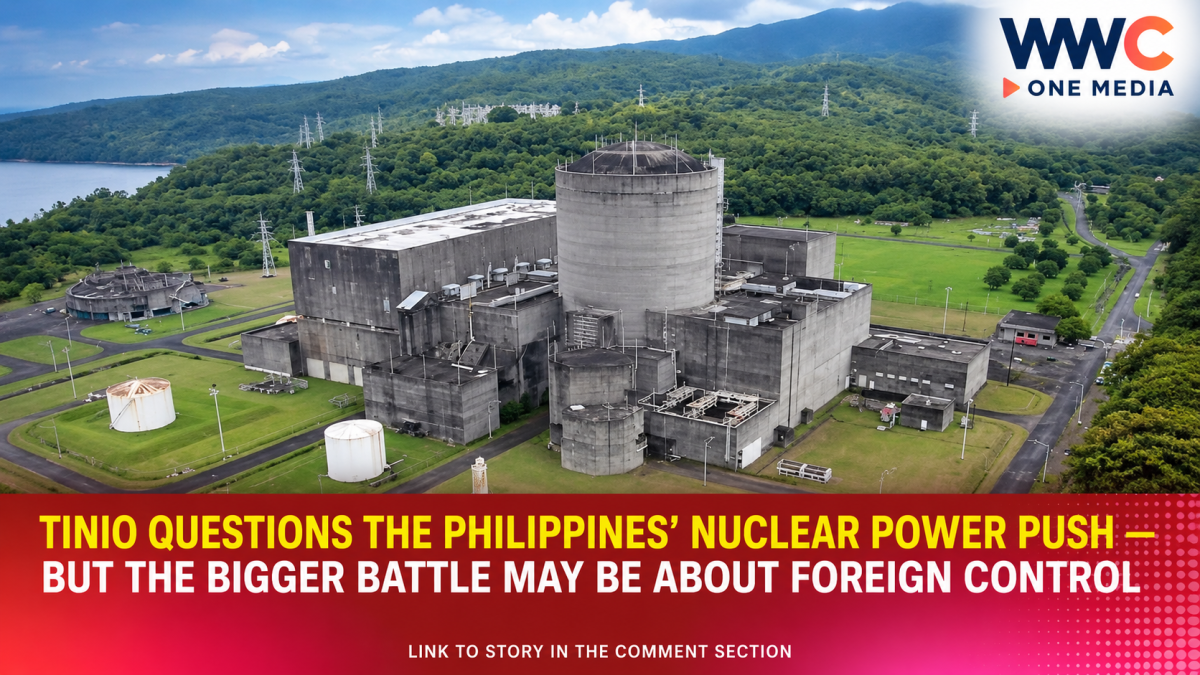
The Philippines is moving closer to nuclear power, but a lawmaker is warning that the country’s emerging nuclear strategy could create a new form of dependence on foreign technology, financing and strategic interests.
ACT Teachers Party-list Rep. Antonio Tinio has questioned the Department of Energy’s nuclear power plans and linked the debate to the Philippines’ growing cooperation with the United States on civilian nuclear technology, as well as the proposed Pax Silica economic and technology project in New Clark City.
Tinio has argued that the government must first establish whether nuclear power is genuinely in the national interest before allowing foreign-backed projects and technologies to shape the country’s energy direction. His concerns come as the DOE accelerates preparations for the Philippines’ first commercial nuclear power facility.
The Nuclear Push Is No Longer Just a Proposal
The Marcos administration has moved significantly beyond simply discussing nuclear power.
The DOE says the Philippines has identified seven potential nuclear plant sites across five provinces: two in Bataan, two in Palawan, and one each in Masbate, Pangasinan and Camarines Norte.
The locations have undergone preliminary assessments based on International Atomic Energy Agency standards. The DOE said the candidate sites cleared initial safety exclusion criteria, including distance from active faults, tsunami-related elevation requirements and volcanic hazard zones.
The government’s current roadmap envisions an initial nuclear facility with roughly 1,200 megawatts of capacity, with construction targeted around 2028 and potential grid connection around 2032. Long-term plans call for nuclear capacity to reach as much as 4,800 MW by 2050.
But these are still targets.
The Philippines has not yet selected a final commercial nuclear plant site, nor has it begun operating a nuclear power plant.
Tinio Sees a Potential Foreign-Dependence Problem
Tinio’s criticism focuses heavily on the relationship between the Philippines’ nuclear ambitions and foreign-backed energy and technology projects.
In August, he described the proposed Pax Silica project as a possible “Trojan horse” for small modular reactors, or SMRs, arguing that the enormous electricity requirements of the planned technology hub could be used to justify bringing nuclear reactors into the country.
Pax Silica is planned as a large economic security and technology zone in New Clark City, Tarlac, with major artificial-intelligence and advanced-manufacturing ambitions.
Tinio has claimed that the project could require around 5 gigawatts of electricity, potentially putting additional pressure on the country’s power system.
He argues that the government should not create a situation in which a large foreign-backed project increases electricity demand and then use that demand as justification for importing nuclear technology from the same foreign sphere of influence.
That is Tinio’s political assessment, however, rather than an established finding that the government is deliberately creating an energy crisis.
DOE Says Nuclear Power Is About Energy Security
The government’s argument is fundamentally different.
DOE officials say nuclear energy is being considered because the Philippines needs a more diverse and reliable electricity mix as demand increases.
The department is currently working through the International Atomic Energy Agency’s Milestones Approach, which provides a framework for countries considering their first nuclear power program.
DOE Undersecretary Giovanni Carlo Bacordo said nuclear power requires far more than simply constructing a reactor. The country must develop regulatory institutions, technical expertise, financing mechanisms, emergency preparedness, waste-management systems and public confidence before deployment.
The DOE has also been preparing distribution utilities for the eventual integration of nuclear-generated baseload power into the national grid.
That means the government’s current strategy is not simply about buying a reactor.
It is about building an entire nuclear regulatory and infrastructure ecosystem.
The Philippines Now Has a Dedicated Nuclear Regulator
One of the biggest developments in the country’s nuclear program came in 2025.
President Ferdinand Marcos Jr. signed Republic Act No. 12305, the Philippine National Nuclear Energy Safety Act.
The law created the Philippine Atomic Energy Regulatory Authority, or PhilATOM, as the country’s independent nuclear safety and regulatory body.
The law gives PhilATOM responsibility for regulating nuclear and radioactive activities and requires the peaceful use of nuclear technology while protecting people and the environment from harmful radiation.
The government has also finalized a seven-phase licensing roadmap covering everything from initial permits and environmental clearances to nuclear construction, testing and eventual operation.
This is a crucial distinction in the current debate.
The Philippines is preparing the regulatory framework for nuclear power, but preparation does not mean a nuclear plant has already been approved for construction.
The US Nuclear Agreement Adds Another Layer
Tinio’s concerns also involve the Philippines-US 123 Agreement on peaceful nuclear cooperation.
Such agreements provide a legal framework for civilian nuclear cooperation, including potential transfers of nuclear technology, equipment and fuel subject to applicable safeguards and regulations.
Tinio argues that the agreement could increase the Philippines’ dependence on American nuclear technology, financing and fuel.
The government, meanwhile, presents international cooperation as part of building the technical capacity needed for a safe nuclear program.
The disagreement therefore goes beyond the question of whether nuclear reactors are safe.
It raises a larger issue:
Who should control the technology, financing and strategic direction of the Philippines’ future nuclear industry?
SMRs Are at the Center of the Debate
Small modular reactors have become particularly controversial.
Supporters see SMRs as potentially attractive for countries such as the Philippines because they can be designed at smaller generating capacities than conventional large reactors and may offer more flexible deployment options.
Tinio, however, argues that SMRs remain insufficiently proven at commercial scale and warns about costs, radioactive waste, accident risks, security and proliferation.
Those criticisms should not be presented as proof that SMRs are inherently unsafe. Rather, they are part of an ongoing international debate about the technology’s commercial maturity, economics, regulation and deployment.
The Philippine government has not announced that it will automatically adopt a specific SMR design.
Bataan Is Still Part of the Conversation
The country’s nuclear discussion also continues to involve the controversial Bataan Nuclear Power Plant.
The 620-MW facility was completed in the 1980s but never operated commercially.
In 2024, the DOE and South Korea’s Korea Hydro & Nuclear Power signed an agreement for a technical and economic feasibility study concerning possible rehabilitation of the plant.
But the government has not committed to rehabilitating the BNPP.
Meanwhile, the DOE’s current site-assessment process has identified new potential locations beyond Bataan.
That means the country’s nuclear strategy remains open to several possibilities rather than being locked into a single reactor or site.
DOE Says Safety Comes First
Malacañang has also tried to address public concerns.
Palace Press Officer Claire Castro said the government would not proceed with nuclear energy if doing so posed unacceptable risks to public safety.
She said any nuclear initiative must comply with safety, security and safeguards requirements aligned with the International Atomic Energy Agency.
That assurance is significant because the Philippines has a complicated nuclear history.
The country built the Bataan Nuclear Power Plant but never operated it, making the current program an attempt to establish a modern nuclear framework decades after that experience.
The Energy Crisis Argument Cuts Both Ways
At the heart of the political debate is the country’s electricity supply.
The DOE sees nuclear power as one potential source of stable, low-carbon baseload electricity that could help meet rising demand.
Critics argue that the government should first address existing problems involving transmission capacity, electricity pricing, generation reliability and energy-market structure before committing to expensive nuclear technology.
The Pax Silica debate has intensified these concerns because the proposed AI and advanced-manufacturing hub could become a major electricity consumer.
The DOE itself has acknowledged that the project will require careful power planning and has been examining ways to ensure the development does not put the country at a disadvantage.
The Real Question Is Bigger Than Nuclear Power
The Philippines now faces a strategic decision.
Should nuclear energy become part of the country’s long-term solution to rising electricity demand?
If so, how much should the country rely on foreign technology?
Who pays for the reactors and supporting infrastructure?
How will radioactive waste be managed?
How will communities participate in site decisions?
And, perhaps most importantly, how can the Philippines ensure that a nuclear program strengthens energy independence rather than creating another form of external dependence?
Those questions are legitimate regardless of whether one supports or opposes nuclear power.
The bottom line
Tinio’s warning comes at a time when the government’s nuclear program is moving rapidly from policy discussion toward concrete preparation.
The DOE has identified potential sites, established a nuclear regulatory framework, developed a licensing roadmap and begun preparing the power sector for possible nuclear generation.
But the most controversial part of the debate may still be ahead.
The Philippines must determine not only whether it wants nuclear power, but also whose technology, money and strategic interests will shape the program.
Tinio sees the danger of foreign dependence.
The government sees an opportunity to strengthen energy security.
And as the Philippines moves toward its 2032 nuclear target, the decision could affect the country’s electricity system — and its energy sovereignty — for decades.
WWC ONE MEDIA M.J.E



Leave a Reply