
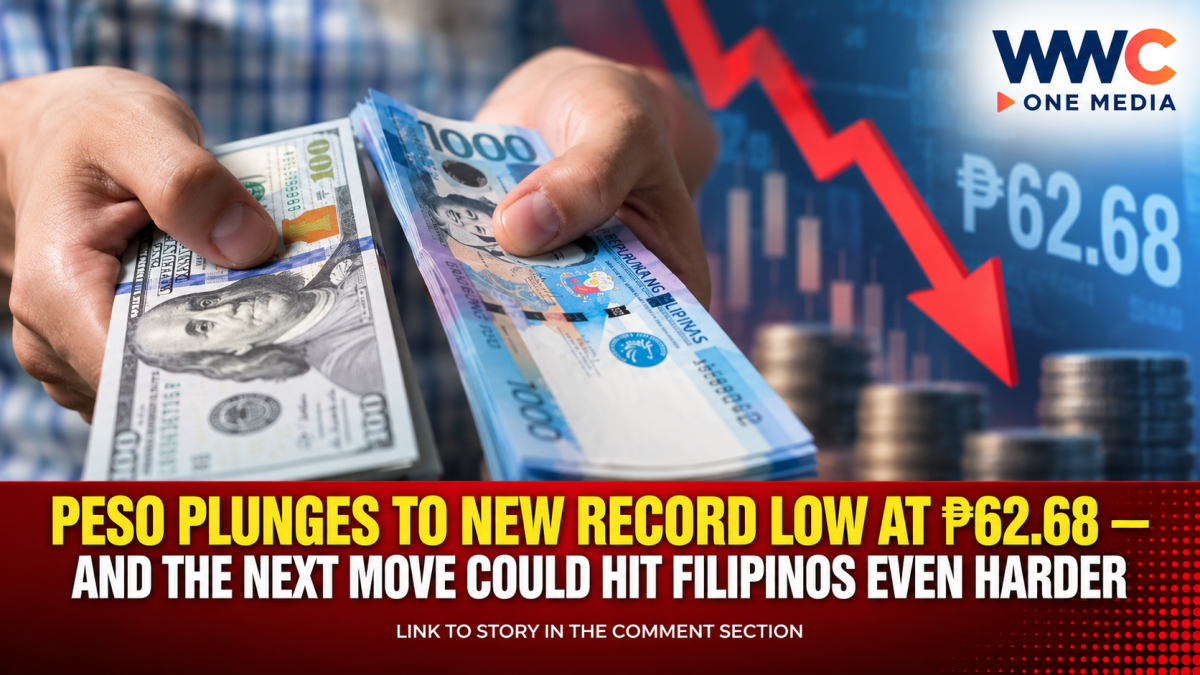
MANILA, Philippines — The Philippine peso has broken another record against the US dollar, closing at ₱62.68 to $1 on Friday, as rising oil prices, renewed Middle East tensions and growing expectations of tighter US monetary policy continued to pressure the local currency.
The latest close was 14.5 centavos weaker than Thursday’s ₱62.535 and surpassed the previous record-low close of ₱62.625 recorded on September 8. During Friday’s trading session, the peso moved between ₱62.63 and ₱62.775.
The latest decline marks another setback for the peso after it had already repeatedly breached historic lows this year.
Oil shock adds pressure
One of the biggest immediate concerns is the renewed surge in global oil prices.
Brent crude climbed back above $100 per barrel, reaching around $104 as tensions involving the United States and Iran intensified and concerns grew over disruptions to energy supplies. Higher oil prices are particularly important for the Philippines because the country relies heavily on imported fuel.
Economists say more expensive oil means Philippine importers need more US dollars to pay for energy, potentially increasing demand for the greenback and putting additional pressure on the peso.
Rizal Commercial Banking Corp. chief economist Michael Ricafort said the dollar-peso rate weakened for a third consecutive trading day as crude prices climbed to their highest level in several months.
The Federal Reserve is another problem
The peso is also facing pressure from expectations that the US Federal Reserve could raise interest rates at its upcoming meeting.
Fresh US inflation data showed consumer prices increased 0.4% in August, while annual inflation reached 3.4%. Core inflation, which excludes food and energy, rose 0.3% month-on-month and 2.4% year-on-year.
Markets have consequently increased their expectations for a Fed rate hike. Reuters reported that traders were pricing in roughly an 85% probability of a quarter-point increase at the Fed’s September 15–16 meeting.
A higher US interest-rate environment can strengthen the dollar by making US assets relatively more attractive to investors, putting additional pressure on emerging-market currencies such as the peso.
Why the peso is particularly vulnerable
Analysts have pointed to several factors behind the peso’s weakness, including elevated oil prices, persistent inflation concerns, higher US Treasury yields and continued demand for dollars.
UnionBank chief economist Ruben Carlo Asuncion said the peso could remain under pressure as oil prices and inflation expectations remain elevated. BusinessMirror reported that analysts see the currency trading around ₱62.60–₱62.90 in the near term.
The weakness also comes against a broader backdrop of geopolitical uncertainty.
The continuing US-Iran conflict has disrupted energy markets and raised concerns about the security of oil shipments through critical Middle Eastern waterways. Reuters reported that Brent crude had risen sharply amid fears of further supply disruptions.
What a weaker peso means for Filipinos
A falling peso can have mixed effects on the Philippine economy.
Filipinos receiving US-dollar remittances may receive more pesos for every dollar sent home. Exporters can also benefit because their dollar earnings translate into more pesos.
But for consumers and businesses dependent on imports, the picture is less favorable.
A weaker currency can raise the peso cost of imported fuel, food, machinery, raw materials and other goods. More expensive fuel can then feed into transportation and production costs, potentially adding to inflationary pressure.
BusinessMirror cited Pantheon Macroeconomics chief emerging Asia economist Miguel Chanco, who warned that peso weakness would add to existing pressures facing consumers and businesses.
BSP faces a difficult balancing act
The peso’s slide also creates a challenge for the Bangko Sentral ng Pilipinas (BSP).
The central bank has to balance economic growth with the risk that a weak peso and higher imported fuel costs could push inflation higher.
Recent BSP data show just how far the exchange rate has moved. The central bank’s published figures show the peso-dollar rate had already moved above ₱62 in September, with the monthly average for September standing at about ₱62.48 through the latest available data.
The latest record therefore comes at a particularly sensitive time for policymakers, with international oil prices, US monetary policy and geopolitical developments all capable of moving the currency quickly.
The ₱63 question
For now, the peso remains below the psychologically important ₱63-per-dollar threshold.
But with oil prices again above $100, US inflation proving sticky and financial markets increasingly anticipating a Fed rate hike, pressure on the Philippine currency has not disappeared.
The key question for markets now is whether the peso can stabilize around current levels—or whether another wave of oil-price increases and dollar strength could push the exchange rate toward ₱63 and beyond.
For ordinary Filipinos, that distinction matters. A weaker peso is not simply a number on a financial-market screen—it can eventually show up in fuel prices, imported goods, business costs and household expenses.




Leave a Reply