
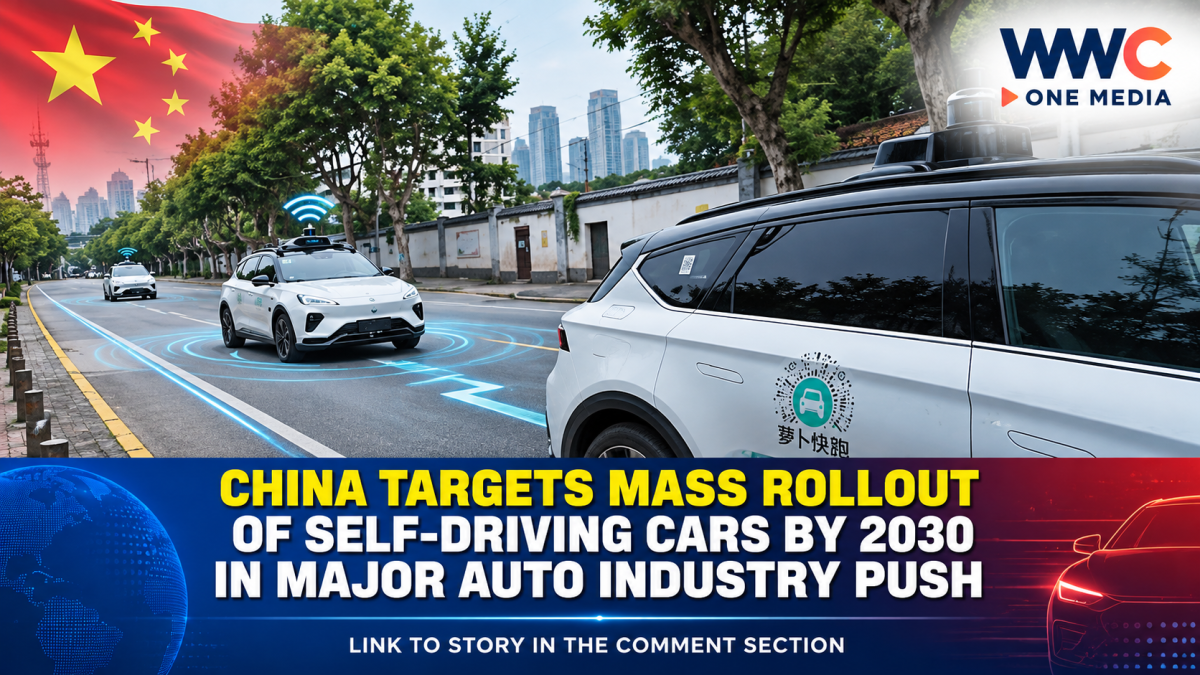
BEIJING, China — China is accelerating its race toward a driverless future, unveiling a major roadmap aimed at achieving the large-scale deployment of self-driving vehicles by 2030.
The ambitious plan is part of a broader strategy to strengthen China’s smart electric vehicle industry, boost the global competitiveness of its carmakers and expand the country’s influence over the future of automotive technology.
And if the targets are achieved, self-driving vehicles could soon move from limited pilot projects to a much bigger presence on China’s roads.
Self-Driving Cars Set for Wider Rollout
Under the new roadmap, China plans to significantly expand the deployment of vehicles equipped with autonomous-driving capabilities.
Automated driving technology is expected to be progressively rolled out across:
- Highways
- Urban expressways
- Selected city roads
The goal is to move beyond small-scale testing and demonstrations toward wider real-world use.
China has already become one of the world’s biggest testing grounds for autonomous driving, with robotaxis and advanced intelligent driving systems being developed and tested in several major cities.
Now, the country’s focus is shifting toward one much bigger challenge: scaling the technology for mass deployment.
China Wants Safer Autonomous Driving
Safety will be a major part of the country’s long-term strategy.
The roadmap aims to improve the safety performance of autonomous-driving vehicles, with the broader objective of developing systems capable of achieving safety levels beyond those of human drivers in relevant driving tasks.
China has also been strengthening standards and regulations covering intelligent and connected vehicles.
This includes tighter oversight involving:
- Vehicle production
- Road safety
- Autonomous-driving technology
- Software upgrades
- Product quality
- Technical standards
The government is also exploring specialised approval pathways for certain key automotive components and low-volume vehicles.
The message is clear: China wants to move faster on autonomous driving — but with stronger rules and tighter oversight.
Chinese Carmakers Eye the Global Top 10
The strategy goes far beyond driverless cars.
China also wants to develop multiple domestic automakers capable of ranking among the world’s top 10 car companies by sales.
The government plans to strengthen:
- The international appeal of Chinese car brands
- Global market expansion
- Automotive technology development
- International investment
- Vehicle and component research
- China’s influence over global automotive standards
Chinese carmakers have already expanded aggressively overseas, particularly in electric vehicles.
Companies are now increasingly competing not just on battery technology and price, but also on software, artificial intelligence and advanced driving systems.
The next global automotive battle may no longer be decided by who builds the cheapest electric car — but by who builds the smartest one.
Beijing Moves to Tackle Overcapacity
The new roadmap also addresses one of the Chinese auto industry’s biggest challenges: excess production capacity.
Authorities plan to increase oversight of vehicle and battery manufacturing while discouraging overinvestment.
The strategy includes efforts to:
- Curb inefficient expansion
- Encourage industry consolidation
- Eliminate inefficient production capacity
- Strengthen antitrust enforcement
- Improve product-quality supervision
- Promote fair competition
- Reduce inappropriate local government incentives
China’s auto sector has grown rapidly, but intense competition has also placed enormous pressure on manufacturers.
The government’s latest plan suggests authorities want the industry to become not only bigger — but also more sustainable and globally competitive.
Foreign Partnerships Still Part of the Strategy
Despite increasing competition between Chinese and international carmakers, China also plans to encourage deeper cooperation with foreign companies.
Potential areas of collaboration include:
- Vehicle research
- Key component development
- Technology investment
- Manufacturing
- International market expansion
This could become increasingly important as the global automotive industry undergoes a major transformation.
Cars are rapidly becoming more dependent on software, artificial intelligence, sensors and high-performance computing.
That means traditional automakers are increasingly competing with technology companies.
The Race for the Driverless Future
China is not alone in pursuing autonomous vehicles.
Companies and governments around the world are investing heavily in robotaxis and advanced self-driving technology.
But China’s combination of massive electric vehicle production, growing artificial intelligence capabilities, extensive road networks and government support could give the country a major advantage in scaling autonomous mobility.
Several Chinese cities have already announced plans to expand autonomous driving in passenger transport, logistics and commercial services.
The latest national roadmap could now provide a bigger policy framework for those efforts.
The real test, however, will be whether the technology can safely move from controlled pilot zones into everyday traffic.
What Could Change by 2030?
If China’s strategy succeeds, the country’s roads could look dramatically different by the end of the decade.
Potential changes could include:
- More autonomous vehicles on major roads
- Expanded robotaxi services
- Driverless logistics vehicles
- Smarter traffic systems
- Greater integration between vehicles and road infrastructure
- More AI-powered vehicle software
- Stronger Chinese influence in global automotive standards
But significant challenges remain.
Autonomous vehicles must still deal with unpredictable road conditions, complex city environments, extreme weather, system failures and human drivers.
Public trust will also be critical.
Technology may be advancing rapidly — but convincing millions of people to trust a vehicle without a human driver could be the industry’s biggest challenge yet.
The Bottom Line
China is aiming for the large-scale deployment of self-driving vehicles by 2030 as it pushes to become a global leader in smart and electric transportation.
The strategy will expand autonomous driving across highways, urban expressways and selected city roads while strengthening safety rules, industry standards and oversight.
China also wants more of its carmakers to join the world’s top 10 by sales and increase the global influence of Chinese automotive brands.
But as Beijing races toward a driverless future, one question could determine everything: Can self-driving technology become safe, reliable and trusted enough for millions of vehicles to finally take the wheel?




Leave a Reply