
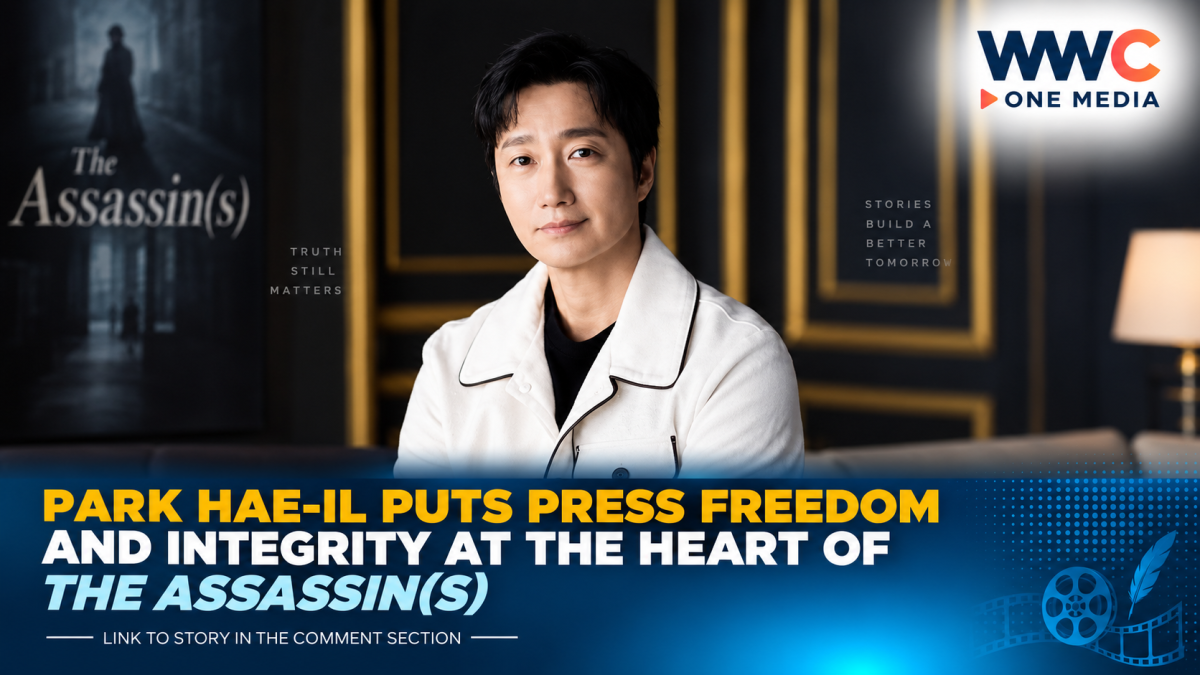
South Korean actor Park Hae-il is bringing questions of truth, journalism and integrity to the center of The Assassin(s), an ambitious new political thriller from acclaimed filmmaker Hur Jin-ho.
Set against one of the most politically charged periods in modern Korean history, the film explores what happens when a violent political event collides with a media system under pressure—and when journalists must decide how far they are willing to go to uncover the truth.
The film is scheduled for release in 2026 and has already attracted international attention ahead of its global festival rollout. Screen Daily identified The Assassin(s) as one of the notable Korean titles being presented internationally, describing it as a thriller set in 1974 and built around an attempted assassination of then-President Park Chung-hee.
A political thriller about more than an assassination
Despite its provocative title, The Assassin(s) is not simply an action movie about a political killing.
The story follows several characters whose lives intersect after the assassination attempt, including a detective who witnesses the incident, a newspaper editor whose coverage is suppressed and a rookie reporter determined to investigate what really happened.
That structure gives the film a second layer.
The central mystery is not merely who pulled the trigger, but what happens to the truth when powerful forces attempt to control the story.
That is where Park Hae-il’s role becomes particularly significant.
Known for performances in films including Decision to Leave and The Host, Park has repeatedly taken on complex characters caught between personal morality and larger social forces.
Park Hae-il and the fight for journalistic integrity
In The Assassin(s), the journalism storyline places press freedom and professional integrity alongside political power.
The film’s newspaper characters represent a profession facing a fundamental choice: publish what the public needs to know or remain silent when the truth becomes dangerous.
That theme gives the movie contemporary relevance despite its historical setting.
Press freedom has long been a sensitive subject in South Korea, particularly when political power, media ownership and national security intersect. By returning to the turbulent 1970s, Hur Jin-ho can examine those tensions through a historical thriller rather than a conventional political drama.
The film therefore uses a real historical backdrop to ask a question that remains relevant today:
What is journalism worth if reporters cannot tell the truth?
A star-powered Korean film
The Assassin(s) brings together three major Korean actors.
Park Hae-il is joined by Yoo Hae-jin, known internationally for films including Exhuma, and Lee Min-ho, whose global profile expanded significantly through projects such as Pachinko. Screen Daily identified all three as the film’s principal stars.
The combination gives the project considerable commercial and international appeal.
Hur Jin-ho is also a major name in Korean cinema. His previous work includes A Normal Family, which premiered internationally at the Toronto International Film Festival in 2023.
The production comes from Hive Media Corp, the company behind major Korean historical and political films including 12.12: The Day and Harbin. That connection further places The Assassin(s) within a recent wave of Korean cinema revisiting politically significant chapters of the country’s history.
Why the 1974 setting matters
The film is set during the authoritarian era of Park Chung-hee’s presidency.
That period was marked by intense political conflict, restrictions on political opposition and significant pressure on the media.
By placing journalists and investigators at the center of an assassination mystery, The Assassin(s) can explore how ordinary professionals respond when institutions around them are under extraordinary pressure.
The historical setting also allows the filmmakers to examine the gap between official narratives and the truth that emerges behind them.
That is potentially the film’s most powerful hook.
From historical incident to modern warning
The assassination attempt depicted in the film is not being presented simply as a historical curiosity.
Instead, The Assassin(s) appears designed to explore the people who had to live through its consequences—and the struggle to determine what actually happened.
That makes Park Hae-il’s involvement especially intriguing.
Rather than relying solely on spectacle, the movie appears to be building its tension around information, secrecy and competing versions of the truth.
And that could make it one of the more politically charged Korean films arriving in 2026.
International spotlight is already growing
The movie has been drawing attention in international film markets ahead of its release.
Screen Daily listed The Assassin(s) among notable Korean projects being showcased internationally in early 2026, highlighting both its star cast and its historical thriller premise.
The film has also been announced as a world-premiere title at the 2026 Toronto International Film Festival, giving it an important international platform before its wider release.
That festival exposure could significantly raise international interest in the project, particularly because Korean cinema continues to attract global audiences with politically ambitious and historically grounded stories.
The real battle may be over the truth
At its core, The Assassin(s) is shaping up to be a story about more than an attempted political assassination.
It is about the people who witness history—and what happens when they are pressured to keep quiet.
For Park Hae-il’s character and the journalists surrounding him, the greatest danger may not necessarily come from the assassin.
It may come from what happens when the truth itself becomes a threat.
And that is precisely what could make The Assassin(s) one of the most intriguing Korean films of 2026.


Leave a Reply