
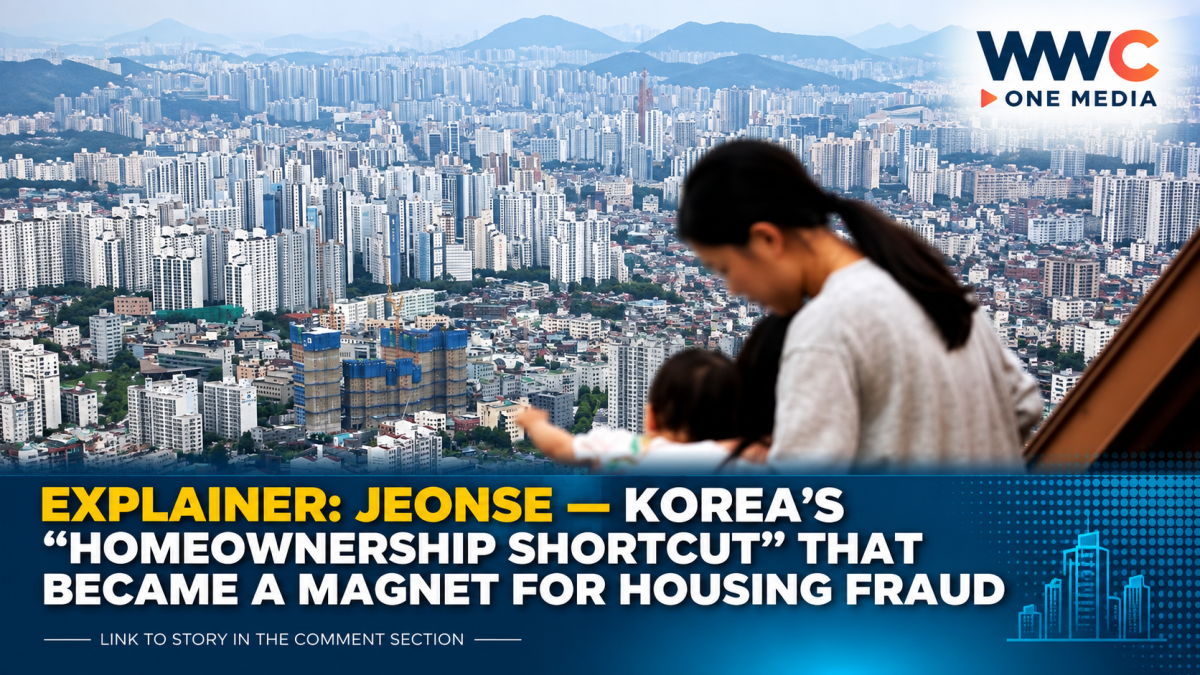
South Korea’s jeonse system was once viewed as one of the country’s most distinctive answers to expensive housing. Instead of paying rent every month, tenants hand their landlord a huge refundable deposit, live in the property for the duration of the lease, and expect the money back when they move out.
For decades, the arrangement helped millions of Koreans secure housing without conventional monthly rent. But when property prices began falling, interest rates rose and landlords became increasingly leveraged, the system exposed a dangerous weakness: the tenant’s enormous deposit can become the landlord’s source of financing—and the tenant may be left chasing that money if the property loses value or the landlord cannot repay.
How does jeonse actually work?
Under a typical jeonse contract, a tenant pays a large lump-sum deposit instead of monthly rent. The deposit can represent a substantial portion of the property’s market value—commonly around 50% to 80% in descriptions of the system.
The tenant then occupies the property, generally for about two years, without paying conventional monthly rent. At the end of the contract, the landlord is expected to return the entire deposit.
That sounds simple.
The crucial part is what happens to the money in between.
Historically, landlords could use the deposit as effectively interest-free financing, investing it or using it to purchase or finance other properties. When property values were rising, the system could keep functioning because a landlord could often obtain a new tenant’s deposit and use it to return the previous tenant’s money.
This created a system in which housing deposits could circulate through the property market.
Then the housing market turned
The model becomes much more dangerous when property prices decline.
Imagine a property originally worth 500 million won with a 400 million-won jeonse deposit. If the property’s value falls significantly, the landlord may no longer have enough equity to cover the tenant’s deposit.
The problem becomes even worse if the landlord owns several properties financed through similar deposits.
That is where the term “jeonse fraud” entered South Korea’s housing debate.
Fraudulent or abusive schemes can involve landlords, brokers or other participants allegedly inflating property values, collecting large deposits and then leaving tenants unable to recover their money.
But it is important to distinguish ordinary jeonse risk from deliberate fraud. Not every tenant who loses a deposit has been defrauded. Some cases arise because landlords become insolvent or property values fall sharply.
Why young Koreans became particularly vulnerable
Jeonse historically offered an attractive alternative to monthly rent, particularly for households that could assemble the enormous deposit.
But that advantage increasingly came with a major financial burden.
As housing prices rose, deposits became so large that many tenants relied on loans to finance them. That meant a renter could simultaneously face a huge deposit obligation and interest payments on the money borrowed to provide that deposit.
For younger Koreans struggling to buy homes in an increasingly expensive market, jeonse could therefore look like a middle ground between renting and owning.
They could live in desirable housing without purchasing the property outright.
But financially, they were still exposed to the property’s value.
The “gap” that can turn dangerous
One of the biggest vulnerabilities involves the relationship between a property’s market value and its jeonse deposit.
If the deposit becomes too close to—or even exceeds—the property’s realistic sale value, the arrangement becomes increasingly risky.
This is particularly dangerous when a landlord depends on the next tenant’s deposit to repay the previous tenant.
If the property cannot be sold for enough money and a new tenant cannot be found at the same deposit level, the financial chain can break.
That can leave the departing tenant waiting for hundreds of millions of won that they may need for their next home.
Why Korea’s housing crisis made the problem worse
Jeonse’s vulnerabilities became more visible amid major shifts in South Korea’s property and financial markets.
The country’s housing market has faced repeated swings in prices, interest rates and lending conditions.
Meanwhile, the government under President Lee Jae Myung is still grappling with a broader housing affordability crisis. Reuters reported in August 2026 that Seoul’s government unveiled a package designed to increase housing supply and provide additional financial support for young and first-time buyers, while maintaining restrictions intended to curb speculation.
More recently, the Financial Times reported that property prices in Seoul had surged sharply, particularly around areas benefiting from the semiconductor and AI boom, putting additional pressure on younger people trying to enter the housing market.
That creates a complicated environment for jeonse.
When property prices rise rapidly, deposits can also become extremely expensive. When prices fall, landlords may struggle to return those deposits.
Jeonse is slowly losing its dominance
The traditional system has also been losing ground to wolse, the more familiar monthly-rent model.
In a wolse arrangement, tenants generally provide a much smaller deposit and pay rent each month.
The shift reflects changing economic conditions. Lower interest rates once made the jeonse model particularly attractive to landlords, while rising borrowing costs and changes in housing policy have reduced some of its advantages.
Available data cited in discussions of Korea’s rental market show that monthly rental contracts overtook jeonse contracts in 2022.
That doesn’t mean jeonse is disappearing.
It remains deeply embedded in South Korea’s housing market.
But the experience of the past several years has forced renters, banks, regulators and policymakers to reconsider just how much financial risk should sit on the tenant’s shoulders.
Why the system still survives
Despite the scandals and risks, jeonse has not simply vanished because it offers a major benefit to tenants: no traditional monthly rent during the lease period.
For landlords, the enormous deposit can provide access to capital.
For tenants who have sufficient funds—or can obtain affordable financing—the system can still make financial sense compared with paying monthly rent indefinitely.
The fundamental issue is therefore not that jeonse itself is automatically fraudulent.
The danger arises when high deposits, excessive leverage, falling property values and weak safeguards collide.
The bigger lesson
Jeonse was born from a very specific period in Korea’s economic development, when housing demand was soaring, mortgage markets were less developed and high interest rates made large deposits useful to landlords.
It helped facilitate housing access and became a defining feature of Korean real estate.
But the same mechanism that once helped people get ahead can become a serious liability when property prices reverse.
And that is why jeonse remains one of the most important housing stories in South Korea today.
What was once seen as a shortcut to secure a home without monthly rent has become a warning about what happens when a renter’s biggest asset—and biggest financial risk—is tied to the landlord’s property.


Leave a Reply