
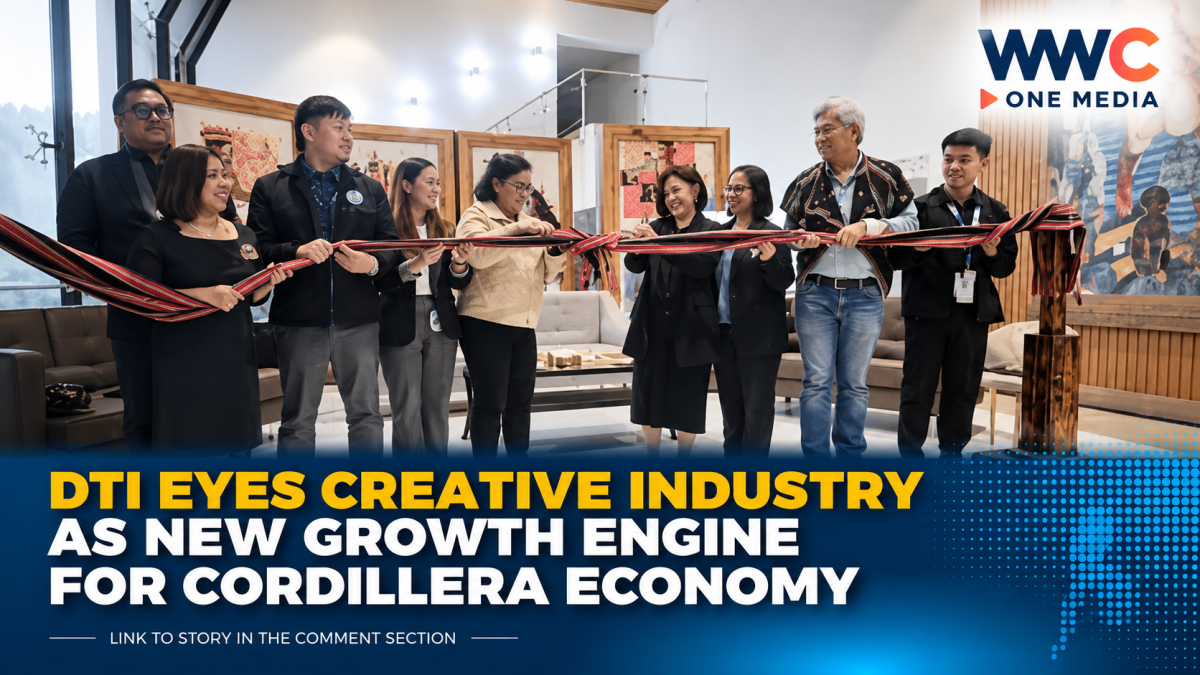
BAGUIO CITY — The Cordillera Administrative Region is looking beyond its traditional economic strengths, with the Department of Trade and Industry (DTI) increasingly turning to creative industries and digital talent as a potential new engine of growth.
The push comes as the region seeks to make its economic expansion more inclusive and resilient while creating opportunities for artists, artisans, digital creators and creative entrepreneurs across the six provinces and Baguio City.
The Cordillera economy expanded 4.4 percent in 2025, reaching a gross regional domestic product of about P394.96 billion, according to the Philippine Statistics Authority figures cited by the Philippine Information Agency. While services remained the region’s primary growth driver, DTI has identified creative industries and digitalization as important areas for diversification.
From traditional crafts to the digital economy
The region’s creative potential is hardly new.
Baguio City has been a UNESCO Creative City of Crafts and Folk Arts since 2017, reflecting the area’s long-standing reputation for weaving, woodcarving, silvercraft, basketry and other forms of traditional craftsmanship.
But officials increasingly see an opportunity to combine that cultural heritage with modern industries such as animation, game development, digital entertainment, graphic design and online content creation.
The Philippine Information Agency reported that DTI-CAR has been working with the Creative Support and Development Activities program to combine traditional heritage with high-value digital skills. The program’s model is now being replicated beyond the Cordillera, while localized creative hubs are being developed in areas including Apayao.
This represents a significant shift: instead of treating culture and creativity simply as tourism attractions, policymakers want them to become income-generating businesses that can compete in national and international markets.
The numbers behind the creative push
The opportunity is already visible in Baguio and surrounding communities.
According to PIA reporting on the Cordillera’s digital creative sector, DTI-CAR has identified around 2,000 registered creative-industry stakeholders, with the sector contributing an estimated P300 million to the region’s gross domestic product.
The broader Philippine creative economy is also expanding. Government officials cited in the same report said the national creative industry employed 7.51 million people in 2024, equivalent to about 7.3 percent of Philippine GDP, with the industry growing 3.9 percent from 2023 to 2024.
For the Cordillera, that creates an opportunity to turn its pool of artists, designers, cultural workers and digital professionals into businesses capable of selling beyond the region.
Why Baguio could become the region’s creative hub
Baguio already has several advantages.
Its UNESCO designation gives the city an international identity tied to crafts and folk art, while its universities, tourism industry and growing digital ecosystem provide a potential talent pipeline.
DTI and the Department of Information and Communications Technology have previously promoted digital creative development in the city, including animation, game development and other digital entertainment fields.
A DTI-led initiative has also established a Digital Entertainment Exchange Facility at the Cordillera School of Digital Arts campus. The facility provides access to digital entertainment equipment, coworking space and related resources intended to make it easier for aspiring talents and service providers to enter or upgrade their digital careers.
The strategy is significant because digital creative work does not necessarily depend on being physically located in Metro Manila. A designer, animator, developer or content creator based in the Cordillera can potentially serve clients anywhere in the Philippines—or overseas.
Traditional culture could become an economic advantage
The region’s traditional industries remain central to the strategy.
Cordilleran weaving and crafts have already demonstrated their commercial potential. DTI reported that Cordilleran MSMEs generated P20.5 million in sales at the Philippine National Trade Fair, representing 17 percent of total sales recorded by participating businesses nationwide at that event.
The challenge is to move beyond selling raw or conventional products.
Design, branding, intellectual property protection, digital marketing and e-commerce can help transform indigenous designs and traditional skills into higher-value products while giving creators greater access to consumers outside the region.
Earlier DTI initiatives have similarly focused on helping local artists and crafters improve product design, quality, production and marketability.
A new economic lane for the Cordillera
The push toward creative industries comes at a time when the Cordillera is trying to broaden its economic base.
The region’s 2025 economic growth was driven by all three major sectors, with services posting 5.3-percent growth, agriculture, forestry and fisheries 4.3 percent, and industry 1.7 percent. However, the regional government has acknowledged that overall growth of 4.4 percent remained below its target of at least 5.5 percent.
That makes diversification increasingly important.
Creative industries could offer the region another path—one based not only on natural resources and tourism, but also on ideas, culture, skills, technology and intellectual property.
The long-term challenge will be converting that potential into sustainable businesses, better-paying jobs and exportable creative services.
For Cordillera’s artists and entrepreneurs, the opportunity could be much bigger than simply selling a locally made souvenir.
The real prize may be turning the region’s culture and creativity into a globally marketable economic asset.



Leave a Reply