
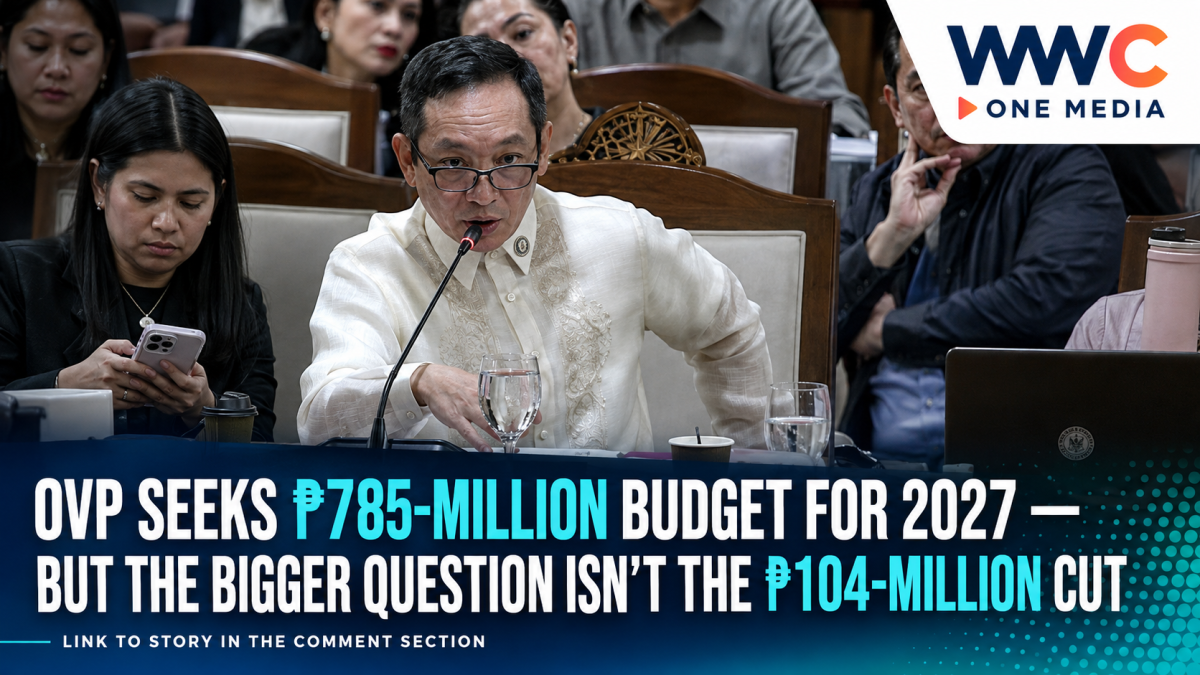
MANILA, Philippines — The Office of the Vice President is heading into the 2027 budget season with a smaller spending plan, asking Congress for ₱785.204 million in new appropriations, or roughly ₱104 million less than the ₱889.236 million appropriated to the office for 2026.
The proposed reduction translates to 11.7 percent, even as the overall proposed Philippine national budget is expanding to ₱7.2 trillion for 2027. The national spending plan is about 6 percent higher than the ₱6.793-trillion 2026 budget.
The Department of Budget and Management has included the OVP allocation in the 2027 National Expenditure Program, the executive branch’s proposed spending plan that Congress will review and may amend before it becomes the General Appropriations Act.
Where the ₱785 million would go
Under the proposal, ₱561.651 million—more than two-thirds of the requested new appropriation—would go to Maintenance and Other Operating Expenses or MOOE.
Another ₱220.232 million is proposed for Personnel Services, while ₱3.321 million would be allocated for Capital Outlay.
Separately, ₱15.544 million is automatically appropriated for the Retirement and Life Insurance Premiums of OVP plantilla personnel. When that automatic appropriation is added, total funding associated with the office would amount to approximately ₱800.748 million, although the OVP’s proposed new appropriation itself remains ₱785.204 million.
That distinction is important because some reports combine the automatic retirement allocation with Personnel Services, resulting in a personnel-related figure of ₱235.776 million. The underlying figures, however, reconcile once the automatic appropriation is taken into account.
Direct-aid programs remain at the center
Despite seeking less money, the OVP says it plans to continue several programs providing transportation, livelihood, education and disaster-related assistance.
Approximately ₱193.103 million of the MOOE allocation has been identified for procurement of goods, livelihood assistance grants under the MagNegosyo Ta ‘Day program, and other assistance-oriented initiatives.
The OVP’s targets include reaching 150,000 learners through the Pagbabago Campaign, assisting 23,000 individuals or families through disaster operations, distributing R.I.I.C.E. Food Bags to 30,000 individuals or families, and providing Libreng Sakay services to an estimated 1.2 million commuters.
Other programs identified for continued funding include the KALUSUGAN Food Truck and disaster operations, wheelchair distribution, Al-Janazah kits and other supplies, and the You Can Be VP Program.
The OVP said the lower proposal is designed to allow those services to continue while keeping personnel and basic operations funded.
OVP points to its spending record
The Vice President’s office is also using its budget-utilization figures to argue that it can implement programs despite the smaller allocation.
According to the OVP, its budget utilization rate has averaged more than 90 percent in recent years. It also reported an obligation rate of 43.07 percent as of June 30, 2026, slightly above its 41-percent target for that point in the fiscal year.
Those figures were released by the OVP itself and describe obligations—funds committed for contracts, purchases or other authorized expenditures—not necessarily the amount of cash already disbursed to beneficiaries.
House hearing immediately raises transparency question
The budget story took on another dimension when the OVP faced the House Committee on Appropriations on September 2.
During the hearing, Rep. Robert Nazal initially moved to extend parliamentary courtesy to the OVP and waive further questioning, arguing that the committee had extended similar treatment to the Office of the President a day earlier.
ACT Teachers Rep. Antonio Tinio objected, arguing that budget hearings should prioritize transparency and accountability rather than automatically shielding high-ranking offices from questioning.
Nazal subsequently withdrew his motion after OVP Chief of Staff and Undersecretary Zuleika Lopez indicated that the office was prepared to answer lawmakers’ questions.
The House’s official schedule confirms that the OVP’s fiscal year 2027 budget briefing was set before the appropriations panel on September 2 as part of Congress’ ongoing examination of the proposed national spending plan.
That exchange could prove significant. The numbers may be smaller this year, but legislators are still expected to examine where the money will go, whether program targets can be met and how effectively previous allocations were used.
A budget debate with a much larger political backdrop
The deliberations are also occurring while Vice President Sara Duterte is facing an ongoing impeachment trial in the Senate.
Among the matters raised in that proceeding are allegations concerning previous confidential-fund expenditures of the OVP and the Department of Education during Duterte’s tenure. Those allegations remain part of an ongoing constitutional proceeding and should not be treated as finally established findings.
State auditors have testified about questioned or disallowed confidential expenditures, while Duterte’s defense has contested key prosecution assertions and interpretations surrounding the spending.
The current OVP spending plan, however, is markedly different from those earlier budgets. House appropriations vice chair Zia Alonto Adiong said ahead of the hearings that he was not aware of any request for confidential funds in the proposed 2027 OVP budget; the 2026 national budget likewise contained no such OVP allocation.
Smaller than 2026—but not a return to the lowest level
The ₱785.204-million request would represent a reduction from 2026, but it would still be above the ₱733.198 million in new appropriations the OVP received for 2025.
The 2025 figure followed a major congressional reduction from an earlier proposal exceeding ₱2 billion. DBM’s official 2025 General Appropriations Act records ₱733.198 million for the office.
For 2026, the OVP initially sought around the ₱733-million level before the DBM-backed proposal increased and Congress eventually appropriated ₱889.236 million.
The result is a three-year pattern in which the OVP’s funding has moved sharply depending on negotiations between the office, the executive budget department and Congress.
And that may be the real story behind the 2027 numbers.
A smaller request could reduce pressure on lawmakers to make dramatic cuts. But with congressional scrutiny, questions about previous spending and Duterte’s impeachment trial unfolding at the same time, the fate of the OVP budget may depend on far more than whether ₱785 million is considered enough.
The next question is whether Congress will largely preserve the leaner spending plan—or rewrite it once again before the 2027 national budget reaches President Ferdinand Marcos Jr.’s desk.
WWC ONE MEDIA MJE
Leave a Reply