
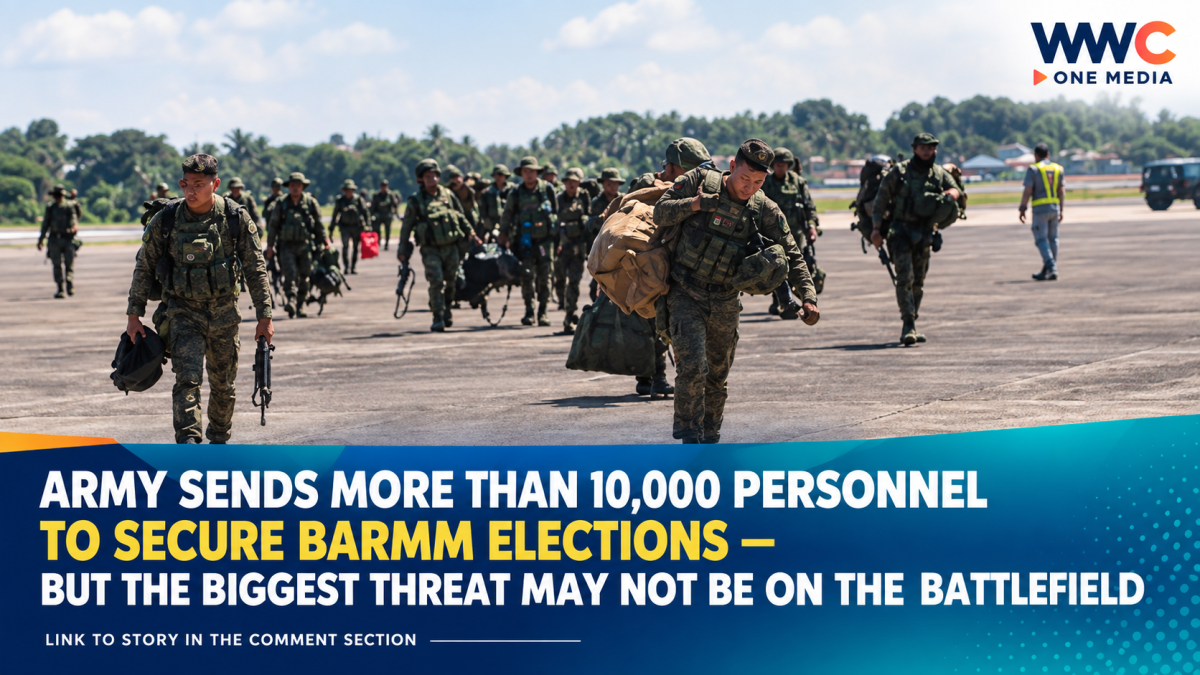
MANILA, Philippines — More than 10,000 Philippine Army personnel have been deployed across the Bangsamoro Autonomous Region in Muslim Mindanao as authorities mount one of the most closely watched election-security operations in the region’s recent history ahead of the September 14, 2026 Bangsamoro Parliamentary Elections.
The Army said 10,031 soldiers and CAFGU Active Auxiliary members from the 1st, 6th and 11th Infantry Divisions have been mobilized to support security operations surrounding the historic vote. Specialized and augmentation units have also been positioned in strategic areas as election day approaches.
The deployment is significant not merely because of its size. The September election will determine the composition of the first regularly elected Bangsamoro Parliament, replacing the appointed Bangsamoro Transition Authority that has governed the autonomous region during its political transition.
And with fewer than two weeks remaining before voting begins, the security buildup is continuing.
The Philippine Army’s 1st Infantry “Tabak” Division recently dispatched two additional provisional battalions to Lanao del Sur, adding to eight infantry battalions already operating there. Armor and field artillery units are also supporting the security force, while another Special Forces battalion is expected to reinforce operations before election day.
That growing military presence reflects the scale of the challenge confronting election authorities.
More Than 2.39 Million Voters Will Decide BARMM’s Political Future
Around 2.393 million registered voters are expected to participate in the Sept. 14 polls, voting across 5,212 precincts in 105 municipalities and two cities, according to Bangsamoro election authorities.
They will help form an 80-member Bangsamoro Parliament under a system unlike the conventional congressional elections familiar to most Filipino voters.
Of the 80 seats, 40 will go to political-party representatives through proportional representation, 32 will be elected from single-member parliamentary districts, and eight are reserved for sectoral representatives.
The election therefore marks more than a change of officials. It represents a major stage in the shift from a transitional government to a parliament directly shaped by Bangsamoro voters.
The vote has already been postponed several times.
Originally scheduled much earlier in BARMM’s transition, the first regular parliamentary elections were eventually reset to September 14, 2026 under Republic Act No. 12317, signed in March. The law provides that succeeding Bangsamoro elections will eventually be synchronized with national and local elections beginning in May 2031.
President Ferdinand Marcos Jr. has also declared Sept. 14 a special non-working day throughout BARMM to give residents the opportunity to vote.
Security Concerns Extend Beyond Armed Groups
The massive troop presence does not mean authorities have identified one specific imminent attack.
Instead, the Armed Forces says it is continuously assessing possible threats and adjusting its deployment based on conditions on the ground.
AFP officials said their priority is to prevent violence while ensuring that voters can make their choices freely, stressing that soldiers must remain politically neutral and avoid influencing the electorate.
But the security environment is far from routine.
The Philippine National Police earlier said 108 localities had been classified by COMELEC as election “areas of concern,” with varying security risk levels. Lanao del Sur had the highest number of areas classified in the most serious red category, according to an August security assessment.
The PNP itself has committed thousands of personnel to the elections. Malacañang said in August that 8,299 police officers were scheduled for deployment, with additional personnel available depending on threat assessments and COMELEC requirements.
President Marcos has directed the PNP, Armed Forces and other government agencies to maintain security, pursue operations against private armed groups and coordinate through joint security control centers ahead of the election.
Intimidation and Vote-Buying Are Also Under the Microscope
Some of the most serious threats to the credibility of the election may not come from open armed confrontation.
A recent pre-election assessment conducted by the Asian Network for Free Elections and the National Democratic Institute identified concerns among voters involving intimidation, vote-buying and so-called “flying voters.”
Those findings add another dimension to the security operation.
Deploying soldiers and police can deter physical violence, but ensuring a genuinely free election will also depend on preventing coercion, illegal campaign practices and the misuse of local political influence.
COMELEC has already revived its Kontra Bigay mechanisms and adopted rules addressing vote-buying, vote-selling and the abuse of state resources for the BARMM election.
The Bigger Test Comes After Deployment
The presence of more than 10,000 Army personnel sends a clear signal that authorities are taking the Sept. 14 election seriously.
But sheer troop numbers will not determine whether the historic vote succeeds.
The harder test will be whether security forces can protect communities without intimidating voters themselves, remain neutral amid intense local political competition and prevent armed groups or political actors from disrupting the process.
Army commanders have repeatedly instructed deployed soldiers to maintain discipline, professionalism and impartiality while respecting the rights of voters.
That distinction matters because the Sept. 14 election is ultimately about more than choosing 80 parliamentarians.
It is a test of whether years of peace negotiations, transitional governance and institution-building can culminate in a credible political transfer of power through the ballot box.
For the more than 2.39 million Bangsamoro voters preparing to participate, the thousands of troops now being deployed are meant to provide the security around that choice.
Whether they can also guarantee that the choice is made freely may be the bigger challenge.
WWC ONE MEDIA MJE


Leave a Reply