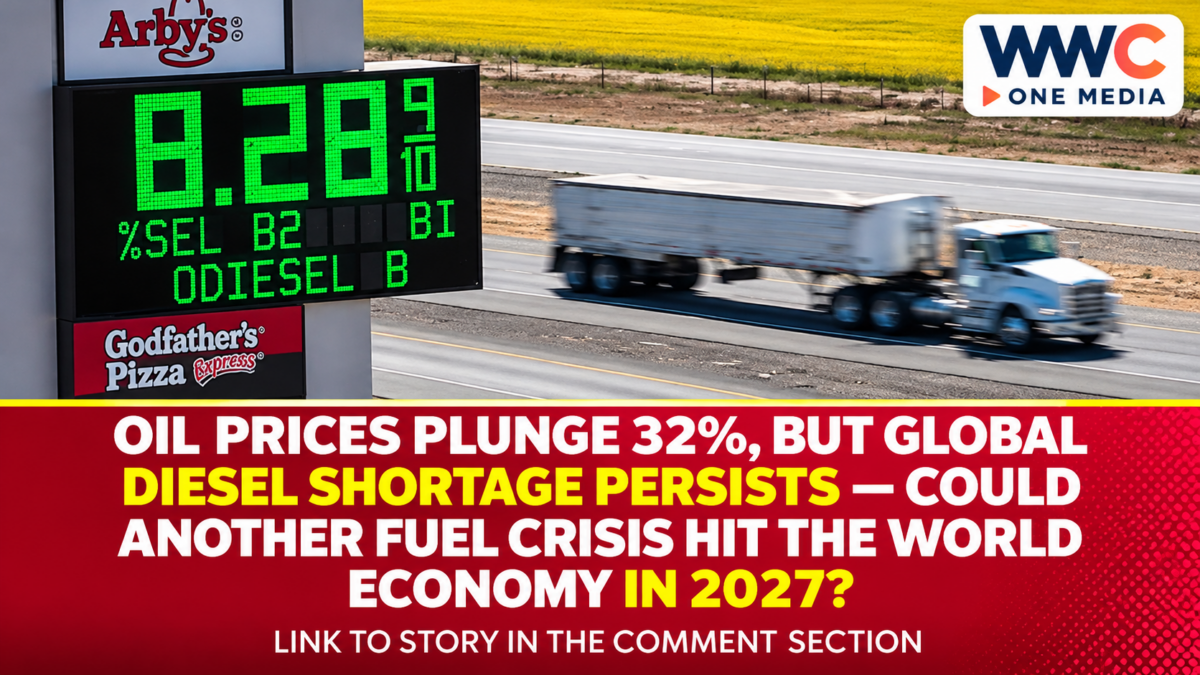
The global diesel shortage is threatening to undermine the economic relief expected from falling crude oil prices, exposing a growing divide between the availability of unprocessed petroleum and the finished fuels that keep businesses, transportation networks and agricultural operations running.
North Sea Dated crude oil fell approximately 32% from US$136 per barrel in early October to around US$93 during the November 2026 reporting period.
European diesel prices declined by just 11% over the same period, remaining approximately 77% above their pre-war levels.
The divergence presents a potentially difficult economic scenario heading into 2027: improving crude oil supplies may not immediately translate into affordable transportation, lower distribution expenses or sustained relief from inflation.
Global diesel shortage exposes an uneven oil market recovery
International Energy Agency projections released on Nov. 13 point towards a return to an overall oil-market surplus during the fourth quarter of 2026.
However, an improving balance between worldwide oil production and consumption does not necessarily mean that individual petroleum products are readily available.
Diesel remains particularly vulnerable because its production requires functioning refinery infrastructure, suitable crude supplies and dependable distribution networks.
An increase in crude oil availability cannot independently compensate for damaged refineries or restricted exports of finished petroleum products.
This distinction has previously been examined in WWC ONE MEDIA’s coverage of the projected 2027 oil supply surplus and its potentially uneven effect on retail fuel prices.
For businesses purchasing diesel, the relevant question is not simply whether more crude oil is being produced. It is whether sufficient finished fuel can reach their markets at commercially manageable prices.
Oil production rebounds, but refineries face a different reality
Global oil production reached 105.4 million barrels per day in October 2026, representing an increase of 2.3 million barrels per day from September.
Nevertheless, the recovery in petroleum production has not eliminated downstream supply constraints.
The global refining industry faces a separate set of operating challenges involving maintenance requirements, equipment availability, transportation expenses and the commercial suitability of different crude oil grades.
A refinery cannot necessarily convert every additional barrel of crude into whichever petroleum product happens to command the highest market price.
Production depends partly on the facility’s configuration and the characteristics of its feedstock.
Consequently, expanding crude oil production may provide only limited near-term relief when the principal bottleneck involves the capacity to manufacture and distribute diesel.
Why the diesel shortage could persist into 2027
The October 2026 Oil Market Report estimated that global diesel and gasoil availability declined by 1.5 million barrels per day year-on-year during the second quarter and by 1.7 million barrels per day during the third quarter.
Reduced petroleum product shipments from the Middle East, Russia and parts of Asia contributed to the contraction.
Although some production has recovered, the market must also replenish inventories depleted during earlier disruptions.
The distinction between current production and accumulated inventory losses is important.
A market can temporarily achieve a balance between daily supply and demand while still maintaining insufficient reserves to absorb another major interruption.
Rebuilding those reserves requires sustained improvements in production and distribution.
Until that occurs, diesel buyers could remain exposed to renewed price volatility even when headline crude oil prices appear relatively stable.
America’s diesel forecast delivers another warning
The US Energy Information Administration’s November Short-Term Energy Outlook forecasts an average American retail diesel price of US$5.03 per gallon in 2027.
That would represent a modest decline from the projected 2026 average of US$5.25.
However, the new 2027 estimate is higher than the US$4.49 per gallon projected in October.
The upward revision reflects continuing concerns about international supplies of refined petroleum products.
The forecast also places the expected 2027 diesel price substantially above the US$3.66 average recorded in 2025.
WWC ONE MEDIA previously examined the decline in American diesel prices and whether lower fuel costs could eventually reduce transportation expenses.
The latest annual outlook illustrates why a short-term reduction in retail prices should not automatically be interpreted as a complete recovery in the underlying fuel market.
Refiners cannot solve the problem by producing diesel alone
American refiners have responded to strong petroleum product margins by maintaining elevated operating rates.
US crude oil inputs to refineries averaged 16.6 million barrels per day in October 2026.
However, refinery operations generate multiple petroleum products rather than diesel alone.
Increasing output to meet demand for one product can simultaneously affect supplies of gasoline and other fuels.
This relationship creates additional commercial considerations for refinery operators attempting to balance production against different patterns of demand.
WWC ONE MEDIA previously explored this challenge in its analysis of falling US gasoline prices alongside relatively tight diesel supplies.
High refinery utilisation can support additional production, but it does not eliminate the possibility of maintenance-related interruptions or unexpected equipment failures.
The global refining industry’s ability to sustain production will therefore remain an important factor in determining fuel availability throughout 2027.
Transport, agriculture and food prices remain exposed
The wider economic consequences of expensive diesel extend beyond filling stations.
Businesses that depend heavily on road freight, agricultural equipment and industrial machinery must incorporate fuel expenses into their operating budgets.
When diesel prices remain elevated, companies may face difficult decisions involving delivery charges, profit margins and product pricing.
Consider a logistics operator whose vehicles consume substantial quantities of diesel. A decline in crude oil prices offers little immediate financial relief if the company’s actual fuel purchase costs remain high.
Agricultural producers face similar considerations when evaluating production and distribution expenses.
However, expensive diesel does not automatically establish that every food product will become more costly. Consumer prices also reflect agricultural output, labour expenditure, exchange rates, commercial competition and government policies.
For APEC economies, the degree of exposure will depend on local energy infrastructure, petroleum import requirements and the effectiveness of domestic supply arrangements.
Emergency diesel reserves could provide temporary relief
On Oct. 11, 2026, IEA Executive Director Fatih Birol encouraged member governments to accelerate outstanding emergency petroleum stock releases, giving particular attention to diesel.
Member countries were also encouraged to evaluate whether additional diesel releases would be necessary.
Emergency reserves can help reduce immediate supply pressure while disrupted production facilities recover.
However, drawing down inventories is not a permanent substitute for functioning refining and distribution infrastructure.
The long-term objective must involve restoring dependable supplies while rebuilding sufficient reserves to withstand future interruptions.
Maritime security remains another important consideration, as illustrated by WWC ONE MEDIA’s earlier coverage of shipping risks and disruptions affecting the Strait of Hormuz.
What happens next for global diesel prices?
The next phase of the global energy recovery will depend on whether additional crude oil supplies can be converted into sufficient quantities of finished petroleum products.
Refinery production, diesel export volumes, maritime transportation costs and commercial inventories will provide important indicators of progress.
The EIA’s next Short-Term Energy Outlook is scheduled for Dec. 8, 2026.
For businesses and households, the most meaningful sign of recovery will be sustained improvement in actual fuel availability and purchasing costs.
Falling crude oil prices may offer welcome relief. But until the diesel supply chain recovers, the world economy could remain vulnerable to another period of expensive transportation and persistent fuel-related inflation.
Frequently Asked Questions
Why is there a global diesel shortage despite falling oil prices?
Crude oil requires refining before it becomes diesel. Disrupted refinery operations, restricted product exports and depleted inventories can constrain diesel availability even when crude oil supplies improve.
Will the global diesel shortage continue in 2027?
Energy-market forecasts indicate that refined fuel supplies could remain constrained during 2027. The duration of the shortage will depend on refinery recovery, international exports and inventory replenishment.
What is the US diesel price forecast for 2027?
The November 2026 EIA outlook forecasts an annual average of US$5.03 per gallon, compared with its previous estimate of US$4.49.
Can expensive diesel increase food prices?
Elevated diesel prices can increase agricultural and transportation expenses. However, actual food-price movements also depend on production levels, labour costs, competition and other economic factors.
Does an oil surplus guarantee cheaper diesel?
No. An overall oil surplus does not guarantee sufficient supplies of every refined petroleum product. Diesel prices also depend on refinery output, shipping costs, inventories and regional demand.