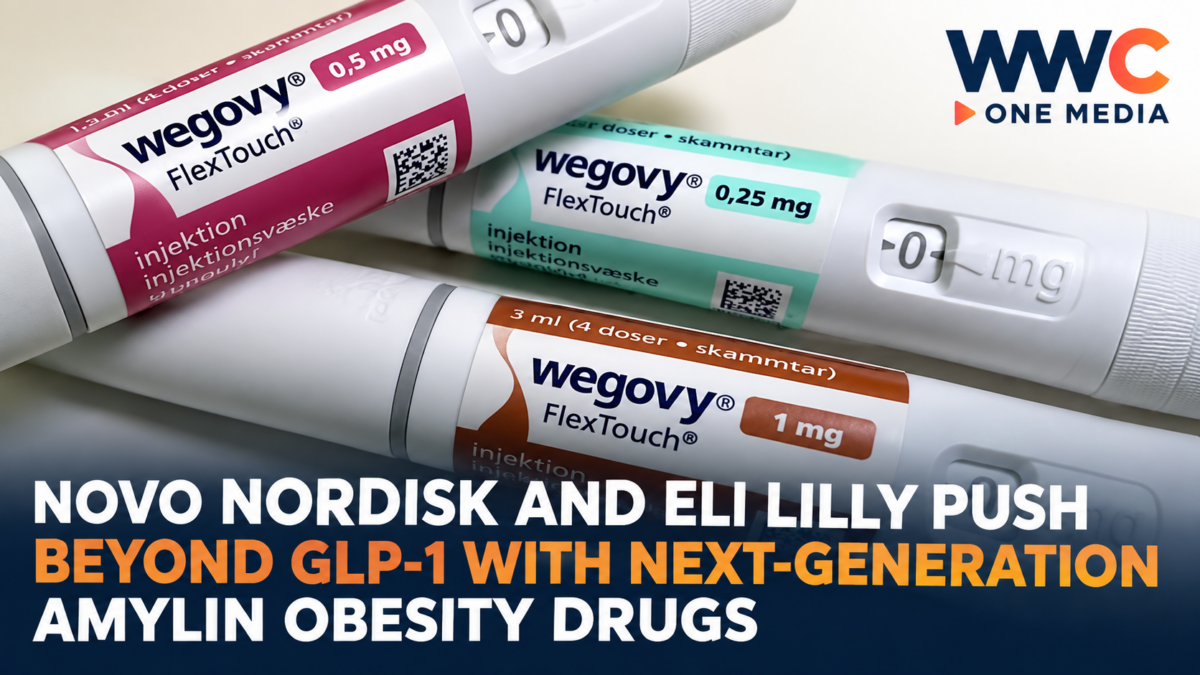
NEW YORK — The battle over the next generation of obesity medicines is moving beyond GLP-1 drugs such as Wegovy and Zepbound, as Novo Nordisk and Eli Lilly race to combine today’s blockbuster treatments with another appetite-regulating hormone that could push weight loss even higher.
That hormone is:
amylin.
Both pharmaceutical giants are developing medicines designed to mimic or influence amylin, a naturally occurring hormone released after eating that helps the brain recognize fullness.
The strategy is becoming one of the most important new fronts in obesity treatment.
Instead of relying on GLP-1 alone, drugmakers are increasingly combining several biological pathways in hopes of achieving:
Greater weight loss
Better blood-sugar control
Longer-lasting appetite suppression
and potentially
Better body composition.
For Novo Nordisk, the centerpiece is:
CagriSema.
For Eli Lilly, one of the newest contenders is:
EloraTZP.
And the early results suggest the obesity-drug race could become even more competitive.
THE FIRST GENERATION OF GLP-1 DRUGS ALREADY CHANGED MEDICINE
The current obesity revolution was largely driven by medicines such as:
Wegovy
Ozempic
Zepbound
and
Mounjaro.
Novo Nordisk’s Wegovy and Ozempic contain:
semaglutide.
Eli Lilly’s Zepbound and Mounjaro contain:
tirzepatide.
These medicines help reduce appetite and improve metabolic control by acting on hormone pathways involved in:
Hunger
Satiety
Blood sugar
and
Digestion.
Their commercial success has transformed obesity from an area many pharmaceutical companies once avoided into one of the largest growth markets in medicine.
But neither Novo nor Lilly intends to stop with the current generation.
THE NEXT TARGET IS AMYLIN
Amylin is a hormone naturally produced alongside insulin by the pancreas.
After a person eats, it helps signal that the body has received food.
That can:
Increase feelings of fullness
Reduce appetite
and
Slow gastric emptying.
Drugmakers believe activating the amylin pathway alongside GLP-1 or other metabolic pathways could lead to greater weight reduction than today’s therapies alone.
That is why amylin has quickly become one of the pharmaceutical industry’s most closely watched obesity targets.
NOVO’S BIG BET IS CAGRILINTIDE PLUS SEMAGLUTIDE
Novo Nordisk’s next-generation candidate is called:
CagriSema.
It combines two drugs:
Cagrilintide
and
Semaglutide.
Cagrilintide is a long-acting amylin analog.
Semaglutide is the GLP-1 medicine already used in:
Wegovy
and
Ozempic.
The idea is that the two mechanisms attack appetite from complementary biological directions.
Semaglutide influences GLP-1 receptors.
Cagrilintide acts through the amylin pathway.
Together, Novo hopes they can produce deeper weight loss than semaglutide alone.
NOVO JUST REPORTED 21% WEIGHT LOSS
Novo Nordisk recently reported new Phase 3 results from its REDEFINE 9 trial.
Adults with overweight or obesity receiving CagriSema achieved average weight loss of approximately:
21%
after 68 weeks.
That is an important number because it puts the medicine in the weight-loss range increasingly associated with the strongest injectable obesity therapies.
Novo is positioning CagriSema as a major potential successor to Wegovy.
But the development program has not been completely smooth.
CAGRisema HAS HAD BOTH WINS AND SETBACKS
CagriSema generated enormous expectations when Novo first began developing it.
Earlier studies suggested the combination could potentially produce weight reductions approaching bariatric-surgery territory for some patients.
But subsequent trials produced mixed investor reactions.
In one previous head-to-head study, CagriSema did not deliver the degree of superiority over Lilly’s tirzepatide that some investors had hoped for.
That disappointed markets.
Novo has since released additional trials showing more encouraging results.
The latest data illustrate an important lesson:
one obesity trial cannot tell the entire story.
Results vary depending on:
Dose
Trial duration
Patient population
Diabetes status
and
Comparator drug.
NOVO SAYS CAGRisema BEAT A LOWER DOSE OF TIRZEPATIDE IN DIABETES
In another late-stage study called:
REIMAGINE 5,
Novo tested a lower-dose version of CagriSema in people with type 2 diabetes.
Participants receiving:
CagriSema 1.0 mg/1.0 mg
lost an average:
12.4% of body weight.
Those receiving:
tirzepatide 5 mg
lost:
9.1%.
CagriSema therefore met the trial’s superiority goal for weight reduction.
But this comparison needs context.
Tirzepatide can also be given at:
10 mg
or
15 mg.
Those higher doses have produced greater weight loss in other studies.
So the REIMAGINE 5 result does not prove CagriSema is universally superior to Zepbound or Mounjaro.
It proves superiority against one specific tirzepatide dose in one defined trial population.
LILLY IS BUILDING ITS OWN AMYLIN WEAPON
Eli Lilly is taking a somewhat different approach.
Its experimental medicine:
eloralintide
is a selective amylin receptor agonist.
The company is testing it both alone and in combination with its existing blockbuster drug:
tirzepatide.
That combination is known as:
EloraTZP.
Tirzepatide already targets two hormone receptors:
GIP
and
GLP-1.
Adding eloralintide effectively adds a third metabolic pathway:
amylin.
That makes EloraTZP a triple-acting obesity therapy.
THE NEW LILLY DATA ARE STRIKING
Lilly released Phase 2b results showing that adults with obesity or overweight and type 2 diabetes who received EloraTZP lost up to an average:
23.3% of their body weight
over:
48 weeks.
That translated to approximately:
54.1 pounds.
Participants receiving tirzepatide 15 mg alone lost an average:
14.8%
or approximately:
34.4 pounds.
The difference is substantial.
Lilly also reported better blood-sugar reductions with the experimental combination.
A1C fell by as much as:
2.9 percentage points
with EloraTZP,
compared with:
2.4 percentage points
for tirzepatide alone.
THAT RESULT MAY BE EVEN MORE NOTABLE BECAUSE PATIENTS HAD DIABETES
People with type 2 diabetes often lose less weight in obesity-drug studies than people without diabetes.
That pattern has appeared repeatedly across GLP-1 trials.
That makes a result exceeding:
23% average weight reduction
particularly notable in a diabetes population.
But it is still an early-stage comparison.
EloraTZP remains experimental.
It has not yet completed Phase 3 development.
It is not approved for routine medical use.
THERE IS A BIG SIDE-EFFECT CAVEAT
The Lilly result came with an important warning.
Some EloraTZP groups had relatively high rates of treatment discontinuation.
At certain doses, discontinuation reached approximately:
27%.
Gastrointestinal side effects were an important factor, particularly during dose escalation.
Common problems associated with drugs in this broader class can include:
Nausea
Vomiting
Diarrhea
Constipation
and
Abdominal discomfort.
That means the obesity-drug race cannot simply become a contest over who produces the largest weight-loss percentage.
The strongest medicine is only useful if patients can stay on it.
DOSE ESCALATION MAY BECOME CRITICAL
Lilly believes some tolerability problems could potentially be reduced by changing how quickly patients reach higher doses.
This is known as:
dose titration.
Many metabolic medicines are started at lower doses and gradually increased.
That gives the body more time to adjust.
The question for Phase 3 will be whether Lilly can preserve EloraTZP’s powerful weight-loss effect while reducing side effects and discontinuation rates.
That may determine whether the medicine becomes commercially important.
LILLY PLANS PHASE 3 TRIALS
Based on the Phase 2b results, Lilly says it plans to begin:
Phase 3 trials in the fourth quarter of 2026.
Phase 3 studies are much larger and are typically required before regulators consider a new medicine for approval.
They will provide more information about:
Weight loss
Blood sugar
Safety
Tolerability
and potentially
Long-term health outcomes.
The strongest Phase 2 result does not guarantee success in Phase 3.
That is why the upcoming trials matter so much.
NOVO IS MUCH CLOSER TO MARKET WITH CAGRisema
This is where Novo currently has an important advantage.
CagriSema is already in:
Phase 3 development.
Novo has said it plans to bring the medicine toward regulatory review and potentially launch it much sooner than Lilly’s EloraTZP.
That means Novo could establish a commercial foothold in the amylin-combination category before Lilly’s newer drug arrives.
But arriving first does not guarantee long-term leadership.
Lilly entered the obesity market later than Novo with Zepbound and quickly became an enormous competitor.
The same dynamic could happen again.
THIS IS TURNING INTO A TWO-FRONT WAR
Novo and Lilly are now competing on at least two major obesity fronts.
The first is:
today’s market.
That includes:
Wegovy versus Zepbound.
Ozempic versus Mounjaro in diabetes.
The second is:
tomorrow’s market.
That includes:
CagriSema,
EloraTZP,
retatrutide,
amycretin,
oral medicines,
and other experimental therapies.
The winner of the current market is not guaranteed to dominate the next generation.
LILLY ALSO HAS RETATRUTIDE
EloraTZP is not Lilly’s only advanced obesity candidate.
The company is also developing:
retatrutide.
Retatrutide targets three different hormone receptors:
GIP
GLP-1
and
glucagon.
Earlier clinical results generated enormous attention because some participants achieved weight loss exceeding 20%.
Lilly therefore has multiple possible successors to Zepbound.
That gives the company a broad pipeline rather than depending on one experimental medicine.
NOVO HAS MORE THAN CAGRisema TOO
Novo is taking a similar portfolio approach.
Beyond CagriSema, it is studying:
Amycretin
higher-dose semaglutide
oral semaglutide
and additional amylin-based therapies.
Novo recently also agreed to pay as much as:
$2.6 billion
for rights outside China to an experimental weight-loss pill developed by Jiangsu Hengrui Pharmaceuticals.
That deal underscores how aggressively Novo is expanding its pipeline as competition intensifies.
ORAL DRUGS COULD CHANGE THE MARKET JUST AS MUCH AS BETTER INJECTIONS
The next obesity-drug revolution may not come only from stronger injections.
Pills could become equally important.
Some patients dislike weekly injections.
An effective oral drug could make obesity therapy easier to:
Start
Prescribe
Ship
and
Scale.
Novo already markets an oral version of Wegovy in several markets.
Lilly has also moved aggressively into pills with:
Foundayo, or orforglipron.
The obesity market could therefore divide into several segments:
High-efficacy injections
Convenient oral medicines
Combination therapies
and eventually
Specialized drugs aimed at preserving muscle.
MUSCLE LOSS IS BECOMING THE NEXT BIG QUESTION
Weight loss is not automatically identical to fat loss.
When people lose substantial body weight, some of the loss can come from:
Lean muscle mass.
That has become one of the biggest research questions surrounding powerful obesity medicines.
Drugmakers are now developing treatments intended to preserve more muscle during weight loss.
Regeneron recently reported that adding its experimental drug trevogrumab to semaglutide substantially reduced muscle loss compared with semaglutide alone.
This could become an entirely new competitive category.
Future obesity drugs may be judged not just by:
How many pounds disappear
but also by:
What kind of tissue disappears.
NOVO IS ALSO STUDYING BODY COMPOSITION
Novo has released CagriSema research examining effects beyond body weight.
Studies are looking at:
Abdominal fat
Liver fat
Pancreatic fat
Bone health
and
Brain responses to food.
Novo says CagriSema reduced harmful fat around internal organs in people with type 2 diabetes.
Early research also suggests substantial weight loss did not produce the degree of bone-health concern that some researchers feared.
These studies are still developing.
But they demonstrate where obesity medicine is heading.
The next generation is increasingly focused on the quality of weight loss, not simply the quantity.
“FOOD NOISE” HAS BECOME PART OF THE SCIENCE
Novo has also studied how CagriSema affects what patients sometimes call:
“food noise.”
That describes persistent thoughts about:
Food
Eating
Cravings
and
When the next meal will happen.
Brain-imaging research presented by Novo suggests CagriSema changes activity in regions involved in:
Reward
Cravings
and
Self-control
when people are shown tempting food.
That could help explain why hormonal obesity medicines are so effective for some patients.
They may alter not only stomach signals but also how the brain responds to food cues.
THIS IS NOT SIMPLY A WILLPOWER DRUG MARKET
The science behind these medicines has also changed how researchers view obesity.
Obesity is increasingly treated as a chronic metabolic disease influenced by:
Hormones
Genetics
Brain signaling
Environment
and
Behavior.
Medicines targeting GLP-1, GIP and amylin alter biological systems involved in hunger and satiety.
That does not eliminate the importance of:
Nutrition
Physical activity
or
Lifestyle.
But it explains why simply telling people to eat less often produces limited long-term results.
LILLY AND NOVO ARE FIGHTING OVER A MARKET THAT COULD EXCEED $100 BILLION
The financial stakes are enormous.
Analysts expect the global obesity-drug market could eventually generate:
more than $100 billion annually.
Some estimates reach:
$150 billion.
That would make obesity one of the largest pharmaceutical markets in the world.
Novo and Lilly currently dominate.
But dozens of competitors are trying to enter.
These include:
Roche
Amgen
Pfizer
AstraZeneca
Merck
Viking Therapeutics
and multiple Chinese biotechnology companies.
The market will almost certainly become far more crowded.
CHINA IS EMERGING AS AN IMPORTANT SOURCE OF NEW DRUGS
China’s role is expanding rapidly.
Hundreds of metabolic and GLP-1-related drug candidates are reportedly under development by Chinese companies.
Western pharmaceutical giants are increasingly licensing those medicines.
Novo’s multibillion-dollar Hengrui agreement is one example.
Other global drugmakers have struck similar deals.
This could reduce development time because companies can license promising compounds instead of creating every drug internally.
It also makes the obesity race increasingly global.
PRICE COULD EVENTUALLY MATTER AS MUCH AS EFFICACY
Current GLP-1 medicines can be expensive.
Insurance coverage varies widely.
Even highly effective therapies provide limited public-health benefit if patients cannot afford them.
As more drugs enter the market, competition could eventually put pressure on:
List prices
Insurance rebates
and
Out-of-pocket costs.
Oral medicines could also potentially become cheaper to manufacture and distribute than complicated injectable pens.
That could expand treatment access.
LONG-TERM USE REMAINS AN IMPORTANT ISSUE
Obesity is generally a chronic condition.
Research has shown that many patients regain weight after discontinuing GLP-1 treatment.
That raises difficult questions about:
How long patients need treatment
Long-term safety
Insurance coverage
and
Lifetime costs.
A medicine producing 25% weight loss is impressive.
But if patients must remain on it for decades, durability and affordability become just as important as the headline percentage.
CARDIOVASCULAR BENEFITS COULD DETERMINE WHICH DRUGS WIN
Weight loss is only one outcome.
Semaglutide has already demonstrated cardiovascular benefits in certain patient populations.
Future obesity medicines increasingly will be expected to show whether they can reduce:
Heart attacks
Strokes
Kidney disease
Fatty liver disease
and
Premature death.
A drug that produces slightly less weight loss but significantly reduces cardiovascular events could be more clinically valuable than one that only wins on the scale.
That is why long-term outcome trials are becoming so important.
DIRECT COMPARISONS MATTER MORE THAN CROSS-TRIAL NUMBERS
Consumers may see headlines such as:
21% weight loss
23.3% weight loss
or
25% weight loss
and assume the largest number identifies the best drug.
That is not scientifically reliable.
Trials may involve different:
Patient populations
Starting weights
Diabetes status
Treatment periods
Doses
and
Statistical methods.
The strongest evidence comes from randomized head-to-head studies where drugs are tested directly against each other under the same conditions.
Until those exist, cross-trial comparisons should be made cautiously.
THE BIGGER STORY: THE OBESITY RACE IS MOVING FROM ONE HORMONE TO MULTIPLE HORMONES
Wegovy proved that targeting GLP-1 could dramatically change obesity treatment.
Zepbound showed that targeting:
GLP-1 plus GIP
could push efficacy even further.
Now drugmakers are adding:
Amylin
Glucagon
and other biological pathways.
The industry is effectively moving from single-mechanism drugs toward metabolic combinations designed to attack obesity from several directions at once.
Novo Nordisk’s CagriSema is already deep into Phase 3 development.
Eli Lilly’s EloraTZP has now produced eye-catching Phase 2b results, with weight loss reaching:
23.3%.
But Lilly also saw higher treatment discontinuation at some doses.
And Novo has experienced its own mixed trial results.
That means there is still no final winner.
The next generation of obesity medicine will not be decided only by who produces the biggest weight-loss number.
It will depend on:
Safety
Side effects
Muscle preservation
Heart and kidney benefits
Convenience
Price
and
whether patients can stay on treatment.
The first GLP-1 revolution was about proving drugs could produce dramatic weight loss.
The next battle between Novo Nordisk and Eli Lilly may be about who can deliver even greater results without making treatment harder for patients to tolerate.