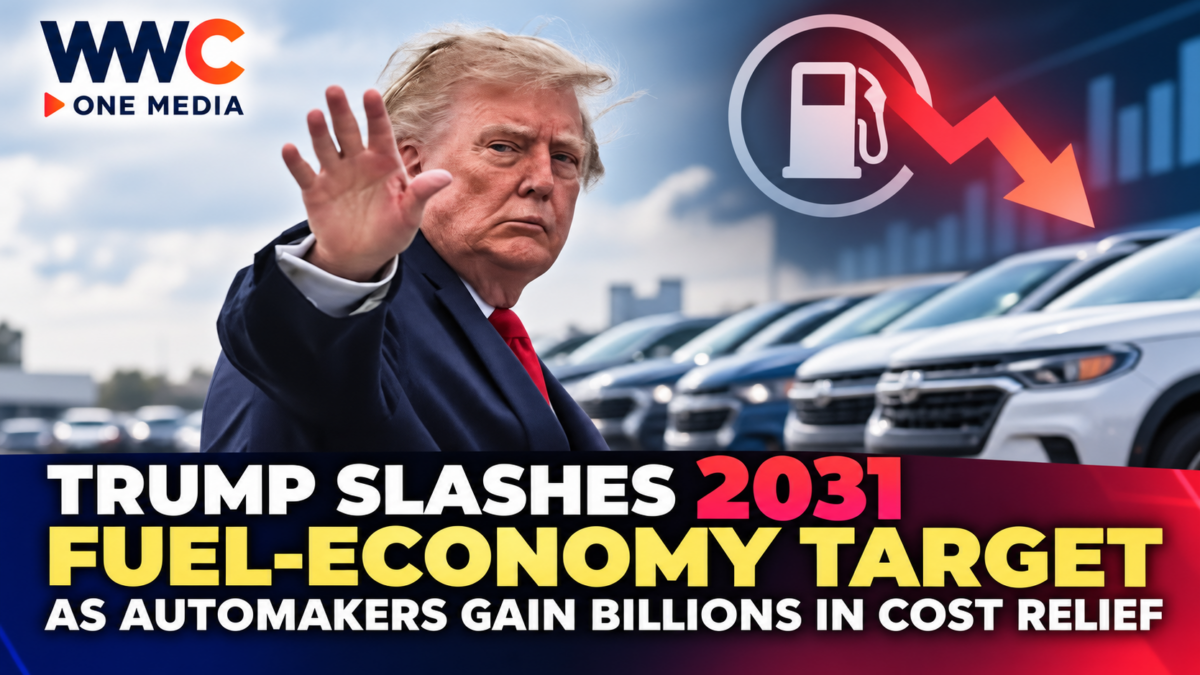
WASHINGTON — The Trump administration has finalized a sweeping rollback of U.S. vehicle fuel-economy rules, cutting the projected 2031 industrywide requirement from roughly 50 miles per gallon to about 35 mpg in a move that could save automakers tens of billions of dollars — while potentially leaving drivers buying significantly more fuel over the life of their vehicles.
The new Corporate Average Fuel Economy, or CAFE, rules dramatically reduce the efficiency improvements automakers would have needed to deliver through 2031.
Under the finalized standard, the industrywide fleet requirement is projected to reach roughly:
34.9 miles per gallon by model year 2031.
The previous Biden-era rule had targeted approximately:
50.4 mpg.
That is one of the largest reversals of U.S. vehicle-efficiency policy in years.
President Donald Trump says the changes will make vehicles less expensive and give Americans more freedom to buy gasoline-powered cars and trucks.
Critics argue the lower standards will simply shift costs from the dealership to the gas pump.
And with fuel prices already under pressure, that trade-off could become increasingly important.
WHAT EXACTLY IS CHANGING?
CAFE standards regulate the average fuel efficiency of vehicles sold by an automaker.
They do not require every individual vehicle to achieve the same mileage.
Instead, manufacturers must ensure that the overall mix of:
Cars
SUVs
Crossovers
Pickups
and other light-duty vehicles
meets federally established efficiency requirements.
Under the new rule, those targets become substantially easier to meet.
That means automakers can sell more lower-efficiency vehicles without facing the same level of compliance pressure.
THE 2031 TARGET FALLS FROM ABOUT 50 MPG TO 34.9 MPG
The contrast is dramatic.
The Biden administration’s 2024 rule envisioned average light-duty fuel economy reaching approximately:
50.4 mpg by 2031.
The Trump administration’s replacement rule projects roughly:
34.9 mpg.
That does not mean every 2031 vehicle will display exactly 34.9 mpg on its window sticker.
CAFE calculations differ from the real-world EPA fuel-economy figures consumers normally see.
But the direction is clear:
automakers will face much less pressure to improve fleet efficiency.
TRUMP SAYS THIS WILL MAKE CARS CHEAPER
The administration’s central argument is affordability.
Modern fuel-economy regulations often require automakers to add technology such as:
Hybrid systems
More efficient engines
Lighter materials
Advanced transmissions
and
Battery-electric vehicles.
Those technologies can reduce fuel consumption.
But they can also increase manufacturing costs.
The Transportation Department argues that weaker standards will allow manufacturers to build vehicles more cheaply and pass at least some of those savings to consumers.
AUTOMAKERS COULD SAVE ABOUT $60.6 BILLION
The scale of the estimated savings is enormous.
Reuters reported that the Transportation Department projects the revised standards could cut automakers’ technology costs by approximately:
$60.6 billion through 2031.
That works out to roughly:
$1,289 per vehicle
in avoided technology costs.
The biggest estimated beneficiary is:
General Motors.
The department projects GM could save approximately:
$20.4 billion.
Other estimates include:
Stellantis — $6.6 billion
Ford — $5.8 billion
Toyota — $4.5 billion
and
Honda — $4.1 billion.
For manufacturers already struggling with expensive EV investments and intense global competition, those are meaningful numbers.
BUT LOWER MANUFACTURING COSTS DO NOT GUARANTEE LOWER STICKER PRICES
This is one of the most important distinctions in the debate.
If an automaker saves $1,289 building a vehicle, that does not necessarily mean the buyer will pay $1,289 less.
Vehicle prices are driven by:
Demand
Dealer inventories
Financing costs
Competition
Product mix
and
Manufacturer pricing strategy.
Automakers could pass some savings to consumers.
They could also preserve some of the benefit as higher margins.
So the administration’s projected cost reduction should not automatically be treated as a guaranteed retail-price cut.
THE GOVERNMENT ALSO PROJECTS MUCH MORE FUEL CONSUMPTION
The same federal analysis supporting the weaker standards also points to substantial long-term costs.
Reuters reported that the Transportation Department expects the new rule to increase U.S. fuel consumption by approximately:
100 billion gallons
through 2050.
Additional consumer fuel spending is projected at roughly:
$185 billion.
That creates the central economic trade-off.
Drivers may pay less for the vehicle upfront.
But they may spend more operating it over many years.
THE CLIMATE IMPACT COULD ALSO BE SIGNIFICANT
Transportation remains one of the largest sources of U.S. greenhouse-gas emissions.
Higher fuel consumption means more carbon dioxide.
The administration’s own analysis projects the revised standards could raise carbon dioxide emissions by approximately:
5% through 2050
relative to the prior regulatory path.
Environmental groups argue that this undermines U.S. climate objectives.
The administration counters that the prior standards pushed technology changes faster than consumers and manufacturers could economically support.
THE NEW RULE IS PART OF TRUMP’S BROADER EV POLICY REVERSAL
Trump has repeatedly criticized policies designed to accelerate electric-vehicle adoption.
He has described previous federal rules as an effective:
“EV mandate.”
Technically, CAFE rules did not require consumers to purchase electric vehicles.
Automakers could meet efficiency standards using combinations of:
Efficient gasoline engines
Hybrids
Plug-in hybrids
and
EVs.
But stricter fleet averages created a strong incentive for automakers to sell more electrified vehicles.
By reducing the efficiency target, the administration is weakening that incentive.
THAT COULD EXTEND THE LIFE OF GASOLINE VEHICLES
The practical consequence is that automakers may have more flexibility to continue producing:
Large SUVs
Pickup trucks
and
Traditional gasoline-powered vehicles.
Those models are particularly important to Detroit manufacturers because they often generate high profit margins.
Companies such as:
GM
Ford
and
Stellantis
have all slowed or adjusted parts of their electric-vehicle strategies as U.S. EV demand developed more gradually than many executives originally expected.
The new CAFE standards reduce the financial pressure to accelerate electrification.
STELLANTIS COULD BE ONE OF THE BIG WINNERS
The timing is particularly important for Stellantis.
The owner of:
Jeep
Ram
Dodge
Chrysler
and several European brands
is already undertaking a massive strategic reset.
The company has said it previously overestimated the speed of the EV transition.
Its new plan emphasizes what CEO Antonio Filosa calls:
“freedom of choice.”
That means offering customers gasoline, hybrid, plug-in hybrid and electric options depending on demand.
The Transportation Department estimates the revised standards could lower Stellantis’ technology costs by about:
$6.6 billion through 2031.
FORD ALSO GETS MORE ROOM TO MANEUVER
Ford has spent billions of dollars developing electric vehicles.
But its EV business has also generated substantial losses.
At the same time, Ford continues earning much of its profit from:
F-Series pickups
SUVs
and
Commercial vehicles.
Less aggressive fuel-economy standards give Ford more flexibility to balance traditional vehicles, hybrids and EVs rather than forcing a faster shift toward battery-electric models.
The government estimates Ford could avoid approximately:
$5.8 billion
in technology costs.
GM COULD SAVE THE MOST
General Motors has invested heavily in EV manufacturing and battery technology.
But GM also remains one of America’s largest sellers of:
Pickup trucks
Full-size SUVs
and
Gasoline vehicles.
The Transportation Department estimates the new rules could reduce GM technology costs by:
$20.4 billion through 2031.
GM has publicly supported rules it says better reflect current consumer demand and technological realities.
But the company is still investing heavily in EVs because it competes globally, not just under U.S. regulations.
THAT GLOBAL COMPETITION CREATES A BIGGER QUESTION
Weakening U.S. efficiency rules may lower costs domestically.
But automakers also have to compete in markets where electrification is moving much faster.
In China, EV and plug-in hybrid adoption continues expanding rapidly.
Chinese manufacturers such as:
BYD
Geely
and others
are developing vehicles at extremely fast speeds.
Europe also continues pushing toward lower-emission vehicles.
That creates a strategic risk for U.S. automakers.
If they reduce clean-vehicle investment too aggressively at home, they could fall behind competitors internationally.
CHINA IS THE LONG-TERM COMPETITIVE ISSUE
The debate is therefore larger than fuel economy.
Chinese automakers increasingly lead in:
Battery costs
Charging speed
EV manufacturing scale
Vehicle software
and
Fast product-development cycles.
Trump’s approach emphasizes reducing regulatory costs for U.S. manufacturers.
Critics argue that weaker standards could reduce the incentive to innovate in technologies likely to dominate future global markets.
Supporters counter that forcing companies into technologies consumers are not yet buying at sufficient scale can weaken U.S. manufacturers financially.
Both issues matter.
THE RULE ALSO ENDS AUTOMAKER CREDIT TRADING
The final policy makes another major change.
NHTSA says it will eliminate the inter-manufacturer CAFE credit trading system starting in model year 2028.
Under the previous structure, companies exceeding efficiency targets could generate credits.
Those credits could sometimes be sold to automakers that missed their standards.
Electric-focused companies could therefore benefit financially from producing highly efficient fleets.
Ending credit trading changes those economics.
It also reduces one of the compliance tools available to traditional automakers.
WHY CREDIT TRADING MATTERED
Suppose one automaker sells mostly efficient vehicles.
Its fleet exceeds the regulatory requirement.
Another automaker sells mostly large trucks and SUVs and falls short.
The second company could potentially buy compliance credits from the first.
This created a market-based mechanism for meeting federal standards.
The new rule begins shutting that system down in 2028.
That means each manufacturer will increasingly have to comply based on its own fleet rather than buying its way toward compliance from competitors.
STATES ARE NOW SUING THE ADMINISTRATION
The legal fight has already begun.
On October 2, a coalition of more than two dozen:
States
Cities
and
Counties
filed lawsuits challenging the new standards.
The group includes jurisdictions such as:
California
New York
Michigan
and
Washington.
They argue NHTSA did not meet its legal obligation to establish fuel-economy requirements at the:
“maximum feasible level.”
The administration disputes that interpretation and says the revised rules properly balance affordability, technology and statutory requirements.
The litigation could eventually determine whether the standards survive intact.
THE STATES SAY CONSUMERS COULD LOSE BILLIONS IN FUEL SAVINGS
Opponents of the rollback argue that consumers should look beyond the purchase price.
Their reasoning is straightforward.
A vehicle with higher fuel efficiency may cost more initially.
But if it consumes substantially less gasoline over:
10
12
or
15 years,
the owner can save money over the full life of the vehicle.
The state coalition challenging the standards argues that weaker rules could eliminate roughly:
$220 billion in consumer fuel savings.
That figure differs from the administration’s cost framing because the sides use different assumptions and emphasize different parts of the vehicle-ownership equation.
HIGH FUEL PRICES MAKE THE TIMING MORE COMPLICATED
The rollback is arriving during a period of elevated fuel prices.
Global energy markets have been disrupted by:
Middle East conflict
Diesel shortages
Russian supply restrictions
and
Shipping disruptions.
In late September, oil prices remained elevated, and diesel prices had become a major concern in both the U.S. and Europe.
That makes fuel economy more economically important for drivers.
A policy that lowers vehicle purchase costs could become less attractive if consumers simultaneously face higher fuel bills.
FUEL ECONOMY IS REALLY A TOTAL-COST-OF-OWNERSHIP QUESTION
For consumers, the smartest way to evaluate the rule is not simply:
“Will the car cost less?”
The better question is:
“What will the car cost me over its entire life?”
That includes:
Purchase price
Financing
Insurance
Maintenance
Fuel
and
Resale value.
A cheaper but less efficient vehicle may still cost more overall if fuel prices stay elevated.
Conversely, an expensive efficiency technology may take too long to repay itself for some drivers.
Different consumers can reasonably reach different conclusions depending on how much they drive.
PEOPLE WHO DRIVE MORE FEEL THE DIFFERENCE MORE
Consider two drivers.
One travels:
5,000 miles a year.
Another drives:
20,000 miles.
The second driver has four times as much exposure to fuel costs.
That means efficiency improvements matter much more to:
Long-distance commuters
Rural drivers
Delivery workers
and
High-mileage households.
The purchase-price savings from weaker standards are largely the same regardless of mileage.
The fuel penalty is not.
PICKUP AND SUV BUYERS COULD SEE THE BIGGEST EFFECT
Large pickups and SUVs consume significantly more fuel than smaller passenger vehicles.
They are also highly profitable products for Detroit automakers.
Weaker CAFE standards make it easier for companies to continue selling large numbers of those vehicles.
For consumers who genuinely need:
Towing
Cargo space
or
Off-road capability,
that can preserve choice.
But buyers also carry greater exposure to fuel-price swings.
A modest change in gasoline prices can add hundreds of dollars per year to the operating cost of a large truck.
HYBRIDS COULD STILL BE THE MIDDLE GROUND
The new rules may reduce regulatory pressure for electrification.
But market demand for hybrids remains strong.
Hybrid vehicles offer:
Higher fuel economy
without requiring drivers to depend entirely on charging infrastructure.
Automakers including:
Toyota
Honda
Ford
and increasingly
GM and Stellantis
are expanding hybrid options.
That suggests consumer economics—not just regulation—may continue pushing the market toward higher efficiency even under weaker federal standards.
AUTOMAKERS DO NOT DESIGN CARS FOR ONE REGULATION
Another reason the impact may be less dramatic than the headline suggests is product planning.
Automakers operate globally.
A platform developed for:
Europe
China
Japan
and
North America
may need to satisfy multiple emissions and efficiency regimes.
Companies also spend billions of dollars years before a vehicle reaches showrooms.
That means an immediate regulatory change does not instantly change every vehicle program.
Many EV and hybrid investments will continue because they were already committed or remain strategically necessary.
THE BIGGER STORY: CHEAPER TO BUILD DOES NOT ALWAYS MEAN CHEAPER TO OWN
The Trump administration has given automakers something they have repeatedly asked for:
more flexibility.
The projected 2031 fuel-economy target falls from roughly:
50.4 mpg
to about:
34.9 mpg.
Automakers could avoid an estimated:
$60.6 billion
in technology spending.
That could make some vehicles cheaper to manufacture.
But federal modeling also suggests Americans could consume around:
100 billion additional gallons of fuel
and spend approximately:
$185 billion more at the pump
through 2050.
So the argument is not simply about EVs versus gasoline cars.
It is about when consumers pay.
The administration is betting that reducing the upfront cost of vehicles matters more.
Opponents argue drivers will eventually pay much of that money back through additional fuel use.
And now courts will have a say in whether the rule survives.
The new CAFE standards may make tomorrow’s cars cheaper to build — but the real question is whether American drivers will ultimately save money, or simply move the bill from the dealership to the gas pump.