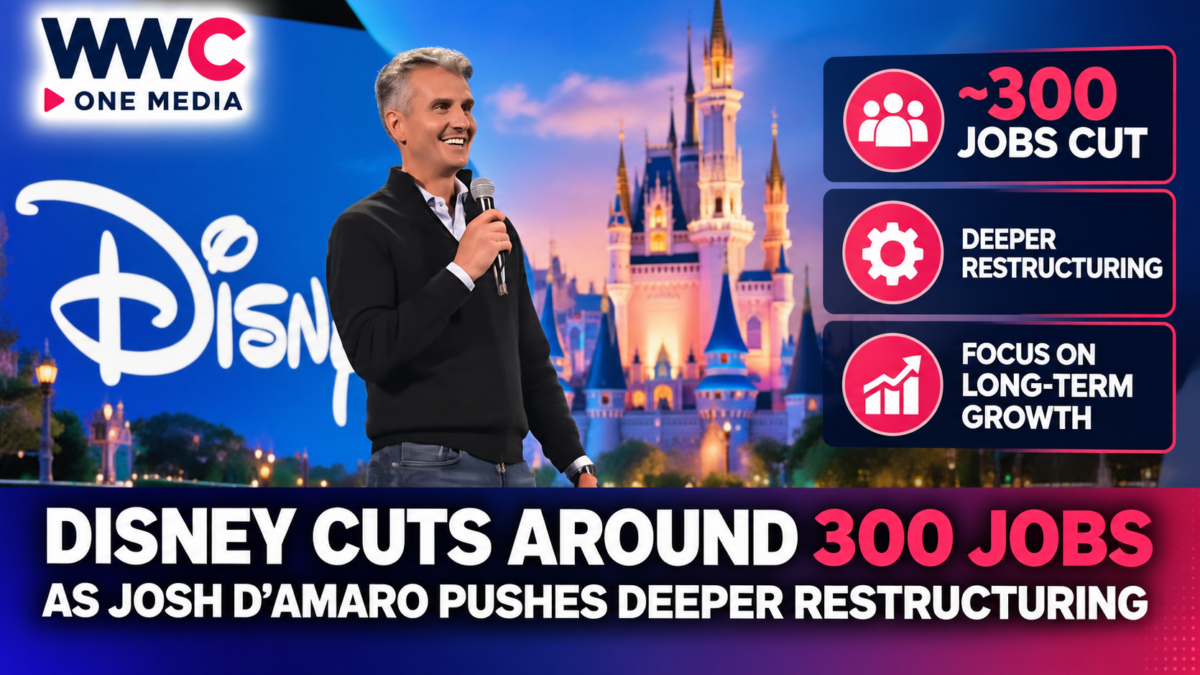
BURBANK — Disney is cutting roughly 300 jobs in another round of layoffs under new CEO Josh D’Amaro, targeting mainly human-resources and technology roles as the entertainment giant continues stripping costs from its corporate structure while redirecting investment toward streaming, artificial intelligence and digital growth.
The September 29 reductions represent the latest wave of job cuts since D’Amaro took control of The Walt Disney Company in March.
This round is smaller than earlier reductions in 2026.
But it carries a broader message.
Disney is still restructuring.
And management has already warned that the cost-cutting process is not finished.
AROUND 300 EMPLOYEES ARE BEING CUT
CNBC reported that approximately:
300 positions
are being eliminated.
The majority are concentrated in:
Human resources
and
Technology.
Reuters separately described the total as several hundred employees, citing a person familiar with the matter.
The reductions affect corporate functions as well as staff embedded within different Disney business units.
Disney Entertainment Television and the motion-picture studio were largely spared from this particular round.
That distinction matters because Disney’s television business is separately preparing for a much broader restructuring.
THIS IS THE THIRD MAJOR ROUND UNDER D’AMARO
Josh D’Amaro officially became Disney CEO on:
March 18, 2026.
He succeeded longtime CEO Bob Iger.
Within weeks, Disney began cutting jobs.
In April, the company eliminated about:
1,000 positions.
Those cuts were connected largely to a new centralized marketing organization and affected areas including:
Marketing
Studios
Television
ESPN
and
Product and technology.
Further reductions followed in July across corporate functions and entertainment operations.
Pixar and National Geographic were among the businesses affected.
The September cuts now add another several hundred positions to that total.
DISNEY HAD ALREADY WARNED MORE CUTS WERE COMING
The latest layoffs should not come as a surprise to investors.
In Disney’s August earnings communication, D’Amaro and Chief Financial Officer Hugh Johnston said the company remained focused on lowering costs across the enterprise.
Management said it was looking at multiple ways to reduce:
Labor costs
and
Selling, general and administrative expenses.
Disney described itself as being:
“mid-stream”
in the process.
In other words, management had already made clear that restructuring was continuing.
THE COMPANY IS TRYING TO CREATE MONEY FOR GROWTH
The strategy is not simply about cutting expenses.
Disney says the goal is to free money that can be reinvested into businesses management believes will drive future growth.
Those areas increasingly include:
Streaming
Technology
Artificial intelligence
Games
Parks and experiences
and
Franchise development.
This is one of the central themes of D’Amaro’s early tenure.
He wants a leaner corporate structure but a more aggressive investment strategy in consumer-facing businesses.
D’AMARO WANTS “ONE DISNEY”
When D’Amaro became CEO, one of his first major themes was greater integration across the company.
He told shareholders Disney needed to act more like:
“one Disney.”
The idea is to reduce the walls separating:
Movies
Television
Streaming
Games
Theme parks
and
Consumer products.
The company increasingly wants a successful franchise to move across all of those businesses.
A movie can generate a streaming series.
A series can become merchandise.
A character can appear in games.
And successful intellectual property can eventually become a theme-park attraction.
Reducing duplicate corporate functions is part of that broader strategy.
HUMAN RESOURCES AND TECH ARE NOW TAKING THE HIT
This round focuses heavily on HR and technology.
That may initially seem surprising because Disney is simultaneously investing aggressively in technology.
But technology restructurings do not necessarily mean technology spending is falling.
They can mean the opposite.
Companies often eliminate overlapping legacy roles while hiring or reorganizing around newer skills.
Disney recently created a companywide Chief Technology Officer position and named Karandeep Anand to the role.
That appointment signals how important technology has become to D’Amaro’s strategy.
The company is trying to centralize technology leadership while reducing fragmentation elsewhere.
AI IS BECOMING PART OF THE RESTRUCTURING STORY
Artificial intelligence is increasingly part of Disney’s transformation.
D’Amaro has repeatedly emphasized combining:
Human creativity
with
New technology.
Disney is exploring AI across areas ranging from internal productivity to entertainment technology and consumer experiences.
AI can automate parts of:
Administrative work
Data analysis
Technology support
Marketing
and
Content workflows.
That does not mean every current Disney layoff is directly caused by AI.
But automation is becoming one of the factors shaping how large media companies decide how many employees they need and which skills they want to retain.
THE TV BUSINESS COULD FACE A MUCH BIGGER RESTRUCTURING
The September layoffs are not the same as Disney’s developing television overhaul.
Reports this week indicate Disney is preparing a major restructuring of its television business under Debra OConnell, chairman of Disney Entertainment Television.
That business includes operations connected to:
ABC Entertainment
20th Television
Hulu Originals
Freeform
and other legacy television units.
The objective appears to be reducing organizational duplication and making television operations more aligned with streaming.
That restructuring could result in additional layoffs.
But the final structure had not yet been announced at the time of the September 29 cuts.
DISNEY’S TV MODEL IS CHANGING BECAUSE CABLE IS SHRINKING
The economic problem behind the restructuring is much bigger than Disney.
Traditional television has been declining for years.
Millions of U.S. households have canceled cable subscriptions.
Advertising dollars have moved toward:
Streaming
Social media
Connected TV
and
Digital platforms.
For decades, cable networks were extraordinarily profitable because distributors paid large monthly fees to carry them.
That business model is weakening.
Disney therefore needs to redesign television operations around a world where streaming becomes the primary destination rather than an extra distribution channel.
DISNEY+ IS BECOMING MORE CENTRAL
D’Amaro wants Disney’s direct-to-consumer operations to become even more important.
Disney+ now sits at the center of the company’s entertainment strategy.
The company is increasingly integrating:
Hulu
ESPN
and
Disney+
into a more connected digital ecosystem.
The strategy is partly designed to reduce friction for consumers.
Rather than moving between completely separate platforms, Disney wants users to access more of the company’s content through connected digital products.
That requires significant technology investment.
It also makes some older corporate structures less necessary.
ESPN IS GOING THROUGH ITS OWN TRANSFORMATION
ESPN is another major piece of Disney’s future.
Traditional cable sports distribution is under pressure.
Disney is pushing ESPN deeper into direct-to-consumer streaming.
Sports rights remain extremely expensive.
But live sports also remain one of the strongest forms of entertainment for attracting large audiences in real time.
That gives ESPN strategic value far beyond a traditional cable network.
D’Amaro’s challenge is balancing:
Sports-rights spending
Streaming investment
and
Profitability.
DISNEY IS STILL A HUGE EMPLOYER
The latest job cuts need perspective.
Disney employed approximately:
231,000 people
at the end of fiscal 2025.
Around:
172,000
were based in the United States.
About:
59,000
worked outside the U.S.
That means the latest 300-person reduction represents only a small percentage of the overall workforce.
But corporate layoffs can have an outsized effect because they frequently affect central functions used by many divisions.
And repeated rounds create uncertainty even when the individual totals are relatively limited.
THE PARKS WORKFORCE REMAINS ENORMOUS
Much of Disney’s total headcount comes from its Experiences business.
Before becoming CEO, D’Amaro ran Disney Experiences, which included approximately:
185,000 cast members and employees worldwide
and generated about:
$36 billion in fiscal 2025 revenue.
That segment includes:
Theme parks
Cruise ships
Hotels
Consumer products
and
Imagineering.
The business became one of Disney’s strongest profit engines during D’Amaro’s tenure.
That experience helps explain his current management style.
He has a reputation for focusing heavily on:
Operations
Efficiency
and
Consumer experience.
BOB IGER HAD ALREADY CUT 7,000 JOBS
Disney’s current downsizing began before D’Amaro.
Under former CEO Bob Iger, Disney announced plans in 2023 to cut:
7,000 jobs
as part of a broader effort to reduce annual costs by approximately:
$5.5 billion.
Those reductions came after years of aggressive streaming investment and the expensive acquisition of much of 21st Century Fox.
The company eventually improved profitability.
But the underlying pressures did not disappear.
Streaming competition remained intense.
Cable continued declining.
And the company still carried organizational complexity created by decades of acquisitions.
D’Amaro inherited that structure.
THE 21ST CENTURY FOX DEAL MADE DISNEY MUCH BIGGER
Disney’s 2019 purchase of major 21st Century Fox entertainment assets significantly expanded the company.
The deal brought businesses including:
FX
National Geographic
20th Century Studios
and major television production assets.
But acquisitions also create overlapping functions.
Multiple teams may perform similar work in:
Technology
Marketing
Finance
HR
and
Distribution.
Years later, Disney is still simplifying parts of the organization built from those combinations.
PIXAR HAS ALREADY BEEN AFFECTED
Pixar was among the businesses hit by previous rounds of cuts.
The animation studio remains one of Disney’s most important creative brands.
But animated films are expensive and can take years to produce.
Disney has been reassessing how much content its studios release after an era when streaming encouraged companies to dramatically increase production.
The broader entertainment industry has since shifted.
Studios increasingly want:
Fewer projects
but
Stronger franchises
and
Higher financial returns per title.
That strategy can reduce staffing needs.
THE STREAMING BOOM CREATED TOO MUCH CONTENT
During the early streaming wars, entertainment companies raced to launch new services.
They produced enormous amounts of original programming to attract subscribers.
Disney was no exception.
That created high spending across:
Disney+
Hulu
Marvel
Star Wars
National Geographic
and other brands.
Eventually investors demanded profitability.
Media companies responded by cutting:
Content budgets
Staff
and
Less successful projects.
Disney’s restructuring is part of that industrywide correction.
DISNEY IS STILL SPENDING HEAVILY WHERE IT SEES GROWTH
Cost cutting does not mean Disney has entered retreat mode.
The company is investing billions of dollars in:
New cruise ships
Theme-park attractions
International parks
Games
Streaming
and
Technology.
D’Amaro led the largest expansion program in Disney Experiences history before becoming CEO.
Management’s argument is therefore straightforward:
cut administrative costs in areas that do not drive growth,
then move the savings toward businesses that do.
GAMES ARE BECOMING A BIGGER PART OF DISNEY
Disney is also pushing more aggressively into gaming.
Under its reorganized Disney Entertainment structure, games and digital entertainment have been brought more closely together with:
Film
Television
and
Streaming.
This reflects the growing importance of interactive entertainment.
Younger consumers may spend more time with characters inside:
Video games
and
Online worlds
than watching traditional television.
Disney wants its franchises to follow audiences into those platforms.
That requires different talent than the traditional television business.
NEW TECH LEADERSHIP SHOWS WHERE DISNEY IS GOING
Disney’s September appointment of a companywide CTO is another important sign.
Karandeep Anand will oversee enterprise technology strategy.
Large entertainment companies increasingly depend on technology for:
Streaming platforms
Advertising systems
Personalization
Consumer data
Theme-park applications
Ticketing
and
Artificial intelligence.
That makes centralized technology leadership more strategically important.
Disney appears to be reducing some existing roles while simultaneously concentrating authority around a more unified technology strategy.
COST CUTTING AND TECHNOLOGY INVESTMENT CAN HAPPEN AT THE SAME TIME
This point is easy to miss.
A company can cut jobs in technology while still increasing technology investment.
Management may decide that:
Old systems
Duplicated teams
or
Manual workflows
are no longer necessary.
The money saved can then be redirected toward:
AI engineers
Cloud infrastructure
Cybersecurity
and
Consumer-facing software.
That is increasingly common across large corporations.
So the latest layoffs should not automatically be interpreted as Disney pulling back from technology.
They may instead reflect a shift in what types of technology work the company values.
WORKERS FACE THE OTHER SIDE OF “EFFICIENCY”
For employees, corporate efficiency has a much more personal meaning.
Disney has conducted repeated rounds of reductions in only a few months.
Even workers whose jobs remain can face uncertainty.
Layoffs can affect:
Morale
Workload
Institutional knowledge
and
Employee loyalty.
Companies therefore face a balance.
Cut too little, and costs remain excessive.
Cut too deeply, and the organization may lose people needed to execute the strategy the layoffs were supposed to fund.
EARLY-RETIREMENT PACKAGES WERE ANOTHER TOOL
Disney also offered voluntary early-retirement packages to certain longtime executives during the summer.
These programs can reduce headcount with fewer involuntary layoffs.
They also allow companies to remove expensive senior positions.
But there is a trade-off.
Long-serving employees often carry extensive knowledge of:
Internal systems
Creative relationships
Corporate history
and
Operating processes.
Replacing that experience is not always easy.
THE U.S. LABOR MARKET IS COOLING TOO
Disney’s reductions are occurring as the broader U.S. labor market shows signs of cooling.
September employment growth came in weaker than economists expected, although Reuters reported there was still no evidence of widespread mass layoffs across the overall economy.
Information and professional-services employment were among the softer areas.
That matters for media and technology workers.
Even relatively small corporate layoffs become more painful when comparable job openings are harder to find.
HOLLYWOOD HAS BEEN CUTTING JOBS FOR YEARS
Disney is far from alone.
Media companies have been cutting costs across:
Television
Streaming
Film
and
Publishing.
The underlying reasons are remarkably similar:
Cable decline
Streaming economics
AI and automation
Advertising pressure
and
Industry consolidation.
Hollywood is effectively trying to rebuild its business model while operating it at the same time.
That means restructuring is becoming a permanent feature rather than a one-time event.
D’AMARO IS STILL EARLY IN HIS TENURE
Josh D’Amaro has only been CEO since March.
That makes the speed of the changes notable.
In his first several months, Disney has:
Centralized leadership
Cut jobs
Reshaped marketing
Reorganized entertainment businesses
Created a companywide technology role
and
Increased emphasis on streaming and AI.
His tenure is still too young to judge on long-term financial results.
But the direction is increasingly clear.
D’Amaro wants a company with fewer internal barriers and more centralized technology and consumer strategy.
THE BIGGER STORY: DISNEY IS NOT JUST CUTTING JOBS — IT IS REDESIGNING WHAT THE COMPANY IS
The headline number is roughly:
300 layoffs.
But that is only one piece of the story.
Disney has spent years transforming from a company built around:
Movie theaters
Cable networks
and
Theme parks
into a company increasingly dependent on:
Streaming
Technology
Direct customer relationships
Data
and
Global franchises.
Josh D’Amaro inherited that transformation.
Now he is accelerating it.
Some traditional corporate roles are disappearing.
New technology leadership is being created.
TV operations are being reorganized.
And Disney is moving money toward the parts of the company it believes will define the next decade.
For investors, the equation is straightforward:
cut enough costs to improve profitability without weakening Disney’s creative engine.
For employees, the stakes are much more immediate.
And that leaves the question hanging over the company’s latest restructuring:
How many more jobs will Disney decide it no longer needs before Josh D’Amaro believes the company is finally lean enough for its next era?