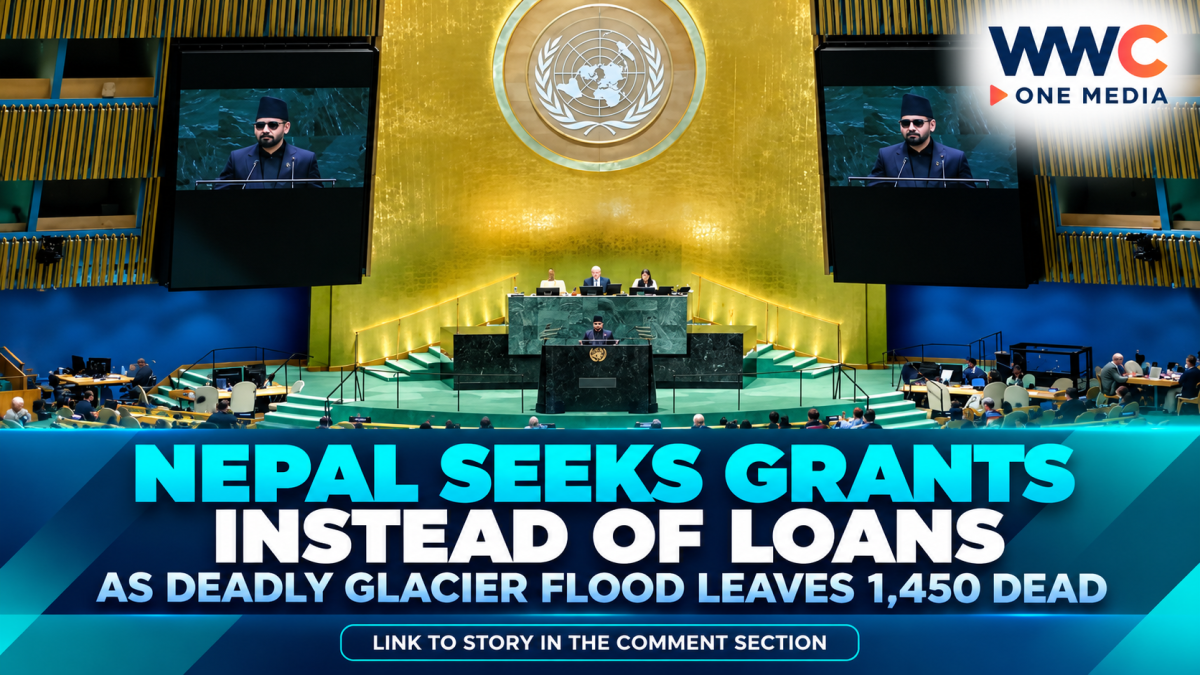
Nepal is asking the international community for grant-based assistance rather than additional loans as it begins the enormous task of rebuilding after a devastating glacier-related flood that killed at least 1,450 people and left more than 6,000 others missing.
Prime Minister Balendra Shah made the appeal during his address to the United Nations General Assembly in New York on Sept. 24, saying Nepal’s recovery and reconstruction needs could reach about 10 percent of the country’s gross domestic product. He argued that climate-vulnerable countries should not have to take on more debt after catastrophic disasters.
The disaster struck mountain communities in late August after the collapse of a glacier near the Nepal-China border triggered landslides and a powerful flash flood that swept through downstream valleys. Roads, bridges, homes, schools and livelihoods were destroyed, while search-and-recovery operations have continued weeks after the disaster.
Shah called for adequate grant-based international support rather than relying primarily on large loans or fragmented smaller grants. Nepal’s government has previously estimated that reconstruction could require several billion dollars, with an initial damage assessment already putting losses at more than 400 billion Nepalese rupees.
The request comes as Nepal faces difficult choices over how to finance reconstruction. Officials have said grants and aid are preferable, but the scale of the damage means loans or other forms of financing may still be necessary to close the funding gap. A detailed Post-Disaster Needs Assessment is expected to provide a clearer estimate of the country’s total recovery requirements.
Shah also called for closer cooperation among Nepal, India and China on Himalayan climate resilience. His proposal includes sharing satellite information, improving monitoring of glacial lakes, strengthening early-warning systems and coordinating disaster responses across borders.
The appeal places climate finance at the center of Nepal’s recovery strategy. The government has argued that countries vulnerable to climate-related disasters should have access to financial assistance that does not further increase their debt burden.
International assistance is already beginning to flow. The World Bank has made up to US$170 million in emergency financing available to help Nepal respond to the disaster and begin its recovery efforts.
The disaster has also intensified discussion about whether existing international climate-finance mechanisms can deliver assistance quickly enough after catastrophic events. Analysts have pointed to the need for faster access to grants for countries facing sudden, large-scale climate disasters.
For Nepal, however, immediate priorities remain rescuing survivors, accounting for missing people and restoring basic infrastructure while authorities determine the full scale of the destruction.
The next stage will depend on how much grant funding Nepal can secure—and whether international support can match the enormous reconstruction needs left behind by one of the country’s deadliest recent natural disasters.