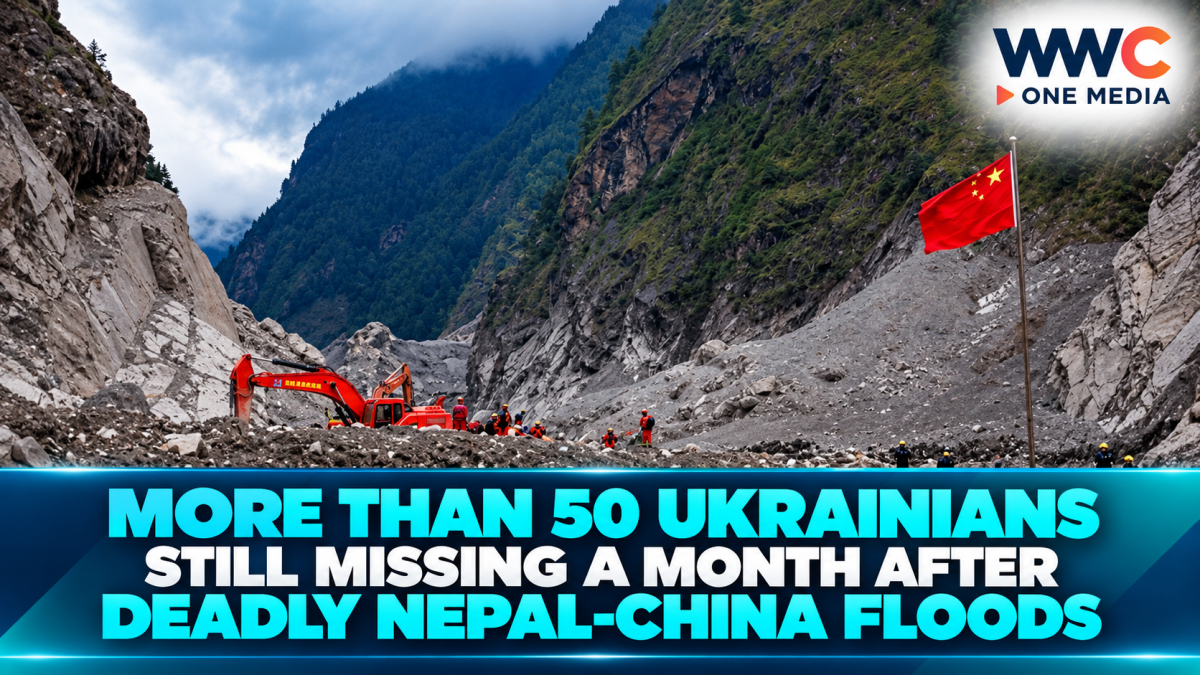
Families of more than 50 Ukrainians remain without answers a month after catastrophic flooding along the Nepal-China border left thousands dead or missing, with relatives still struggling to determine what happened to loved ones caught in the disaster.
Among those missing is 36-year-old Olena Kalynychenko, who was part of a 56-member spiritual retreat group that had traveled to Mount Kailash in Tibet. Her last known location was recorded as she exited China at a border post just 15 minutes before the devastating flood struck.
The group was traveling toward Nepal on Aug. 26 when a Himalayan mountain slope collapse sent a massive torrent of water, ice, mud and debris through communities and infrastructure along the border. The disaster destroyed the Gyirong border crossing and severely damaged roads, bridges and other facilities, making it difficult for authorities to trace people who were traveling through the area.
Nepal has reported that 636 foreign nationals remain missing, including 54 Ukrainians. China has separately reported 261 foreign nationals missing on its side of the disaster zone, including one Ukrainian. More broadly, the floods have left more than 6,000 people unaccounted for while the confirmed death toll has climbed above 1,400.
For the Ukrainian families, the uncertainty has been particularly difficult because many have received little information beyond official lists of those missing, recovered or confirmed dead.
Some families have also encountered a complicated gap between the two countries’ records. Chinese authorities have told at least two families that their relatives had already left Chinese territory before the flood, but Nepal’s immigration facilities and records near the border were destroyed, leaving families unable to confirm whether their relatives actually entered Nepal.
The recovery operation has become an enormous identification effort. Nepal says 1,451 bodies have been recovered, but only 112 had been handed over to families at the time of the latest report. Authorities have collected DNA samples from 2,035 relatives, although officials have not disclosed how many victims have been formally identified.
The scale of destruction is making the search especially difficult. In the devastated town of Betrawati, entire neighborhoods were swept away, leaving survivors searching through thick layers of mud and debris for traces of homes and missing relatives. Rescue teams have also been working around damaged hydropower facilities and buried tunnels in the Himalayan region.
For some families, the last messages from their loved ones came only minutes before the disaster. The retreat group had been preparing to travel home when communications stopped, leaving relatives thousands of kilometers away waiting for confirmation of whether anyone survived.
The disaster has also raised questions about coordination between authorities on both sides of the border, particularly when victims were traveling through areas where immigration records, roads and communications infrastructure were destroyed.
As recovery operations continue, families face a painful wait for DNA identification, recovered remains or credible information about survivors.
A month after the flood, the search for the missing is far from over — and for dozens of Ukrainian families, the hardest question remains unanswered: what happened to their loved ones after they disappeared along the Nepal-China border.