
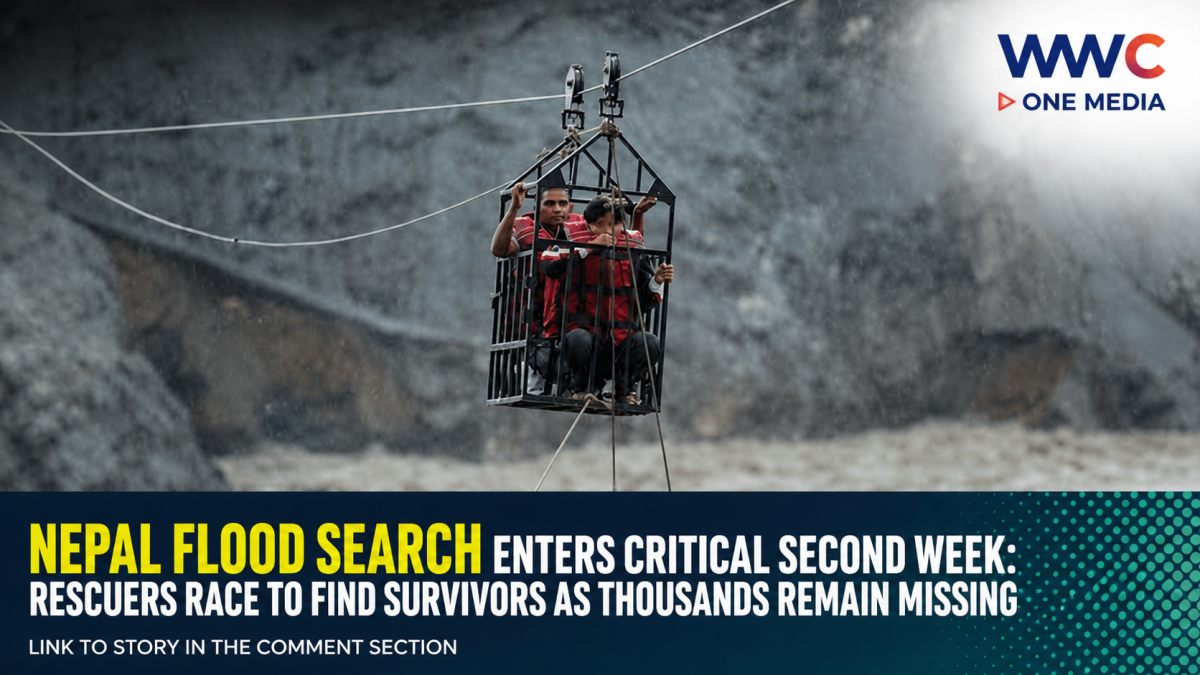
One week after a catastrophic flash flood tore through Nepal’s Himalayan border region, rescue teams are still pushing into collapsed hydropower tunnels, damaged communities and debris-choked river corridors in a desperate search for survivors.
The disaster struck on August 26 after a massive surge of ice, rock, mud and water swept through parts of Nepal and neighboring Tibet. Experts have suspected a glacier collapse or ice-rock avalanche as the trigger.
As search operations entered their second week, the scale of the destruction remained staggering. Reuters reported that at least 1,114 people had died in Nepal and 2,916 were still listed as missing, while China reported 16 deaths and 546 missing in Tibet.
However, Nepalese authorities have reported different totals depending on the latest reporting cutoff and how missing cases are counted. The Kathmandu Post reported 1,127 deaths and 4,858 missing people on September 2, highlighting the continuing difficulty of establishing a definitive toll across the devastated region.
THE SEARCH HAS SHIFTED UNDERGROUND
Some of the most urgent operations are now focused on hydropower projects, where hundreds of workers remain unaccounted for.
Reuters reported that 639 people were still believed to be trapped or missing at affected hydropower sites, with 279 people already rescued. Other assessments have placed the number of missing hydropower workers considerably higher, reflecting the continuing effort to reconcile worker lists from multiple projects.
At Rasuwagadhi Hydropower Project, rescuers have managed to advance roughly 150 metres into a tunnel before being stopped by massive rocks blocking the route.
At Langtang Hydropower, another team has also reached approximately 150 metres underground. Operations are continuing at several other projects, including Trishuli 3A and Trishuli 3B.
The conditions underground remain extremely dangerous. Rescuers are dealing with collapsed sections, mud, floodwater and unstable rock while heavy machinery is being used to clear access routes.
HOPE REMAINS FOR TRAPPED WORKERS
Officials have warned that the chances of finding survivors elsewhere are declining as more time passes. But some hydropower tunnels contain enclosed chambers where workers may have access to air, food or water.
Nepal Electricity Authority board member Amshu Kiran Shahi said rescuers remain confident that people could still be alive in some of these areas. At Trishuli-3A, teams have also been working to clear debris and pump water while attempting to reach a potentially dry chamber.
The situation has turned the tunnels into one of the biggest remaining hopes for rescuers searching for people who disappeared during the disaster.
INTERNATIONAL RESCUE TEAMS JOIN THE FIGHT
Nepal’s rescue effort has also become an international operation.
India and China have sent specialist personnel, while South Korea deployed a 44-member disaster relief team. Singapore has sent a victim-identification team and DNA-testing equipment, while additional international technical assistance is being provided.
More than 9,200 Nepalese Army personnel have been deployed across affected areas, working alongside police, local authorities and foreign rescue specialists. Helicopters, excavators, heavy machinery and other equipment are being used to reach isolated communities and clear roads.
CHINA REOPENS ACCESS TO THE DISASTER ZONE
Across the border in Tibet, China has also intensified operations around the Gyirong border area.
The only road leading to the severely damaged border crossing was washed away, forcing rescue teams to initially rely on airdrops and difficult mountain routes. China has since restored road access, allowing heavy machinery, rescue dogs and life-detection equipment to reach the area.
THE DISASTER HAS LEFT A MASSIVE REBUILDING BILL
The human tragedy is being accompanied by enormous infrastructure damage.
The United Nations Development Programme estimates that about 2.2 million tons of debris were generated by the disaster. Eight existing hydropower projects and four projects under construction were damaged, affecting a significant portion of Nepal’s electricity generation capacity.
Nearly 50 suspension bridges and 31 motorable bridges were also damaged or destroyed, while Nepal’s finance minister has estimated reconstruction could require between US$4 billion and US$5 billion.
THE CLOCK IS STILL TICKING
For families waiting for missing relatives, the second week has brought a painful mix of fading expectations and renewed hope.
Rescuers are still entering tunnels, clearing roads, searching river systems and examining areas buried under enormous quantities of mud and rock. But every additional day makes the search more difficult.
The immediate question is no longer simply how many people died in Nepal’s worst recent disaster. It is whether rescuers can reach those who may still be alive before the remaining pockets of hope disappear beneath the rubble.
WWC ONE MEDIA J.M.D



Leave a Reply