
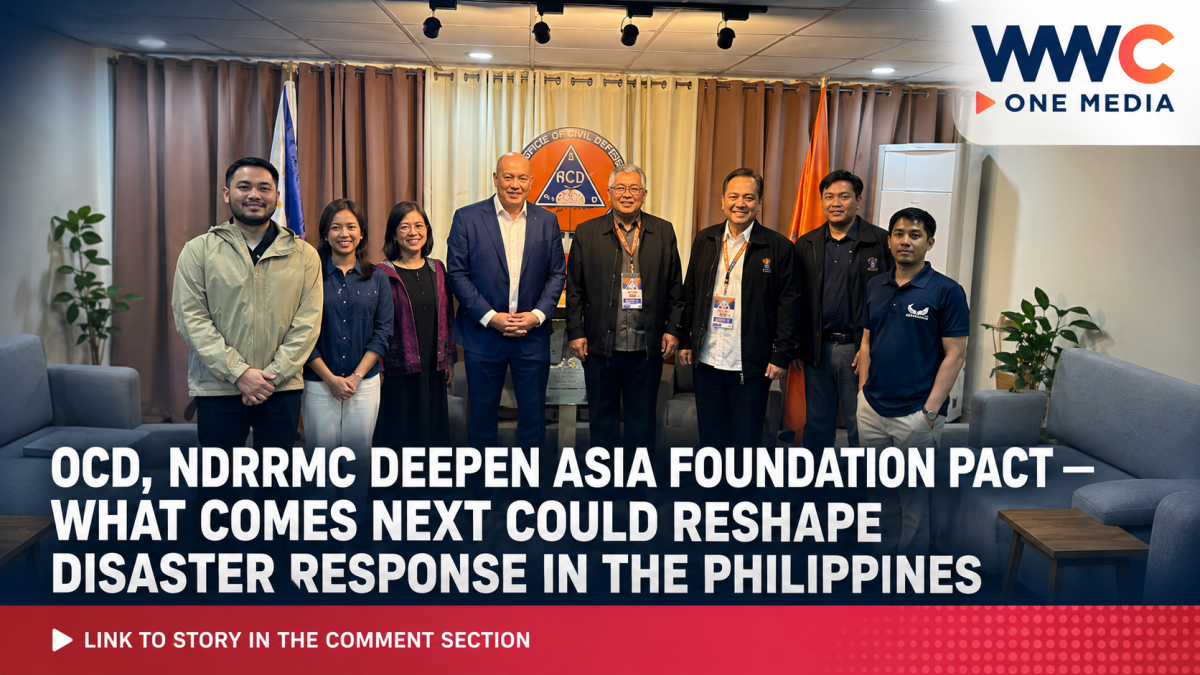
MANILA, Philippines — The Office of Civil Defense (OCD) and the National Disaster Risk Reduction and Management Council (NDRRMC) are moving to deepen their partnership with The Asia Foundation as the Philippines tries to shift disaster policy beyond emergency response and toward stronger preparedness, resilient infrastructure and long-term risk reduction.
The renewed cooperation comes at a critical moment for a country repeatedly exposed to typhoons, floods, earthquakes and other hazards — and as the government faces growing pressure to make disaster preparedness work before communities are forced into another large-scale evacuation.
Manila Standard reported that OCD Administrator Undersecretary Harold Cabreros met with The Asia Foundation’s Philippines country representative Samuel “Sam” Chittick as both sides explored stronger cooperation on disaster risk reduction and management reforms.
The engagement is not simply a ceremonial renewal of ties. OCD has said the partnership is intended to advance disaster resilience policies and initiatives, with discussions also touching on possible support for the agency’s Strategic Infrastructure Development and Management, or SIDaM, Plan.
Why the partnership matters now
The Philippine government has increasingly emphasized that its disaster strategy must move away from waiting for calamities to happen.
In his July 2026 State of the Nation Address, President Ferdinand Marcos Jr. said the government had shifted from a largely reactive model toward a “proactive” and “predictive” approach, supported by digital tools, pre-positioned supplies and a nationwide disaster-response logistics network.
According to GMA News, that network includes disaster resource centers, regional hubs, dozens of spokes and hundreds of last-mile facilities designed to speed the movement of emergency supplies. Marcos said the system was intended to make relief delivery to affected communities possible within 24 hours.
But infrastructure and logistics are only part of the challenge.
One of the most visible tests of the government’s disaster resilience push is the rollout of Ligtas Pinoy Centers, permanent evacuation facilities mandated under Republic Act No. 12076.
The law was signed in December 2024 to establish disaster-resilient and strategically located evacuation facilities in cities and municipalities, reducing dependence on schools, covered courts and other temporary shelters during emergencies.
President Marcos said in July that construction of new Ligtas Pinoy Centers would begin in disaster-prone areas including Bicol, Eastern Samar, Bukidnon and Davao de Oro. The planned structures are being designed for severe hazards, including extreme typhoon winds and major earthquakes.
Choosing where evacuation centers go is becoming a major test
The next challenge is deciding which communities receive the facilities first.
The Philippine Information Agency reported in July that OCD had begun rolling out a standardized prioritization framework for Ligtas Pinoy Centers in Western Visayas. Under the law, the NDRRMC must prepare a prioritized list of local government units, which will then serve as the basis for the Department of Public Works and Highways’ planning and budgeting.
The criteria are intended to ensure that high-risk communities and LGUs capable of supporting the projects are properly identified rather than allowing sites to be selected arbitrarily.
Malacañang later said the site-selection process was already underway. On August 10, 2026, according to the Presidential Communications Office, DPWH formally asked OCD for the prioritized list of sites for future projects. For the proposed 2027 budget, the administration said the allocation envisioned two Ligtas Pinoy Centers per region at ₱90 million per center, subject to the legally prescribed prioritization process.
That makes stronger policy coordination especially important: disaster resilience now depends not only on constructing buildings, but on using risk data, transparent prioritization and long-term planning to put limited resources where they can protect the most people.
The Asia Foundation has worked on Philippine disaster reforms before
The latest engagement also builds on years of cooperation rather than starting from zero.
The Asia Foundation’s Coalitions for Change, a partnership with the Australian government, has previously worked on disaster risk reduction reforms in the Philippines.
In 2017, the NDRRMC approved revised rules governing the National Disaster Risk Reduction and Management Fund following reform work under Coalitions for Change. The changes were intended to make disaster funding more accessible to local governments and strengthen the emphasis on prevention, mitigation and preparedness rather than concentrating resources primarily on post-disaster response.
The Foundation says its Philippine program continues to work with government, civil society and the private sector on policy reform, while Coalitions for Change has included measures aimed at increasing disaster preparedness among its reform initiatives.
That history makes the renewed OCD-NDRRMC partnership potentially more consequential than a one-off technical meeting: the relationship has previously been connected to changes in how disaster policy and financing are designed.
The money is there — but coordination remains crucial
The Philippines already has one of Southeast Asia’s more developed disaster-risk-financing systems, according to the OECD.
Local governments are required to earmark 5% of regular revenues for Local Disaster Risk Reduction and Management Funds. Of that amount, 30% is reserved for quick-response requirements, while the remaining portion supports prevention, mitigation and preparedness.
Yet the OECD also warns that the Philippine system continues to face challenges including fragmented fiscal structures and relatively low insurance penetration, underscoring why better planning and coordination remain important even when financing mechanisms exist.
That distinction is crucial.
A country can have disaster funds, warehouses, evacuation centers and sophisticated hazard data and still suffer avoidable losses if information does not reach communities quickly, projects are placed in the wrong locations, local governments lack capacity, or preventive investments arrive only after disaster strikes.
From agreements to results
For OCD and NDRRMC, the expanded relationship with The Asia Foundation therefore comes with a practical test: turning policy cooperation into measurable improvements on the ground.
The immediate priorities are increasingly clear — resilient evacuation facilities, stronger disaster financing, risk-based infrastructure planning, better local preparedness and faster use of hazard information before emergencies escalate.
The government has already begun laying pieces of that system. Ligtas Pinoy Center selection is moving forward, disaster logistics are being expanded, and officials are publicly embracing predictive rather than purely reactive response.
The deeper question is whether those separate reforms can be connected quickly enough to protect communities before the next major typhoon, earthquake or flood puts the system to the test.
For a country where disaster preparedness is measured not by plans on paper but by lives protected when warnings become reality, the success of the OCD-NDRRMC-Asia Foundation partnership will ultimately depend on what happens long after the meetings end.
WWC ONE MEDIA MJE



Leave a Reply