
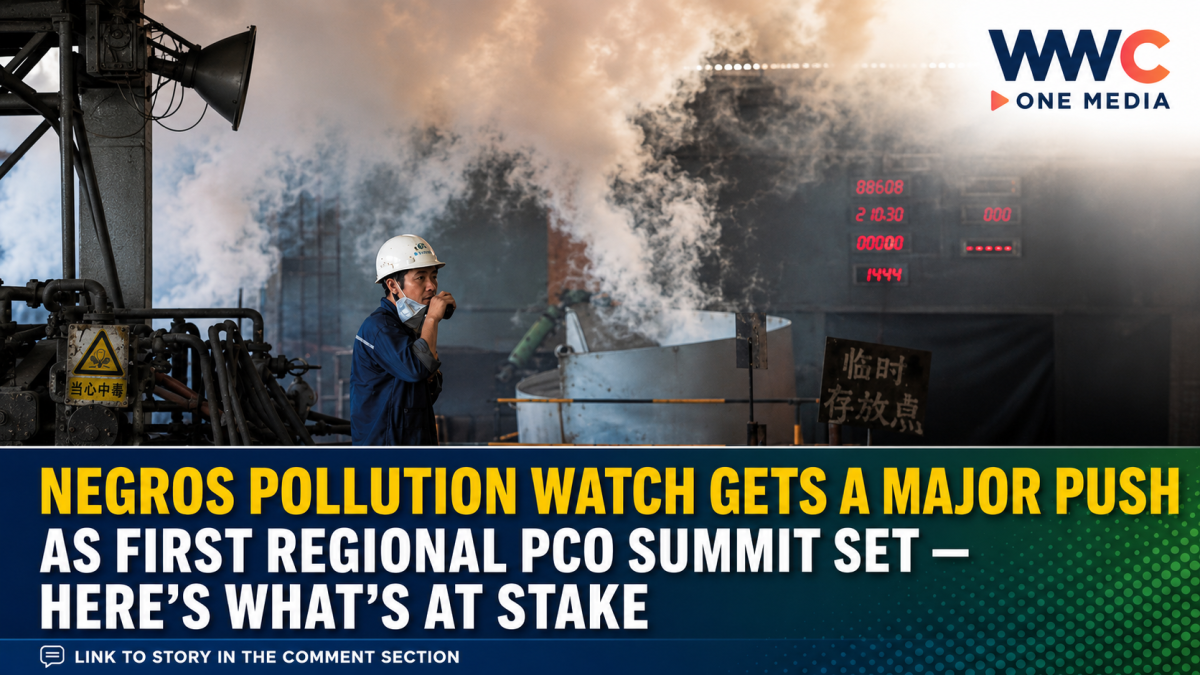
BACOLOD CITY — Pollution control officers (PCOs) from across Negros and Siquijor are set to converge in Bacolod City next month for what organizers describe as the first PCO summit in the Negros Island Region (NIR), putting environmental compliance, emerging technologies and pollution-control solutions under the spotlight.
The two-day summit will be held on October 15 and 16, 2026, in Bacolod City, bringing together pollution control officers, environmental practitioners, industry representatives, regulatory experts and environmental solution providers from Negros Occidental, Negros Oriental, Siquijor and Bacolod City.
The event is being organized under the theme “Unmasking Tomorrow for a Cleaner, Brighter, Sustainable Negros Island Region.” According to the Pollution Control Association of the Philippines Inc. (PCAPI), the gathering will focus on the emerging challenges facing environmental compliance and the evolving role of PCOs in protecting the region’s land, air and water.
The announcement comes as environmental management in the newly established Negros Island Region continues to develop, with government agencies and industry stakeholders working to strengthen coordination across the island and Siquijor.
Why the summit matters
Pollution control officers play a critical role in helping establishments comply with environmental regulations and in implementing measures aimed at preventing, reducing and controlling pollution.
For the Negros Island Region, the challenge is particularly significant because the area combines major urban centers, agricultural activity, industrial operations, tourism destinations and communities spread across three provinces and a highly urbanized city.
PCAPI said the upcoming summit will examine emerging environmental challenges, practical solutions, innovative technologies and industry best practices that can help organizations respond to increasingly complex compliance requirements.
The program will include expert discussions, regulatory updates, industry experiences and presentations on emerging environmental trends.
Participants will also have opportunities to exchange experiences with other PCOs and environmental practitioners.
Technology takes center stage
One of the summit’s notable components will be a “solution marketplace,” where participants can explore technologies and practical approaches designed to address environmental-management problems.
Organizers also plan interactive case discussions and “challenge room” sessions, allowing participants to examine real-world compliance issues rather than relying solely on classroom-style presentations.
The goal is to give PCOs actionable ideas they can bring back to their respective organizations.
That practical component could be especially important for businesses facing increasingly sophisticated environmental requirements involving emissions, wastewater, solid waste and other pollution-control concerns.
Environmental compliance is already a regional priority
The summit is not happening in isolation.
Recent activities involving environmental practitioners in the region show that regulators and stakeholders have already been working to strengthen technical capacity.
The Environmental Management Bureau in Region 6, for example, has conducted activities involving PCOs and industry stakeholders, including efforts related to climate-change considerations and emergency preparedness for sugar mills and alcohol distilleries in Negros.
Publicly available information from environmental practitioners also shows continuing work on environmental impact assessment, disaster-risk reduction and climate-change adaptation in the NIR.
These efforts underline a broader shift: environmental compliance is increasingly being viewed not simply as a regulatory requirement, but as part of business continuity, disaster preparedness and long-term sustainability.
Negros faces a changing environmental landscape
The creation of the Negros Island Region has also created a new framework for coordinating government services across Negros Occidental, Negros Oriental and Siquijor.
That makes collaboration among environmental regulators, local governments, industries and technical professionals increasingly important.
For PCOs, this means keeping up with changing regulations while also understanding how new technologies can improve pollution monitoring, waste management, resource efficiency and environmental reporting.
The upcoming summit provides a venue for those stakeholders to share information and potentially develop more consistent approaches across the region.
What businesses should watch
For companies operating in Negros and Siquijor, the summit could offer more than professional networking.
Environmental compliance can directly affect operating permits, project approvals, production activities and the ability of companies to avoid costly violations or environmental incidents.
The event’s emphasis on practical solutions could therefore be particularly relevant to industries that generate wastewater, air emissions, hazardous materials or significant solid waste.
However, the summit itself does not change environmental regulations.
Instead, it is designed to help PCOs and environmental practitioners better understand existing requirements, emerging issues and available solutions.
A bigger environmental conversation is emerging
The timing is significant.
Negros is experiencing continued economic development while also confronting climate-related risks, urban growth, industrial activity and the environmental pressures associated with agriculture and tourism.
That creates a difficult balancing act: how can the region continue attracting investment and creating jobs without allowing economic expansion to come at the expense of environmental protection?
The answer will require more than a single summit.
It will depend on effective enforcement, capable environmental officers, responsible industries, informed local governments, reliable monitoring and communities willing to participate in environmental protection.
The October summit could nevertheless become an important meeting point for those efforts.
The challenge after the summit
The real test will begin after the two-day event ends.
Experts can share new technologies. Regulators can explain new requirements. Industry representatives can present successful practices.
But those lessons will only matter if they are translated into better environmental management on the ground.
For Negros and Siquijor, the first regional PCO summit represents an opportunity to build stronger professional networks and develop practical responses to pollution and compliance challenges.
The bigger question is whether those ideas can move beyond the conference rooms — and into factories, businesses, communities and local environmental programs across the Negros Island Region.
The October gathering may be the beginning of that conversation, but creating a genuinely cleaner and more sustainable Negros will ultimately depend on what stakeholders do after the summit.



Leave a Reply