
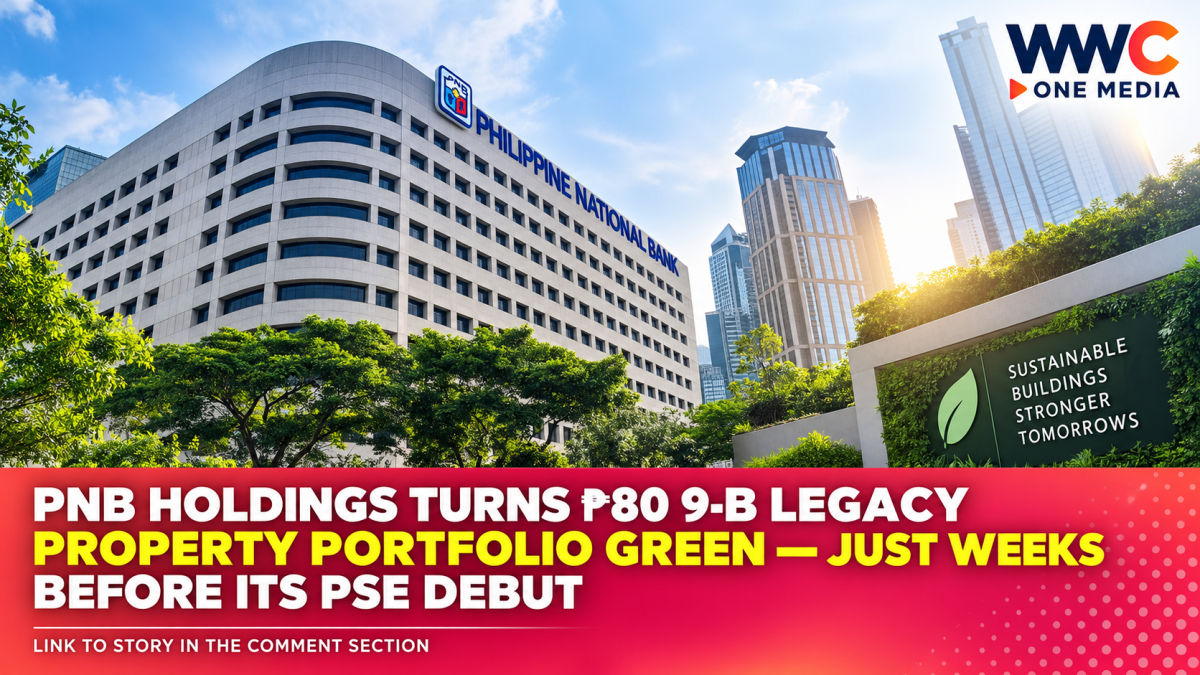
MANILA, Philippines — PNB Holdings Corp. is trying to prove that some of Metro Manila’s aging corporate landmarks do not need to be torn down to stay valuable.
Instead, the Lucio Tan-linked property company is betting on renewable electricity, lower energy consumption, water recycling, technology-driven waste management and adaptive reuse to extend the commercial life of a property portfolio recently valued at around ₱80.9 billion.
And the timing is significant.
The sustainability drive is accelerating just weeks before PNB Holdings’ scheduled Sept. 25, 2026 listing on the Philippine Stock Exchange, putting the company’s ability to turn decades-old real estate into productive, modern assets increasingly under an investor microscope.
Two landmark buildings switch to renewable power
At the center of the strategy are two of the company’s most recognizable properties: PNB Financial Center in Pasay City and PNB Makati Center along Ayala Avenue.
PNB Holdings has shifted the electricity requirements of both buildings to 100% renewable energy, backed by more than 5 megawatts of geothermal power supplied by First Gen.
First Gen confirmed that the agreement, signed on Aug. 18, covers direct renewable-power supply from its Tongonan geothermal facility in Leyte to the two Metro Manila properties. BusinessMirror separately reported the same agreement and capacity.
For PNB Holdings, the move is more than a corporate environmental pledge. Electricity is one of the biggest operating costs for large commercial buildings, making energy sourcing and consumption increasingly relevant to both operating margins and a property’s competitiveness.
The company is also scheduling equipment such as chillers, pumps and elevators according to building occupancy instead of simply running systems at full capacity throughout the day. LED lighting and inverter-based equipment form part of the efficiency program as well.
Old buildings, new uses
Perhaps the more interesting part of PNB Holdings’ strategy, however, is what it isn’t doing.
Rather than automatically demolishing older buildings and replacing them with new towers, the company has increasingly turned to adaptive reuse—modernizing existing structures while preserving important architectural elements.
The PNB Makati Center, formerly associated with Allied Bank, was designed by noted Filipino architect Carlos Arguelles. Instead of being cleared for redevelopment, the Ayala Avenue property has been repositioned to accommodate corporate offices, business-process outsourcing tenants, co-working facilities and lifestyle-oriented spaces.
The building has about 28,131 square meters of gross leasable area, according to PNB Holdings.
Independent BusinessMirror coverage has likewise highlighted PNB Holdings’ approach to preserving and repurposing the PNB Makati Center and PNB Financial Center rather than erasing their architectural identities through wholesale demolition.
At PNB Financial Center, formerly specialized banking and ticketing areas have also been converted into event spaces while retaining the building’s large floor plates, high ceilings and other defining characteristics.
That strategy could become increasingly important for Metro Manila, where property owners must decide whether decades-old buildings sitting on extremely valuable land should be demolished, rebuilt—or given a commercially viable second life.
Recycling and water reuse enter the equation
PNB Holdings is also attacking smaller but recurring sources of environmental waste.
Through its EcoStation program with technology-enabled waste-management company Rezbin, tenants are given incentives to segregate and deposit recyclable materials.
PNB Holdings says the program has already diverted more than 32,100 recyclable deposits from landfills. Because that figure comes from the company itself, it should be treated as a company-reported sustainability metric rather than an independently audited environmental figure.
Water management is another part of the program.
At the roughly 10-hectare PNB Financial Center property, treated wastewater is reused for landscaping and other non-potable purposes, reducing the amount of freshwater required for daily property operations.
Taken individually, measures such as LED lighting, recycled water or smarter elevator schedules may sound incremental. Applied across large commercial properties over many years, however, the cumulative reduction in energy, water and operating requirements can become financially meaningful.
The ₱80.9-billion question
The bigger story may ultimately be less about sustainability awards and more about whether these initiatives can unlock the value buried inside PNB Holdings’ property portfolio.
The company’s assets were recently appraised at around ₱80.9 billion, considerably above the valuation implied by its initial stock-market listing price.
Forbes reported earlier this year that PNB Holdings’ properties had a fair value of ₱80.9 billion while being carried at roughly ₱46.8 billion in book value. The company pursued a lower market valuation amid volatile financial conditions.
The portfolio includes PNB Financial Center, PNB Makati Center and a strategically located 8,000-square-meter property near Buendia and Paseo de Roxas in Makati.
The latter could eventually become one of the company’s biggest development opportunities. PNB Holdings’ prospectus outlines plans for a strategic redevelopment program beginning with the Buendia property, envisioned as a high-end mixed-use project.
Earnings are already moving higher
PNB Holdings is also heading toward its market debut with improving operating numbers.
For the first six months of 2026, the company reported ₱634.3 million in revenue, up 26% from ₱502.7 million a year earlier.
Net income climbed 85.3% to ₱209.9 million, while EBITDA increased 40.3% to ₱336.5 million.
PNB Financial Center generated about 67% of total revenue, while PNB Makati Center contributed another 26%, underscoring just how important these two mature properties remain to the company’s earnings.
That makes the sustainability program commercially relevant: improving the efficiency, occupancy and usefulness of those buildings could directly affect the assets producing most of PNB Holdings’ current income.
Not a traditional IPO
One distinction investors should keep in mind is that PNB Holdings’ Sept. 25 debut is not a traditional IPO.
The company is pursuing a listing by way of introduction, meaning it does not need to conduct a conventional public offering of new shares as part of the listing. PNB Holdings itself says no common shares are being publicly offered for subscription or sale in connection with the listing and related property-dividend distribution.
Reuters-linked reporting and Asian Banking & Finance have also reported Sept. 25 as the official listing date.
That distinction matters because the listing is primarily about creating a publicly traded market for the property company and unlocking the value of assets previously sitting within the PNB/LT Group structure—not raising billions of pesos through a conventional IPO.
From aging assets to investor test
PNB Holdings’ sustainability campaign therefore arrives at an unusually important moment.
Renewable electricity, recycled water, efficient building systems and adaptive reuse may make compelling environmental talking points.
But after Sept. 25, investors will be able to judge something much harder:
Can PNB Holdings turn some of Metro Manila’s oldest corporate landmarks into assets capable of competing with the city’s newest generation of green buildings—and can that transformation finally unlock the enormous gap between their historical book values and their estimated market worth?
That may be the real sustainability test.
WWC ONE MEDIA J.M.D




Leave a Reply