MANILA, Philippines — October 31, 2026
For millions of Filipinos, the biggest economic challenge is no longer simply saving money or preparing for the future. It is finding enough income to cover food, transportation, electricity and other basic necessities.
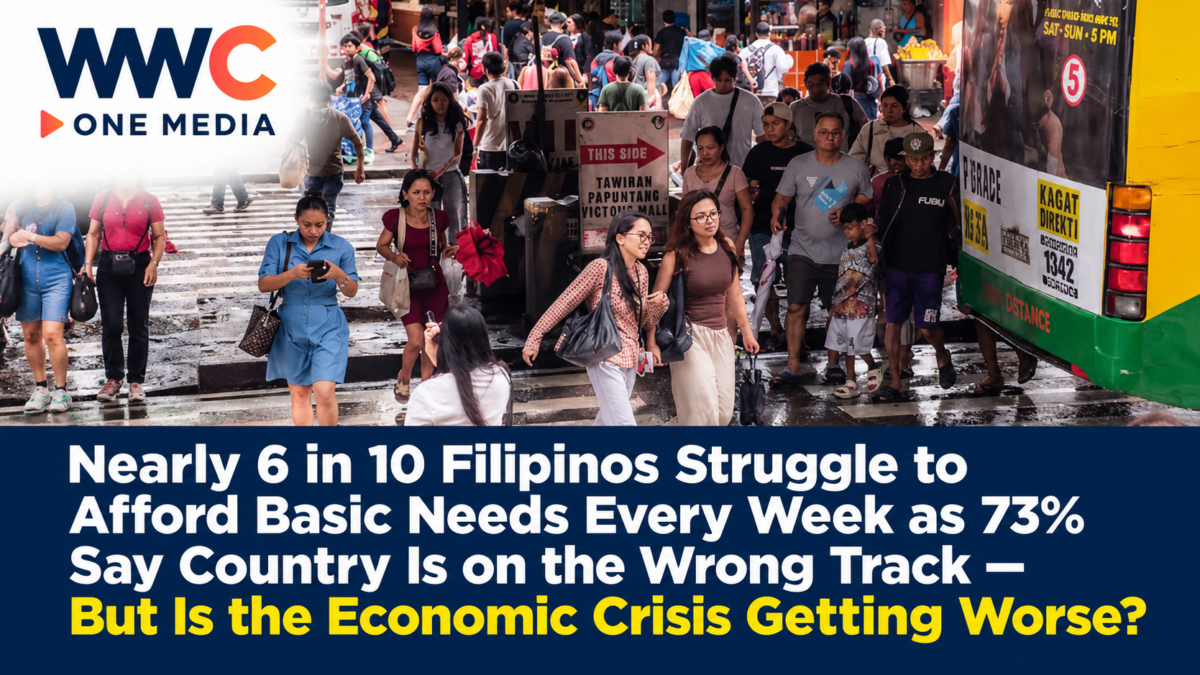
A new nationwide survey has revealed widespread financial pressure among Filipino households, with 58.6% of respondents saying they struggle to afford essential expenses at least once a week.
Even more troubling, 83% reported encountering financial difficulties at least once a month, underscoring the persistent strain on household budgets.
The October 2026 Philippine Public Opinion Monitor, conducted by WR Numero Research and reported by InsiderPH on October 31, also found growing pessimism about the country’s direction.
Approximately 72.62% of respondents believe the Philippines is heading in the wrong direction, up from 68% in June.
Only 17.60% believe the country is moving in the right direction.
The results come as the country continues to grapple with high consumer prices, rising transportation expenses and pressure on household purchasing power.
Official figures from the Philippine Statistics Authority show that inflation accelerated to 7.2% in September from 6.1% in August, with food, utilities and transportation among the major contributors.
Yet the survey presents an important contradiction.
While pessimism about the country increased, the share of respondents struggling financially every day or every week actually declined slightly compared with June.
The bigger question is whether these modest improvements signal that household conditions are beginning to stabilize — or whether stubbornly high prices and declining public confidence are warning of a deeper economic problem.
Nearly 59% of Filipinos Struggle to Pay for Basic Necessities Every Week
The October survey found that 58.6% of respondents experienced difficulty paying for basic necessities at least weekly during the preceding three months.
These expenses include food, household bills, transportation and other essential needs.
The figure is significant because it measures how frequently people encounter financial pressure, not simply whether they consider themselves poor.
An employed individual may still experience financial hardship if earnings are insufficient to meet living expenses.
Similarly, a household may have enough income during one pay period but struggle when rent, utilities, debt payments and school expenses become due.
Of those surveyed, 28.8% said they experienced financial difficulties daily.
Another 24.4% reported struggling once or twice a month, bringing the total experiencing hardship at least monthly to 83%.
Only 4.5% said they never encountered difficulty paying for basic necessities.
The findings suggest that financial pressure is not confined to households experiencing the most severe poverty.
It also affects people whose income may be adequate in some periods but insufficient in others.
Financial Hardship Improves Slightly, but Remains Widespread
The survey also contains evidence of modest improvement.
In June, 32.2% of respondents said they experienced financial difficulties daily.
By October, that figure had fallen to 28.8%.
The share reporting hardship at least weekly also declined from 61.1% to 58.6%.
Meanwhile, the proportion experiencing financial difficulties rarely or never increased from 15.2% to 17%.
These changes suggest that some households may be experiencing less frequent financial pressure than earlier in the year.
However, the national margin of error means small differences should be interpreted cautiously.
The results do not establish that the majority of Filipino households are now financially secure.
Even after the improvement, nearly six in ten respondents continued to report difficulty covering essentials at least weekly.
The survey therefore points to persistent financial vulnerability rather than a complete deterioration across every measure.
Almost Three in Four Believe the Philippines Is on the Wrong Track
The most striking deterioration appeared in public perceptions of the country’s direction.
WR Numero Research found that 72.62% of respondents believed the Philippines was moving in the wrong direction.
That represents an increase from the 68% reported in June.
Only 17.60% expressed the view that the country was headed in the right direction.
These figures suggest that dissatisfaction extends beyond individual financial circumstances.
Respondents may be considering economic performance, government services, employment prospects, public policy and other national concerns.
However, the survey results alone do not establish why each respondent expressed dissatisfaction.
The finding is an indicator of public sentiment, not a direct assessment of any particular government program.
For policymakers, the difference between personal hardship and perceptions of national direction is important.
Even when some households experience limited financial improvement, broader economic uncertainty may continue to weaken confidence.
Philippine Inflation Reaches 7.2% as Food and Utility Costs Rise
The latest survey comes against a difficult inflation backdrop.
According to the Philippine Statistics Authority, annual headline inflation reached 7.2% in September 2026, compared with 6.1% in August.
Food and non-alcoholic beverage inflation accelerated to 6.7%.
Inflation for housing, water, electricity, gas and other fuels reached 8.4%, while transportation inflation rose to 14.6%.
These figures explain why basic necessities remain central to household financial concerns.
When essential goods and services become more expensive, families have less flexibility to spend on other needs.
Low-income households may be especially vulnerable because food, transport and utilities account for a larger share of their budgets.
WWC ONE MEDIA previously examined these pressures in Philippines Faces Broader, Stickier Inflation Wave as Food, Fuel and Labor Costs Rise.
That report discussed the growing risk that price pressures would spread across multiple parts of the economy rather than remain concentrated in fuel alone.
However, it is important to distinguish the economic data from the survey findings.
The PSA measures actual consumer price changes, while WR Numero Research measured respondents’ reported experiences and opinions.
The two provide complementary evidence, but they are not interchangeable.
A Previous Survey Found More Filipino Families Consider Themselves Poor
The October findings are consistent with earlier research showing substantial financial vulnerability.
In July, an OCTA Research survey found that 39% of Filipino families considered themselves poor, up from 35% in March.
The increase represented approximately 1.1 million additional families identifying themselves as poor.
WWC ONE MEDIA covered the findings in Poverty Sentiment Surges in the Philippines: 1.1 Million More Families Say They’re Poor — What’s Driving the Change?.
The OCTA survey also found that self-reported hunger increased during the period it examined.
These indicators reinforce concerns about economic hardship.
But they measure different concepts.
Self-rated poverty reflects how households assess their own economic position.
Financial hardship frequency asks how often respondents struggle to pay for necessities.
Official poverty incidence, meanwhile, is calculated using income or expenditure data and government poverty thresholds.
Different surveys may therefore produce different percentages without necessarily contradicting one another.
Hunger Remains a Major Concern for Vulnerable Families
Food insecurity remains one of the clearest consequences of inadequate household resources.
Social Weather Stations reported that 20.3% of Filipino families experienced involuntary hunger at least once in the three months preceding its June 2026 survey.
That was lower than the 23.2% recorded in March.
Nevertheless, the proportion remained significant.
WWC ONE MEDIA examined the results in Hunger Rate Falls to 20.3% in June — But One Region Is Still Facing a Bigger Food Crisis.
The findings demonstrated how national improvements can conceal worsening conditions in particular regions.
Hunger is also more severe than general difficulty paying bills.
A family may report financial hardship because it has difficulty paying electricity or transport expenses without necessarily experiencing involuntary hunger.
These distinctions are essential when evaluating the scale and nature of economic distress.
Will the ₱60 Metro Manila Wage Increase Be Enough?
Higher wages are one possible way to ease household financial pressure.
In Metro Manila, a ₱60 daily minimum wage increase took effect in September 2026.
The adjustment raised the daily minimum wage for covered non-agricultural workers from ₱695 to ₱755.
However, the benefit is not available to every Filipino worker.
It applies to the relevant wage categories and geographic jurisdiction.
WWC ONE MEDIA examined the measure in ₱60 Metro Manila Wage Hike May Do Little to Lift Consumer Spending as Households Stay Cautious.
The article explored concerns that households might save additional income or use it to pay existing obligations rather than increase discretionary spending.
The latest WR Numero survey provides another reason for caution.
When a large proportion of households struggle to cover essentials, even additional income may be absorbed by food, bills and transportation.
Whether the wage increase meaningfully improves purchasing power will depend on the relationship between income growth and living costs.
Government Relief Programs Face a Difficult Test
The Philippine government has introduced measures intended to help households manage economic disruption.
One example is a financing agreement with the Asian Development Bank supporting programs focused on livelihoods, food, transportation and other economic concerns.
WWC ONE MEDIA reported on the initiative in Philippines Signs $1.5-Billion ADB Emergency Financing Deal — But Will It Bring Down Fuel, Fare and Food Costs?.
The financing is intended to support government responses to economic pressures.
However, access to financing is not the same as an immediate reduction in household expenses.
The benefits depend on how programs are designed, funded and implemented.
For households experiencing weekly financial difficulty, the most important question may be how quickly assistance reaches those who need it.
The new survey does not evaluate the effectiveness of any individual government program.
It does, however, provide evidence that the need for practical household support remains widespread.
Consumer Confidence Could Affect Philippine Businesses
Persistent financial hardship has consequences beyond individual households.
When families prioritize essential expenses, they may reduce spending on dining, entertainment, travel, electronics and other discretionary purchases.
That can affect businesses dependent on consumer demand.
Retailers may respond by expanding lower-priced offerings, increasing promotions or adjusting their product inventories.
Service companies may face more price-sensitive customers.
For the wider economy, weakened consumer confidence can create challenges because household spending is an important source of economic activity.
However, survey sentiment does not automatically translate into an equivalent decline in measured consumption.
Actual spending patterns depend on employment, income, credit availability, government assistance and other conditions.
Businesses should therefore evaluate public opinion together with retail sales, consumer expenditure and official economic data.
Are Filipinos Losing Hope About Their Economic Future?
The latest pessimism figures contrast with earlier research showing optimism among many Filipinos.
In September, a separate survey reported that 48% expected their living conditions to improve over the following year.
WWC ONE MEDIA covered those expectations in Nearly Half of Filipinos Hope for Better Living Conditions — But Economic Pressures Still Loom.
There is no necessary contradiction between the findings.
A person can believe the country’s overall direction is unfavorable while still hoping their own family’s situation will improve.
The surveys also ask different questions and may use different research methods.
It would therefore be misleading to conclude that 73% of Filipinos have personally abandoned hope for a better future.
The October survey measures dissatisfaction with the country’s direction, not the absence of all personal optimism.
What the Survey Actually Tells Policymakers
The October Philippine Public Opinion Monitor was conducted through face-to-face interviews with 1,225 Filipino adults from October 7 to 13.
The reported national margin of error was approximately ±2.6 percentage points at a 95% confidence level.
The research provides a snapshot of public opinion during that period.
It does not directly measure the bank balances, income levels or consumption expenditures of all Philippine households.
The survey also interviewed individual adults, so its percentages should not automatically be described as percentages of families.
Nevertheless, the findings are relevant to economic policy because they reveal how frequently respondents experience difficulty meeting essential expenses.
The combination of widespread hardship and negative perceptions of national direction suggests that public confidence may be difficult to rebuild without tangible improvements in everyday living conditions.
The Bigger Question: Can Economic Improvement Reach Ordinary Filipinos?
The central challenge highlighted by the research is the gap between economic policy and household experience.
National growth statistics, government spending programs and business investment are important.
But for ordinary households, progress is often measured more directly.
Can a family buy enough food?
Can workers afford transportation to their jobs?
Can parents cover school and healthcare expenses?
Can electricity and housing bills be paid without borrowing?
These questions help explain why financial hardship can remain widespread even when particular economic indicators show improvement.
The October survey shows that some measures of personal financial stress have eased since June.
At the same time, pessimism about the country’s direction has grown.
That combination suggests that policymakers must address both the practical cost of living and public confidence in the broader economic outlook.
The Bottom Line
The October 2026 Philippine Public Opinion Monitor found that 58.6% of Filipino respondents experienced difficulty paying for basic necessities at least weekly.
A total of 83% reported financial difficulties at least monthly.
Meanwhile, 72.62% believed the Philippines was heading in the wrong direction, up from 68% in June.
The findings come as national inflation reached 7.2% in September, adding pressure to food, utilities and transportation expenses.
Yet the survey also recorded modest improvement in how often respondents experienced financial hardship.
Daily difficulty declined from 32.2% in June to 28.8% in October.
The picture is therefore one of persistent household vulnerability combined with worsening perceptions of the national outlook, rather than uniform deterioration across every indicator.
As nearly six in ten Filipinos continue struggling to cover basic needs every week, one question now confronts policymakers: Can higher incomes, price stability and effective economic assistance restore confidence — or will the growing gap between economic promises and household realities deepen public pessimism?