GENERAL LUNA, SIARGAO — October 31, 2026
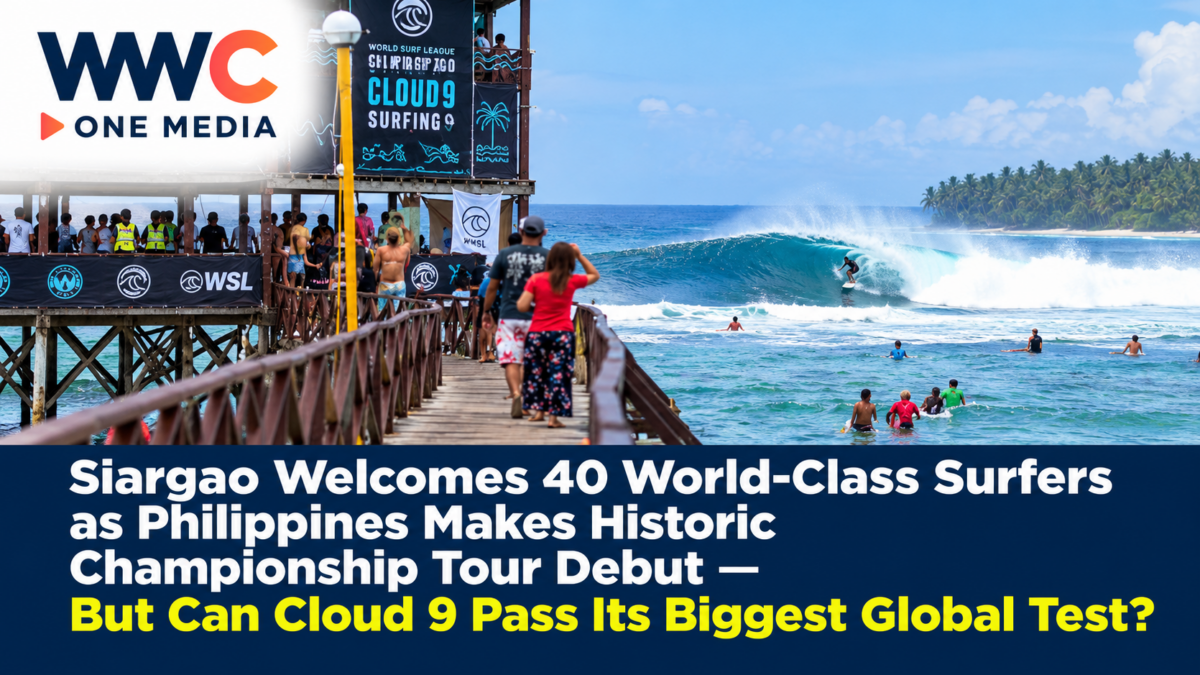
The Philippines is stepping onto one of surfing’s biggest international stages as Siargao welcomes 40 elite athletes for the country’s first-ever World Surf League (WSL) Championship Tour event.
The historic Philippines Pro, presented by the Philippine Sports Commission (PSC), brings some of the world’s most accomplished surfers to the legendary Cloud 9 reef break in General Luna, Surigao del Norte.
The event marks a major upgrade for Siargao, which has long hosted international surfing competitions but is now welcoming the sport’s premier professional circuit for the first time.
Among the expected competitors are Brazil’s Yago Dora, Gabriel Medina and Italo Ferreira, Japan’s Kanoa Igarashi, and Australian surfing star Molly Picklum.
Three Filipino surfers—John Mark “Marama” Tokong, Jayuard Alciso and Mara Lopez—are also scheduled to represent the host nation.
But the competition carries stakes far beyond the waves.
As InsiderPH reported on October 30, the event will test the Philippines’ ability to coordinate international aviation, transportation, electricity, public works, emergency services and local government operations.
The country hopes to use the experience to strengthen its reputation as a destination for major international sports competitions.
For Siargao, the question is no longer whether its waves are world-class. It is whether the island’s infrastructure and the country’s event-management capabilities can match the international attention now coming its way.
Cloud 9 Becomes the Philippines’ First Championship Tour Venue
Siargao’s Cloud 9 has long been recognized for its powerful right-hand reef break, attracting professional surfers and enthusiasts from different parts of the world.
The destination has hosted the Siargao International Surfing Cup for decades, helping establish the island’s international reputation.
Its elevation to a Championship Tour venue represents a major milestone.
The Championship Tour is the WSL’s top professional competition series, featuring surfers competing at the highest level of the sport.
Moving from Qualifying Series competition to Championship Tour status raises expectations for both the athletes and the organizers.
The competition requires professional judging, broadcast operations, athlete services, spectator management, emergency response and dependable infrastructure.
For the Philippines, this is an opportunity to demonstrate that its most famous surfing destination can support a major event within the international calendar.
However, successfully hosting one competition does not automatically establish the country as a permanent destination for every category of global sporting event.
That reputation must be built through consistent performance.
Forty Elite Surfers Bring Global Attention to Siargao
The competition features a field of 24 men and 16 women.
Leading the men’s contingent are some of professional surfing’s most recognizable competitors.
Brazil’s Yago Dora arrives as one of the headline athletes, alongside former world champions Gabriel Medina, Italo Ferreira and Filipe Toledo.
Italy’s Leonardo Fioravanti and Japan’s Kanoa Igarashi are also among the international competitors.
The women’s field includes Australia’s Molly Picklum and internationally recognized surfers Caroline Marks, Erin Brooks, Gabriela Bryan and Lakey Peterson.
Their participation places Siargao before an audience that follows professional surfing around the world.
The event is an opportunity for the Philippines to showcase not only its sporting conditions but also its tourism attractions and local surfing culture.
However, the expected exposure should not be confused with a confirmed economic return.
The actual tourism and financial benefits will depend on visitor spending, event operations, local business participation and subsequent travel demand.
Molly Picklum Arrives With Momentum After Portugal Victory
One of the biggest names associated with the Siargao event is Australian world champion Molly Picklum.
Picklum recently captured the women’s title at the MEO Rip Curl Pro Portugal, defeating Caitlin Simmers in a closely contested final.
Her victory strengthened her position in the 2026 championship race.
WWC ONE MEDIA covered the result in World Champion Molly Picklum Storms to First 2026 Victory in Portugal and Takes Surfing’s Top Spot — But Can She Defend Her Crown in Siargao?.
The Siargao stop offers another opportunity for Picklum and her rivals to compete for valuable championship points.
But Cloud 9 presents a different challenge from Portugal.
Its reef break demands precise wave selection, timing and confidence in powerful surfing conditions.
The presence of world-class competitors also gives Filipino spectators an opportunity to see elite professional surfing on home shores.
Three Filipino Surfers Get Their Moment on the World Stage
For Philippine surfing, the participation of local athletes is among the most meaningful aspects of the event.
John Mark “Marama” Tokong is one of the country’s most accomplished surfers and a four-time Siargao International Surfing Cup champion.
His familiarity with Cloud 9 could provide an advantage in navigating its challenging conditions.
Jayuard Alciso and Mara Lopez also represent the Philippines in the event’s local participation program.
Their inclusion provides an opportunity to compete against internationally established athletes and gain experience associated with major professional competitions.
The event’s competitive structure distinguishes between direct Championship Tour participation and local trials, so the three athletes should not automatically be described as having identical entry arrangements.
For younger Filipino surfers, seeing local competitors participate in a globally recognized event may provide encouragement to pursue the sport.
But developing future champions will also require training facilities, access to equipment, experienced coaching and opportunities for consistent competition.
The Biggest Test May Happen Away From the Waves
Hosting an international competition on an island creates logistical demands that go beyond those faced by venues in major metropolitan centers.
Siargao depends on aviation, roads, ports, electricity and other infrastructure to accommodate visitors and maintain daily services.
A major sporting event can increase demand on those systems.
Travelers, athletes, officials, technical teams and media organizations may arrive within a relatively concentrated period.
Their requirements include transportation, accommodation, communications and reliable power.
As a result, a successful event depends on more than competition schedules.
It also requires cooperation among multiple government agencies and private organizations.
That coordination is a central focus of the Philippines’ latest preparations.
Government Agencies Coordinate Transport, Power and Infrastructure
The Philippine Sports Commission is working with several national agencies to support the event.
These include the Department of Transportation, Department of Public Works and Highways, Civil Aviation Authority of the Philippines, Philippine Ports Authority and National Electrification Administration.
The Department of Tourism and Philippine Amusement and Gaming Corporation are also among the supporting organizations.
Siargao Electric Cooperative is involved in electricity-related coordination.
Philippine Airlines and other transportation stakeholders are participating in preparations.
These partnerships are intended to help ensure that the event’s operational requirements are met.
However, the presence of multiple agencies does not establish that every infrastructure concern has been permanently resolved.
The competition provides an opportunity to assess how effectively government and private organizations can work together under international event conditions.
Air Connectivity Could Determine Siargao’s Long-Term Growth
One of the most important issues for Siargao is accessibility.
As an island destination, it depends heavily on air connections and transfers for tourism.
A major international sporting event can generate temporary demand, but the larger opportunity is to attract visitors who return after the competition.
Reliable transport connections are therefore essential.
Flight availability, airport operations, baggage handling and onward transportation affect the visitor experience.
The same challenge is visible elsewhere in the Philippine tourism industry.
WWC ONE MEDIA previously examined the importance of connectivity in Cebu Tourist Arrivals Top 1 Million as Foreign Visitors Surge 27% — But Connectivity May Decide How Much Bigger the Boom Gets.
That report showed how aviation infrastructure can influence tourism growth and international competitiveness.
For Siargao, dependable transport could help convert international surfing exposure into additional tourism demand.
But the extent of any increase remains uncertain.
The Rebuilt Cloud 9 Tower Adds Symbolic Importance
The event also carries significance for Siargao’s recovery from past natural disasters.
The original Cloud 9 Tower, an iconic feature of the surfing destination, suffered destruction during Super Typhoon Odette in December 2021.
A rebuilt tower has become part of the area’s preparations for the international competition.
The Philippine Star reported that the new structure was developed through cooperation between the Philippine Sports Commission and the General Luna local government.
Its return provides an important symbol of recovery for the local surfing community.
However, rebuilding a landmark is only one element of long-term disaster preparedness.
Siargao remains exposed to severe weather, coastal hazards and the operational risks associated with island infrastructure.
The challenge is to improve resilience while expanding tourism.
Siargao’s Tourism Recognition Creates a Bigger Opportunity
The international surfing event arrives after Siargao earned recognition among Asia’s leading island destinations.
WWC ONE MEDIA previously reported on those honors in Philippines Tourism Put on Global Spotlight as Boracay, Palawan and Siargao Win International Recognition.
The article highlighted Siargao’s inclusion in Condé Nast Traveler’s 2025 Readers’ Choice Awards for the top islands in Asia.
Such recognition strengthens the destination’s international profile.
The Championship Tour now offers a different form of visibility.
Rather than being recognized solely for its natural attractions, Siargao is hosting an event in which those attractions become the setting for elite global competition.
The potential benefits extend to accommodations, restaurants, surf schools, transport providers and other tourism businesses.
But the actual economic gains must be measured rather than assumed.
The Philippines Is Building a Sports Tourism Strategy
The Siargao event is part of a broader government effort to use sporting competitions as platforms for economic development.
Administrative Order No. 38 established the National Sports Tourism Inter-Agency Committee to improve coordination among agencies responsible for international sports events.
The committee is chaired by PSC Chairman Patrick Gregorio.
The policy recognizes that sports tourism can involve multiple economic sectors.
Major competitions may generate activity in hospitality, transportation, entertainment and event services.
They can also encourage investment in facilities and promote host destinations internationally.
But delivering those benefits requires effective planning and evaluation.
Government support should be considered alongside event costs, public infrastructure requirements and potential benefits for local communities.
The long-term objective is to create a sustainable international events industry, not simply attract attention for a few days.
Boracay’s International Swimming Event Provides a Useful Comparison
The Philippines has already used other island destinations to host international sports competitions.
In August, Boracay welcomed the fourth Southeast Asian Open Water Swimming Championships.
The competition brought together more than 100 athletes and provided organizers with experience in international event operations.
WWC ONE MEDIA reported on the achievement in Boracay Just Passed a Major International Test — Could the World’s Best Swimmers Be Next?.
The event generated discussion about the possibility of hosting bigger international swimming competitions.
But no future hosting rights should be treated as secured unless formally announced.
The comparison with Siargao is instructive.
Both destinations are globally recognized for their natural attractions.
Both are attempting to use those conditions as a foundation for international sports events.
And both face the challenge of sustaining operational standards after the initial competition.
Cebu’s Triathlon Events Show That Sports Tourism Can Spread Beyond Major Cities
Sports tourism is not limited to surfing and open-water swimming.
Cebu’s Camotes Islands recently hosted a leg of the National Age Group Triathlon Series, attracting athletes across several competitive categories.
WWC ONE MEDIA examined the event in Hermosa and Caluya Rule NAGT Camotes — But the Bigger Story Is What Comes Next for Philippine Triathlon.
The competition illustrated how sporting events can introduce visitors to destinations outside major urban centers.
However, the Camotes event was a domestic competition, while Siargao is hosting a top-tier international surfing event.
The scale and technical requirements are different.
Both nevertheless demonstrate how sports can support destination promotion and athlete development.
For the Philippines, a successful national sports tourism strategy may involve different types of events rather than concentrating exclusively on the largest competitions.
A Bigger Sports Tourism Industry Must Also Benefit Local Communities
The arrival of international athletes and visitors can create opportunities for businesses.
But large events can also put pressure on local resources.
Hotels and accommodations may experience stronger demand.
Restaurants and transport providers may gain additional customers.
At the same time, residents may face congestion or rising demand for limited services.
The challenge is ensuring that tourism growth provides broad and lasting benefits.
For Siargao, this could involve supporting local surf schools, small businesses, transport operators and community-based tourism providers.
The event also creates an opportunity to promote environmental responsibility.
Cloud 9’s reputation depends on the quality of its coastal environment and surfing conditions.
Preserving those assets is essential to long-term tourism competitiveness.
What Would Make Siargao’s Championship Tour Debut a Success?
A successful event should be assessed through several measures.
Competition operations must meet professional standards.
Athletes and officials need safe and reliable facilities.
Travel and transportation systems must function effectively.
Organizers must manage communication, power supply and emergency services.
Visitors should have a positive experience.
Local businesses and communities should also have opportunities to benefit.
Beyond the immediate event, the Philippines should examine whether the experience improves its ability to attract and deliver future competitions.
That requires evidence.
Attendance, tourism spending, operational performance and feedback from organizers would provide a stronger basis for evaluating success than publicity alone.
Could Siargao Become a Permanent Stop on Surfing’s Global Calendar?
The Championship Tour upgrade has put Siargao in a stronger position internationally.
Cloud 9 already possesses the natural conditions and surfing history needed to attract professional competitors.
The 2026 event gives the Philippines an opportunity to demonstrate its capacity to host the sport’s premier circuit.
But maintaining a place on the international calendar involves continued cooperation with the WSL and the ability to meet professional event standards.
Weather, scheduling, financial considerations and operational requirements can all influence future competitions.
Therefore, one high-profile debut should not be represented as a guarantee of indefinite hosting rights.
The longer-term opportunity depends on whether the event satisfies organizers, athletes, communities and government partners.
The Bigger Question: Is the Philippines Ready for More Global Sporting Events?
Siargao’s opportunity extends beyond surfing.
A successful Championship Tour stop could strengthen confidence in the Philippines’ broader event-management capabilities.
That could be relevant to future competitions in other sports and destinations.
The country has beaches suitable for swimming and water sports, mountains and trails suited to endurance events, and urban centers capable of hosting indoor and stadium competitions.
But natural attractions alone are insufficient.
International events require dependable infrastructure, skilled personnel, financial planning, safety systems and effective coordination.
Siargao now provides a high-profile opportunity to demonstrate those capabilities.
The Bottom Line
Siargao’s Cloud 9 is hosting the Philippines’ first World Surf League Championship Tour event, bringing 40 elite surfers—including three Filipino competitors—to General Luna.
The competition represents a milestone for Philippine surfing and a major opportunity for the country’s sports tourism industry.
But the event also tests aviation, transportation, electricity, public works and coordination among national and local agencies.
Successful hosting could strengthen the Philippines’ position as a destination for future international competitions.
However, the actual economic benefits and long-term hosting prospects remain to be established.
As the world’s best surfers take on Siargao’s legendary waves, a bigger challenge awaits beyond the shoreline: Can the Philippines prove it has the infrastructure, organization and resilience to become a serious global sports tourism destination — or will the pressure of hosting reveal the obstacles that still need to be overcome?