
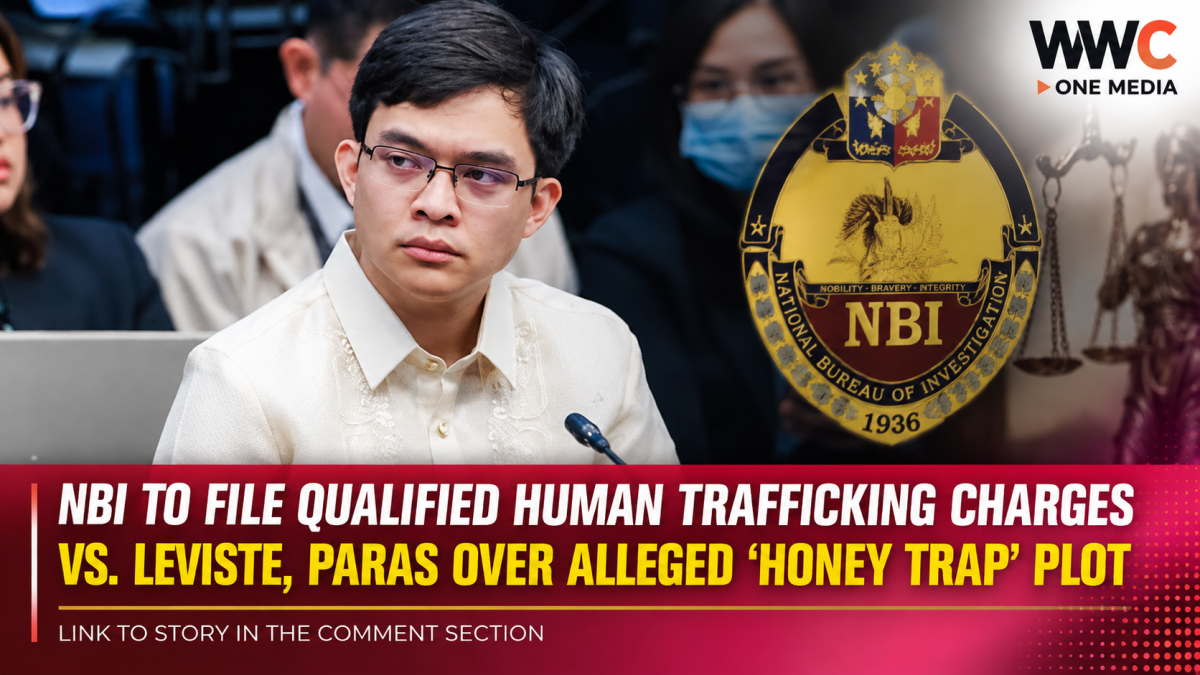
Bureau says investigation found elements of qualified human trafficking in alleged scheme targeting Executive Secretary Ralph Recto; respondents deny accusations
MANILA, Philippines — The National Bureau of Investigation (NBI) is set to bring a qualified human trafficking complaint before the Department of Justice (DOJ) against Batangas 1st District Representative Leandro Leviste, former Negros Oriental lawmaker Jacinto “Jing” Paras, and other individuals over an alleged “honey trap” operation targeting Executive Secretary Ralph Recto.
NBI Director Melvin Matibag said Friday that investigators had completed their probe and found what they considered sufficient elements to pursue a qualified human trafficking complaint.
“Qualified human trafficking yung ifa-file natin,” Matibag told reporters, according to GMA News and Inquirer.
The case stems from an earlier anti-human trafficking operation in Manila in which NBI agents rescued several women and arrested a talent manager. Investigators subsequently uncovered allegations of a plan to use women to lure Recto into a compromising situation and then make damaging accusations against him.
Importantly, the NBI allegations have not been established in court. Leviste, Paras and the other individuals implicated have denied involvement and remain entitled to due process and the presumption of innocence.
The alleged ‘honey trap’ operation
According to the NBI’s investigation, the alleged scheme involved recruiting women to participate in a staged encounter involving Recto.
Witnesses reportedly told investigators that the women would be instructed to execute statements or affidavits containing accusations against the government official.
Earlier reporting by The Philippine Star said one witness claimed the planned accusations would portray Recto as having hired women for sexual services and forcing them to take drugs. The alleged operation was reportedly intended to damage his reputation.
The NBI has described the broader case as involving an alleged effort to discredit government officials.
The bureau’s investigation began after an anti-trafficking operation on July 28, 2026, when a talent manager was arrested and several women were rescued.
Who is facing the complaint?
The latest reports differ slightly in how they count the respondents.
Inquirer and GMA reported that the NBI is pursuing the complaint against seven individuals, including Leviste and Paras. Inquirer identified the other respondents as talent manager alias “Ken” and four lawyers from the Rondain and Mendiola Law Firm.
DZRH, meanwhile, reported that the group includes Leviste, Paras, four lawyers, talent manager alias Ken and Lito D. Guzman, resulting in six additional respondents.
Because the reports are not fully consistent on the final respondent count and names, it is safer at this stage to describe the case as involving Leviste, Paras and several other individuals until the formal DOJ complaint is publicly available.
NBI alleges money and affidavits were part of the plan
The NBI’s account says the women were allegedly promised payments tied to their participation, including the execution of affidavits and the progress of the case.
Earlier reports said a talent manager claimed that payments were to be released in stages.
The NBI is also looking into allegations that lawyers were involved in preparing statements that investigators believe were intended to support the supposed campaign against Recto.
GMA reported that Paras’ camp had previously maintained that the talent manager approached them voluntarily and sought assistance in preparing an affidavit. Paras’ lawyer also disputed the characterization of P5.5 million given to the talent manager as a bribe, describing it instead as financial assistance for expenses connected with his testimony.
Leviste and Paras deny involvement
Both Leviste and Paras have rejected the accusations.
Leviste’s camp previously denied that he financed or participated in the alleged operation. His lawyer later invoked the lawmaker’s constitutional right to remain silent during NBI proceedings.
Paras has likewise denied participating in any unlawful conspiracy. His lawyer said the former lawmaker was willing to cooperate with the investigation and challenged public officials to allow due process to take its course.
Malacañang has also stressed that the respondents have the right to present evidence in their defense.
Leviste was abroad during the investigation
The controversy also drew attention after Leviste left the Philippines.
The Bureau of Immigration previously confirmed that Leviste and his mother, Senator Loren Legarda, departed the country on August 2. The NBI later said Leviste had been given another opportunity to participate in its proceedings.
GMA reported that the Ombudsman had confirmed Leviste had obtained a two-month travel authority.
His lawyer has maintained that Leviste was exercising his constitutional rights while denying the allegations against him.
Why the case is now moving to the DOJ
The NBI’s latest announcement does not mean Leviste, Paras or the other respondents have been found guilty.
The bureau is forwarding its findings to the DOJ’s National Prosecution Service, where prosecutors will determine whether the evidence supports the filing of criminal charges in court.
This distinction is particularly important in a case involving allegations as serious as qualified human trafficking.
The Supreme Court recently reiterated in a separate trafficking case that human trafficking prosecutions involve the State and that such cases cannot simply be dismissed because a complainant later withdraws or executes an affidavit of desistance.
That ruling is separate from the Leviste-Paras investigation and does not determine the outcome of this case.
What happens next?
The next major step is the DOJ review of the NBI complaint.
Prosecutors will assess the evidence and the respondents’ defenses before determining whether probable cause exists to proceed.
For now, the central question is whether the evidence gathered by the NBI can substantiate its allegation that women were recruited or exploited as part of an organized effort to manufacture accusations against a senior government official.
The NBI says its investigation found the elements of qualified human trafficking.
The respondents say the allegations are false.
The DOJ’s proceedings will now put those competing claims and the evidence behind them to the test.
WWC ONE MEDIA J.M.D
Leave a Reply