
MANILA, Philippines — A major change to the Philippines’ free college education program is now official.
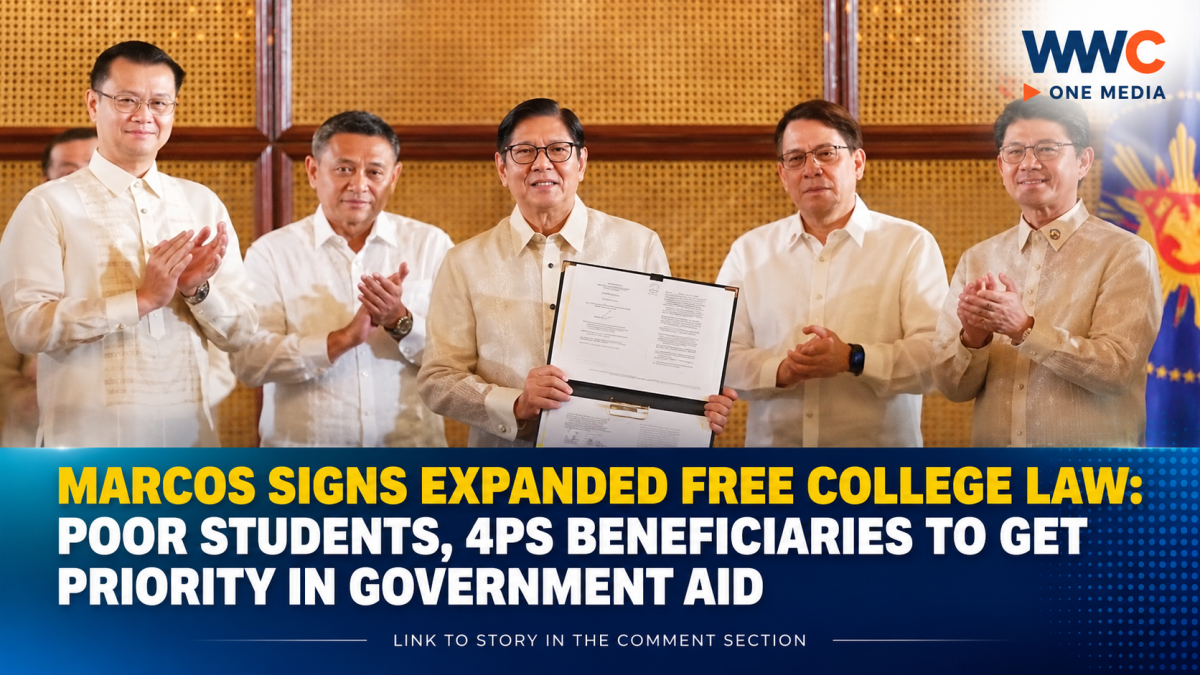
President Ferdinand “Bongbong” Marcos Jr. on Friday, September 4, signed Republic Act No. 12325, amending the Universal Access to Quality Tertiary Education Act (RA 10931) and expanding government assistance for disadvantaged students pursuing college and technical-vocational education.
The new law puts greater emphasis on making sure that government education assistance reaches students who need it most, particularly qualified beneficiaries from Pantawid Pamilyang Pilipino Program (4Ps) households.
Poorest students move to the front of the line
One of the biggest changes is a clearer prioritization system for the Tertiary Education Subsidy (TES).
Under RA 12325, eligible students from 4Ps households receive top priority for TES, while remaining slots are allocated according to household per-capita income.
Students enrolled in government-identified priority programs may also receive additional support.
The change addresses concerns that the original subsidy system was not consistently reaching the poorest Filipino families.
According to the Second Congressional Commission on Education (EDCOM 2), the share of TES grants going to students from the poorest households fell from 74.24% in 2018 to 30.74% in 2022.
That finding became a major argument for changing how financial assistance is targeted.
Free college support goes beyond tuition
The original RA 10931, enacted in 2017, already provides free tuition and other school fees for qualified Filipino students in state universities and colleges (SUCs), local universities and colleges (LUCs), and state-run technical-vocational institutions. It also established the TES and student-loan mechanisms.
But the amended law expands the types of expenses that government assistance can cover.
Among the new provisions are support for internships and Related Learning Experience (RLE) fees, particularly for nursing and other allied-health programs where clinical or practical training is a required part of the curriculum.
The law also provides allowances for students with disabilities and allows a one-year extension of program completion in justifiable circumstances.
Private colleges could also benefit
Perhaps one of the most significant changes is that government assistance will no longer be focused exclusively on public institutions.
RA 12325 establishes a Private Education Assistance (PEA) program for disadvantaged students enrolled in priority programs at qualified private higher-education institutions and technical-vocational institutions.
This creates another pathway for students who may qualify for assistance but cannot—or do not—attend a public college or university.
Marcos said the expanded assistance could help more Filipinos earn a degree, diploma or technical skills qualification.
Government assistance to be reviewed every two years
The law also introduces a mechanism intended to keep financial assistance more responsive to changing economic conditions.
The UniFAST Board is required to review and adjust TES amounts every two years, taking inflation and changing education costs into account.
Another reform creates a single learner reference code, designed to improve the identification and monitoring of beneficiaries as students move from secondary education into tertiary education.
The law also calls for formal mechanisms through CHED and TESDA to address student complaints and requires annual reporting to Congress covering program outcomes, budget utilization and employment-tracking data.
Equity plans required from public institutions
The amendments also require SUCs, LUCs and state-run technical-vocational institutions to implement Equity and Inclusion Plans.
These plans are intended to provide targeted assistance to disadvantaged students, including measures such as fee waivers and priority access to facilities.
The broader goal is to shift the country’s free-education policy from simply getting students through the doors of public institutions toward helping financially vulnerable learners remain in school and finish their programs.
Marcos orders agencies to move on implementation
During the ceremonial signing at Malacañang Palace, Marcos directed CHED, TESDA, UniFAST and other concerned agencies to prepare the implementing rules and regulations needed to put the amended law into effect.
The President said free access to education should not end with admission.
The administration’s stated objective is to ensure students have the support necessary to complete their college or technical-vocational education and eventually enter the workforce with stronger skills.
A major expansion of a law already helping millions
The amended measure builds on an education program that has already significantly expanded access to public higher education.
The Presidential Communications Office reported last week that the government’s Free Higher Education program was benefiting approximately 2.62 million students.
The original law, RA 10931, was signed in 2017 and institutionalized free tuition and other school fees in public higher-education institutions and state-run TVIs, alongside financial assistance programs for students facing additional education costs.
Now, RA 12325 attempts to address one of the program’s biggest challenges: making sure limited government assistance is concentrated on students who face the greatest financial barriers.
What students should watch next
The signing of RA 12325 does not mean every student will automatically receive every form of subsidy described in the law.
Eligibility, prioritization, grant amounts and implementation procedures will depend on the rules that CHED, TESDA, UniFAST and other agencies are required to issue.
For millions of Filipino students and families, however, the direction is clear: the government is expanding the safety net around tertiary education—with poor and disadvantaged learners, qualified 4Ps beneficiaries and students in priority programs moving closer to the centre of the system.
And the biggest question now is no longer whether the law will be signed—it is how quickly Filipino students will actually feel its impact.
WWC ONE MEDIA J.M.D



Leave a Reply