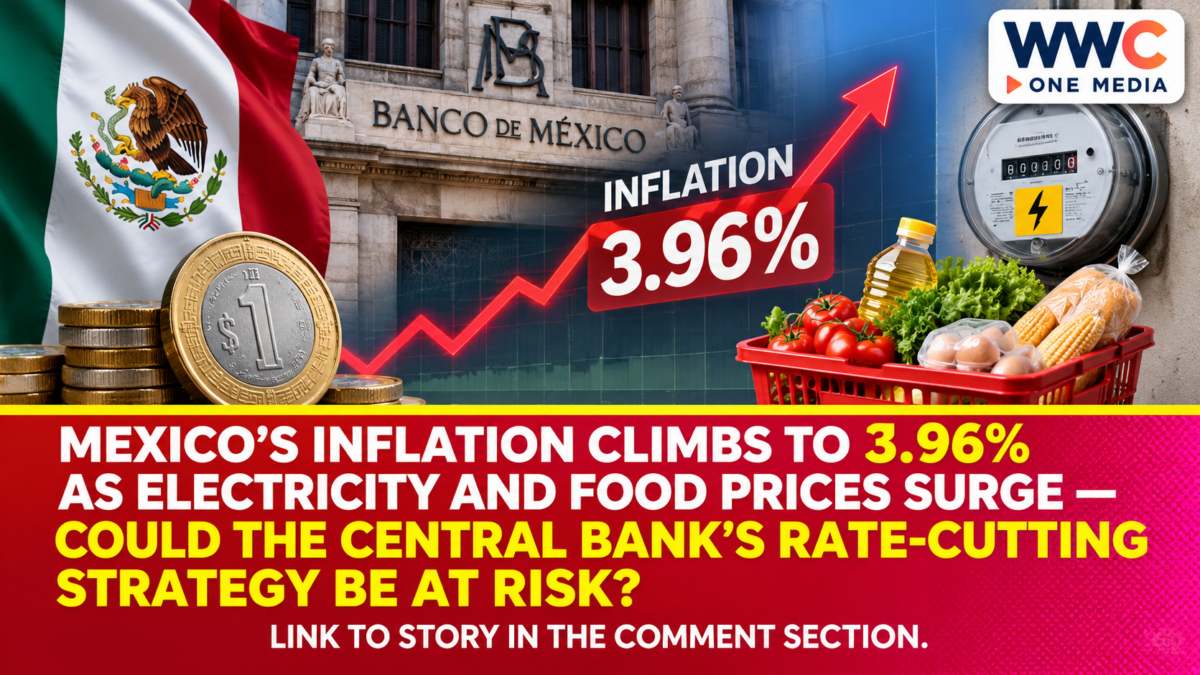
MEXICO CITY — Mexico’s inflation rate accelerated to 3.96% in the first half of November 2026 as sharply higher electricity charges and agricultural prices placed renewed pressure on household budgets, complicating the outlook for the country’s monetary policy.
Consumer prices increased by 0.54% compared with the preceding two-week period, while electricity prices jumped 20.74% and green tomato prices surged 39.31%.
However, the latest inflation report also revealed a significant improvement beneath the headline figure. Core inflation moderated to 3.68% annually, with the core consumer price index declining by 0.10% during the fortnight.
The contrasting developments arrive shortly after Banco de México, commonly known as Banxico, lowered its benchmark interest rate to 6.25%.
For policymakers, the challenge is determining whether the latest acceleration represents temporary pressure from selected commodities and seasonal electricity charges or a more persistent obstacle to achieving price stability.
Mexico Inflation Rate Approaches a Critical Threshold
Mexico’s annual consumer inflation increased from 3.61% in the first half of November 2025 to 3.96% in the corresponding period of 2026.
The latest reading places inflation close to the upper boundary of the central bank’s tolerance interval surrounding its 3% inflation target.
The national consumer price index reached 148.110 points during the first half of November.
However, the composition of inflation has changed considerably over the past year.
Annual core inflation declined from 4.32% to 3.68%, while non-core inflation increased from 1.29% to 4.90%.
The divergence suggests that volatile product categories are playing an increasingly important role in Mexico’s overall inflation performance.
For Banxico, this distinction matters because temporary increases in agricultural prices and regulated electricity charges may require a different monetary policy response from persistent increases across consumer goods and services.
The latest development follows WWC ONE MEDIA’s earlier coverage of Mexico’s decision to reduce its benchmark interest rate to 6.25%.
The November inflation figures provide an important test of the economic assumptions supporting that decision.
Electricity Prices Jump 20.74% as Seasonal Subsidies End
Electricity was the largest individual contributor to Mexico’s consumer price increase during the first half of November.
The national electricity price index increased by 20.74% compared with the preceding fortnight, contributing 0.283 percentage points to the overall consumer inflation reading for the period.
The increase was primarily associated with the conclusion of seasonal electricity tariff subsidies in 11 Mexican cities.
These included Mexicali, Ciudad Juárez, Culiacán, Chihuahua, Hermosillo, Matamoros, Colima, La Paz, Huatabampo, Jiménez and Esperanza.
The expiration of the warm-season electricity tariff programme contributed to a substantial adjustment in measured household energy costs.
However, the national electricity price increase does not mean every Mexican household experienced an identical rise in its electricity bill.
Actual expenses depend on household consumption, geographic location and the applicable tariff structure.
For monetary policymakers, the seasonal nature of the adjustment is particularly important.
A central bank cannot directly extend an electricity subsidy or determine regulated utility charges through its benchmark interest rate.
Nevertheless, higher energy expenses could influence broader consumer spending patterns and inflation expectations if households anticipate sustained increases in their living costs.
Tomatoes and Eggs Intensify Household Food Price Pressure
Agricultural prices represented another significant source of inflation during the first half of November.
Several frequently purchased food products recorded substantial price increases over the two-week period.
Among the most notable movements were:
- Green tomatoes or tomatillos: up 39.31%.
- Tomatoes: up 28.95%.
- Poblano peppers: up 26.97%.
- Serrano peppers: up 17.20%.
- Eggs: up 6.59%.
- Chicken: up 1.99%.
The broader fruit and vegetable price index increased by 5.50% during the fortnight.
Not every food product became more expensive, however.
Onion prices declined by 16.88%, while zucchini prices fell by 11.81%.
The uneven price movements illustrate the volatility that can characterise agricultural markets.
For households, the effect of inflation depends partly on purchasing patterns. Families that allocate a larger share of their budgets to products experiencing rapid price increases may face greater financial pressure than the national average suggests.
For businesses operating in food retail, hospitality and restaurants, fluctuating agricultural costs can complicate inventory management and commercial pricing decisions.
A short-term increase does not establish that these products will continue becoming more expensive at the same pace.
Subsequent price movements will depend on supply conditions, seasonal production and consumer demand.
Core Inflation Falls Despite Rising Headline Prices
Perhaps the most consequential development for Mexico’s monetary policy outlook is the decline in core consumer prices.
During the first half of November, the core index fell by 0.10%.
Goods prices within the core index declined by 0.25%, while services prices increased by just 0.05%.
Core inflation is intended to provide a clearer assessment of underlying price movements by excluding categories characterised by significant volatility or prices that do not respond directly to ordinary market conditions.
Its annual decline to 3.68% therefore provides a different perspective from the headline inflation increase.
However, core prices remain higher than they were one year earlier.
The fortnightly decline should not be interpreted as evidence that Mexico has entered economy-wide deflation or that household living costs have returned to previous levels.
Similar challenges involving different inflation indicators have emerged elsewhere, as examined in WWC ONE MEDIA’s coverage of Japan’s inflation acceleration and the Bank of Japan’s monetary policy outlook.
For central banks, understanding the composition of inflation can be as important as monitoring the overall rate.
Banxico’s Divided Board Faces Another Monetary Policy Test
Banco de México announced its latest interest rate reduction on November 5, lowering the overnight interbank funding rate target by 25 basis points to 6.25%, effective November 6.
The decision was approved by a narrow majority of the five-member Governing Board.
Governor Victoria Rodríguez Ceja and Deputy Governors José Gabriel Cuadra García and Omar Mejía Castelazo supported the reduction.
Deputy Governors Galia Borja Gómez and Jonathan Heath preferred maintaining the previous 6.50% rate.
The central bank indicated that maintaining the new rate for an extended period could support inflation’s eventual return to target.
Its November economic assessment also recognised continuing risks associated with exchange-rate movements, international trade policies, geopolitical developments, weather disruptions and rising production costs.
The bank’s published forecasts anticipate average annual headline and core inflation of 3.7% during the fourth quarter of 2026.
Both measures are projected to reach 3% in the fourth quarter of 2027.
These figures are forecasts rather than guaranteed outcomes. A single fortnightly reading cannot independently establish whether a quarterly average forecast will be achieved.
The international context remains relevant, particularly amid continuing debates over United States Federal Reserve interest rates.
Different monetary policy decisions can influence international financing conditions, investment flows and exchange rates, although Mexico does not automatically need to follow changes in US interest rates.
What Happens Next for Mexico’s Economy?
Mexico’s immediate monetary policy outlook will depend on whether the recent increases in electricity and agricultural prices prove temporary or develop into broader inflationary pressures.
A sustained moderation in core inflation could support Banxico’s stated preference for maintaining its current interest rate.
Conversely, persistent price increases, deteriorating inflation expectations or significant exchange-rate depreciation could complicate that strategy.
Businesses will also need to evaluate how changes in operating costs, financing conditions and consumer purchasing power affect their commercial plans.
The next fortnightly consumer inflation bulletin is scheduled for December 23, 2026.
For households, the latest figures confirm that everyday expenses remain under pressure despite improvements in selected underlying inflation indicators.
For Banxico, the challenge is considerably more complex than responding to a single headline number.
Mexico’s inflation rate is approaching 4%, but its core inflation indicator is moderating. Determining which trend will dominate could shape the next phase of the country’s monetary policy.
Frequently Asked Questions
What is Mexico’s current inflation rate?
Mexico’s annual headline inflation reached 3.96% in the first half of November 2026. Consumer prices increased by 0.54% compared with the preceding fortnight.
Why did electricity prices increase in Mexico?
Electricity prices increased by 20.74% during the first half of November, largely following the expiration of seasonal electricity tariff subsidies in 11 cities.
What is Mexico’s current core inflation rate?
Annual core inflation reached 3.68%. The core consumer price index declined by 0.10% compared with the preceding fortnight.
What is Banxico’s current benchmark interest rate?
Banco de México’s overnight interbank funding rate target stands at 6.25%, following a 25-basis-point reduction effective November 6, 2026.
Will Mexico’s central bank raise interest rates again?
No new rate increase has been announced. Banxico previously indicated that maintaining the current rate for an extended period could support its inflation objectives. Future decisions will depend on economic conditions and subsequent inflation data.