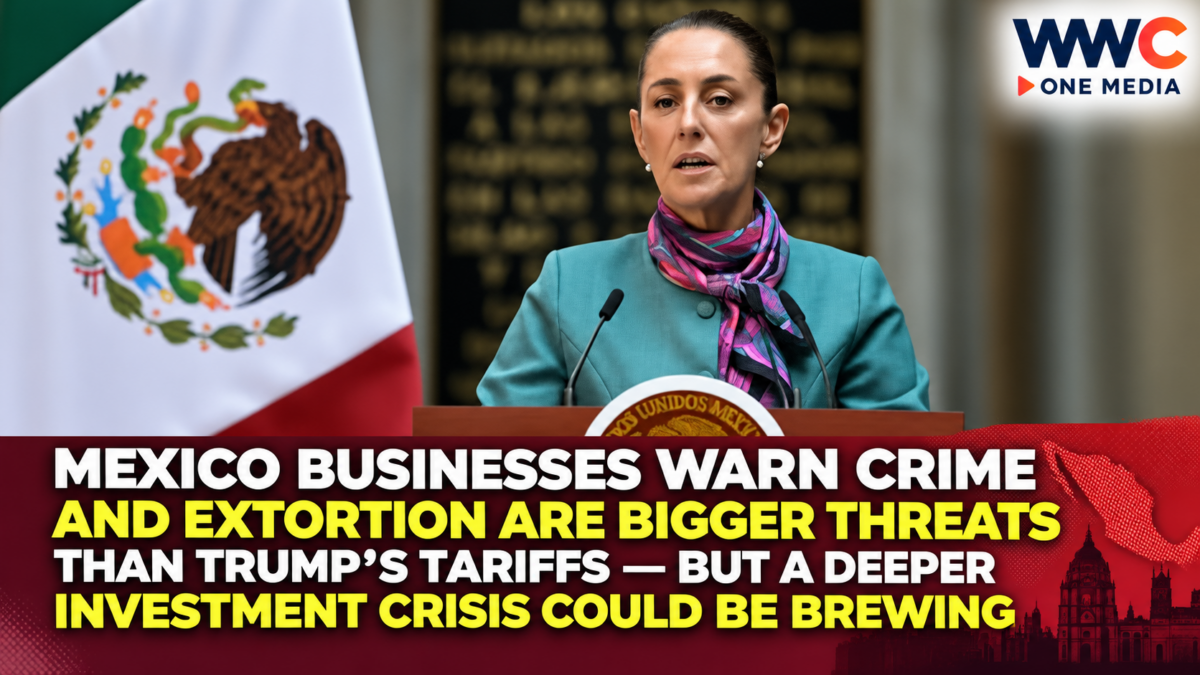
MEXICO CITY, Mexico — October 14, 2026 — Mexican businesses are sounding the alarm over an increasingly dangerous investment environment, warning that organized crime, extortion, judicial uncertainty and tougher tax enforcement have become greater obstacles to expansion than US President Donald Trump’s trade tariffs.
The warning comes from José Medina Mora, president of Mexico’s influential Business Coordinating Council (Consejo Coordinador Empresarial or CCE), who says domestic problems are making companies reconsider investments despite Mexico’s strategic position alongside the United States.
In an October 12 interview reported by Bloomberg, Medina Mora described how criminal organizations have moved beyond traditional protection rackets to interfere directly with the movement and sale of goods.
Some businesses allegedly face forced arrangements involving intermediaries linked to organized crime, increasing distribution costs and reducing legitimate companies’ control over their operations.
The concerns extend beyond security. Business leaders also point to uncertainty surrounding Mexico’s judicial overhaul, stricter tax-deduction rules and shortages of electricity needed for major industrial projects.
But while Trump’s tariffs dominate international headlines, Mexico’s corporate leaders are warning of a potentially more damaging problem: What happens if businesses lose confidence in their ability to operate safely and profitably at home?
Mexico’s Biggest Business Threat May No Longer Be Washington
For years, Mexico’s economic prospects have been closely tied to changes in US trade policy.
Its manufacturing sector relies heavily on access to the American market, while its automotive, electronics and industrial supply chains are deeply integrated with those of its northern neighbor.
But Medina Mora argues that the risks confronting companies inside Mexico have become more immediate.
Persistent criminal activity, uncertainty over the courts and disputes with tax authorities are weighing on investment decisions.
That assessment does not mean US tariffs have become irrelevant.
Instead, the CCE is drawing attention to the combined burden of external trade restrictions and domestic operating risks.
For a company considering a new factory, warehouse or distribution center, access to the US market is important — but so are reliable transportation, enforceable contracts, predictable taxation and employee safety.
The central business concern is that favorable geography alone cannot compensate for weaknesses in the domestic investment environment.
Criminal Groups Allegedly Control Parts of Mexico’s Distribution Networks
One of the most troubling allegations involves the expansion of organized crime into ordinary commercial activities.
According to Medina Mora’s account to Bloomberg, criminal organizations in some regions have moved beyond collecting protection payments.
They are now allegedly inserting themselves into distribution networks and controlling how certain products reach customers.
He highlighted concerns in Sonora, Colima and Michoacán, states with major commercial, agricultural or logistical activities.
The CCE president described cases in which suppliers of construction materials were allegedly compelled to sell through criminal intermediaries.
Those intermediaries then resold the goods at a markup of around 20%, according to his account.
Similar practices reportedly affect products such as beer, shrimp and avocados.
If businesses cannot freely choose their suppliers or customers, they may face higher operating costs, reduced profitability and disruption to legitimate distribution arrangements.
However, the 20% figure is an example reported by the CCE president, not a verified nationwide markup imposed on all Mexican products.
The allegations also do not establish that every distribution business in the affected states is under criminal control.
CCE Says One in Two Businesses Experienced Crime
The scale of criminal activity has become a central concern for Mexico’s private sector.
Medina Mora told Bloomberg that approximately one in two companies reported being a victim of crime during the previous year.
He identified merchandise theft as the most common problem, followed by extortion, vehicle theft and cybercrime.
These offenses can affect businesses in different ways.
Cargo theft creates losses for manufacturers, logistics firms and retailers.
Extortion can force companies to divert resources away from wages, equipment and expansion.
Vehicle theft can interfere with commercial operations, while cybercrime exposes businesses to financial losses and data-security risks.
For smaller companies with limited financial reserves, repeated incidents can be particularly damaging.
However, the one-in-two figure is an estimate cited by the CCE leader. It should not be interpreted as a finding that half of all Mexican companies were formally convicted of or involved in criminal activity.
The actual impact varies by industry, location and business size.
President Claudia Sheinbaum Points to Progress Against Crime
Mexico’s government has highlighted progress in its security strategy under President Claudia Sheinbaum.
According to Bloomberg’s October 12 report, the administration has pointed to a substantial decline in the country’s homicide rate compared with 2020.
The government has also reported more than 2,000 arrests following the introduction of an anti-extortion strategy in 2025.
That initiative included a national hotline for reporting extortion and plans to expand specialized investigative capacity.
Medina Mora acknowledged improvements in certain crime indicators.
However, he argued that businesses continue to face serious problems involving extortion, insecurity and the rule of law.
The differing assessments reflect an important distinction.
A reduction in homicides does not necessarily mean that extortion, cargo theft or other economically damaging crimes have declined at the same pace.
Likewise, arrest totals do not automatically demonstrate that criminal networks have been dismantled or that convictions have followed.
For businesses, the effectiveness of the government’s strategy will ultimately be measured by improvements in everyday security and commercial operations.
Judicial Reform Raises Concerns About Legal Certainty
Mexico’s judicial overhaul has become another source of debate between policymakers and investors.
The constitutional reforms introduced an electoral process for selecting judges, including members of the country’s Supreme Court.
Supporters argue that the changes can strengthen democratic accountability and reduce the influence of entrenched political and judicial interests.
Critics worry that judicial elections could expose courts to political pressure, create uncertainty and weaken the consistency of legal decisions.
For businesses, confidence in the justice system is closely connected to investment decisions.
Companies entering long-term agreements want to know that contracts can be enforced and disputes resolved through predictable legal procedures.
Medina Mora said international investors appear to have become more accepting of the revised judicial framework than they initially were.
Nevertheless, domestic companies continue to express concerns about legal certainty.
The dispute illustrates why investor confidence depends not only on the text of legislation but also on how institutions function in practice.
Mexico’s Tax Crackdown Could Put More Pressure on Businesses
Financial uncertainty is another major concern raised by the business council.
According to Bloomberg, a CCE review of delayed investment projects identified disputes with Mexico’s Tax Administration Service, known as SAT, as a recurring obstacle.
Some businesses along the US border complained of double taxation, while others faced disagreements involving tax claims applied to earlier periods.
Business leaders are also concerned about government proposals affecting corporate income-tax deductions.
The CCE argues that limiting certain deductions could place additional pressure on companies operating with thin profit margins.
In a separate October 8 report by Expansión, Medina Mora warned that poorly designed tax changes could threaten the viability of otherwise compliant businesses.
From the government’s perspective, stronger enforcement and limits on inappropriate deductions can help protect public revenue and improve tax compliance.
The challenge is ensuring that enforcement is predictable, lawful and proportionate.
For investors, uncertainty about future tax liabilities can make projects harder to evaluate.
Mexico Risks Losing Semiconductor and AI Investments
The economic consequences may extend beyond existing companies.
In an October 13 interview with UnoTV, Medina Mora said Mexico had lost investment opportunities involving semiconductors and artificial intelligence infrastructure.
He identified insufficient energy supply, security concerns and uncertainty about the legal environment as important obstacles.
Advanced technology facilities often require substantial amounts of reliable electricity.
Data centers supporting AI systems also depend on adequate transmission capacity, cooling infrastructure and long-term energy arrangements.
If investors cannot secure reliable power, they may choose locations offering better infrastructure.
This presents a challenge for Mexico’s efforts to attract higher-value industrial investment.
Its proximity to the United States makes it attractive for companies seeking North American production and supply-chain options.
However, Mexico must also provide the electricity, infrastructure and regulatory certainty necessary for major manufacturing and technology projects.
The CCE’s comments do not establish how much investment was lost in total or prove that every potential semiconductor project failed because of energy shortages.
They do highlight a concrete concern raised by business leaders about missed industrial opportunities.
Trump Tariffs Still Threaten Mexico’s Automotive, Steel and Aluminum Industries
Despite the focus on domestic risks, US trade restrictions remain a major concern.
Washington’s tariffs on automobiles, steel and aluminum continue to affect Mexican exporters.
Medina Mora argues that Mexico faces disadvantages compared with some competing exporters that have negotiated more favorable trade arrangements.
The CCE has urged authorities to pursue reductions in the tariffs, including measures imposed under Section 232 of US trade law.
Section 232 allows the United States to impose trade restrictions on national security grounds.
These measures can influence the costs and competitiveness of imported industrial products.
Mexico’s close integration with the US automotive supply chain makes tariff uncertainty particularly important.
Automakers and parts manufacturers frequently operate across the border, with components moving between the two countries during production.
Additional trade costs can complicate pricing, investment and sourcing decisions.
However, the existence of US tariffs does not mean every Mexican export faces the same duty.
Applicable treatment depends on product classification, trade-agreement requirements and specific US trade measures.
USMCA Negotiations Remain a Major Economic Test
The future of the United States–Mexico–Canada Agreement, known as USMCA or T-MEC in Spanish, remains central to Mexico’s economic strategy.
The agreement supports trade and investment across the three North American economies.
Business groups want a durable arrangement that provides predictable market access and encourages long-term investment.
In October 9 reporting by EFE, Medina Mora said businesses favored extending the agreement for another 16 years, with periodic reviews rather than prolonged uncertainty.
The CCE believes a more stable trade framework would encourage companies to expand manufacturing and commercial operations.
However, negotiations remain complicated by disagreements over tariffs, energy policy and other issues.
President Sheinbaum has emphasized that the USMCA remains in effect while negotiations continue.
No final long-term extension had been announced in the reporting reviewed.
For businesses, the outcome will influence decisions involving factories, supply chains, logistics networks and international investment.
Trump Pushes Mexico for More Energy Cooperation
Energy has become an increasingly important part of the US–Mexico trade relationship.
According to an October 10 Financial Times report, President Trump has pressed Mexico to consider deeper energy partnerships with American companies.
The discussions include the possibility of increasing Mexican purchases of US natural gas and other energy products.
Such proposals are politically sensitive because Mexico has traditionally emphasized national control over strategic energy resources.
State-owned companies Pemex and the Federal Electricity Commission play major roles in the country’s energy sector.
Sheinbaum’s administration has sought to balance public-sector energy priorities with the need for private investment and infrastructure development.
On October 12, Medina Mora suggested that additional purchases of US fuels and semiconductors could help address American concerns about its bilateral trade deficit.
However, proposals involving increased energy purchases should not be confused with finalized agreements.
The negotiations remain subject to political, commercial and regulatory decisions.
Mexico Still Has Major Advantages for International Investors
Despite the warnings, business leaders have not abandoned their optimism about Mexico’s long-term investment potential.
In an October 11 interview with El Economista, Medina Mora described Mexico as a highly attractive destination for investment in Latin America.
He highlighted the country’s geographic proximity to the United States and its potential to participate in advanced manufacturing and technology supply chains.
Mexico also benefits from an established industrial base, export infrastructure and existing relationships with international companies.
Its automotive and electronics sectors are especially important to North American production networks.
The message from the CCE is therefore more nuanced than a prediction of economic collapse.
Business leaders see substantial opportunities, but they argue that those opportunities require improvements in security, energy availability and legal certainty.
The distinction matters because Mexico could remain attractive to foreign investors while still losing individual projects to competing countries.
Sheinbaum Seeks to Unlock More Private Investment
The Mexican government has also been pursuing greater cooperation with private companies.
According to an October 11 El País report, Sheinbaum has intensified efforts to attract investment and accelerate infrastructure projects.
The administration has helped advance more than 20 previously delayed projects, including energy investments valued at over $3.75 billion.
It has also promoted partnerships involving semiconductors, transportation and medical devices.
The government wants stronger collaboration between public institutions and private businesses to stimulate economic growth.
Business representatives have welcomed opportunities for dialogue but continue to seek clearer rules and more reliable infrastructure.
This creates a policy challenge for the administration.
Attracting investment requires more than announcing projects or negotiating trade agreements.
Companies also need confidence that construction, energy supply, taxation and commercial operations will remain viable over the life of their investments.
New Business Security Assessment Adds to Investor Concerns
A separate October 13 report by Expansión highlighted weaknesses in Mexico’s business operating environment.
The publication cited the US Chamber of Commerce’s Global Rule of Law and Business Dashboard 2026.
According to the report, Mexico scored 24.7 out of 100 in the assessment, below Guatemala’s 31.8 and Honduras’ 33.1.
The framework evaluates conditions linked to transparency, predictability, stability, accountability and due process.
Mexico’s weak score reflects concerns about security and institutional reliability.
However, the assessment is an index-based evaluation of business conditions rather than a direct measurement of foreign investment flows.
It should not be interpreted as proof that Mexico is less attractive than every neighboring country in all investment categories.
Nevertheless, the findings reinforce the CCE’s argument that the domestic operating environment requires attention.
What Mexico’s Investment Problems Mean for Global Supply Chains
Mexico plays an important role in international manufacturing and trade.
Factories in the country supply automobiles, components, electronics and numerous other products to North American markets.
If companies face higher costs from insecurity, tax disputes or unreliable infrastructure, those problems can influence the competitiveness of products moving through international supply chains.
Manufacturers may respond by changing suppliers, shifting distribution routes or postponing expansion.
Over time, some businesses could reconsider where to place new factories and logistics facilities.
For international investors, the important question is whether Mexico can provide a combination of low operating risk, reliable infrastructure and access to major markets.
The country retains important structural advantages.
But those advantages may be weakened if companies cannot consistently operate without disruption.
Could Southeast Asia Benefit From Mexico’s Investment Challenges?
The concerns raised by Mexican business leaders are also relevant to other emerging manufacturing economies.
Countries across Southeast Asia compete for investment in electronics, automotive components, data centers and related industrial activities.
Investors considering new facilities often compare energy reliability, transportation costs, tax policies, workforce capabilities and political risk across potential locations.
If Mexico struggles to meet certain investment requirements, some projects could become more attractive elsewhere.
However, there is no verified evidence that the projects highlighted by the CCE were redirected specifically to the Philippines, Vietnam, Thailand or any other Southeast Asian country.
Any such shift would depend on the characteristics of individual projects and the advantages of alternative locations.
The broader lesson for emerging economies is that investment competitiveness depends on institutional quality and infrastructure as much as market access.
The Bigger Question: Can Mexico Fix Its Domestic Risks Before Investment Moves Elsewhere?
Mexico is entering a crucial period for its economy.
Its proximity to the United States, established manufacturing networks and potential role in the AI supply chain create substantial long-term opportunities.
But business leaders warn that crime, extortion, judicial uncertainty, taxation and infrastructure constraints are undermining confidence.
The government points to progress against violent crime and is pursuing greater cooperation with investors.
The CCE, meanwhile, is calling for stronger action to protect businesses and create more predictable conditions for growth.
US trade policy remains an important source of uncertainty, especially for automotive, steel and aluminum exporters.
Yet the most immediate investment challenges identified by the business council are increasingly domestic.
The outcome will depend on whether Mexico can improve security, strengthen confidence in legal institutions, establish predictable tax rules and provide the infrastructure required by new industries.
Trump’s tariffs may threaten Mexico’s exporters, but the country’s business leaders are warning about something closer to home: Unless crime, legal uncertainty and infrastructure problems are addressed, Mexico could lose investment opportunities even if it secures better trade terms with Washington.