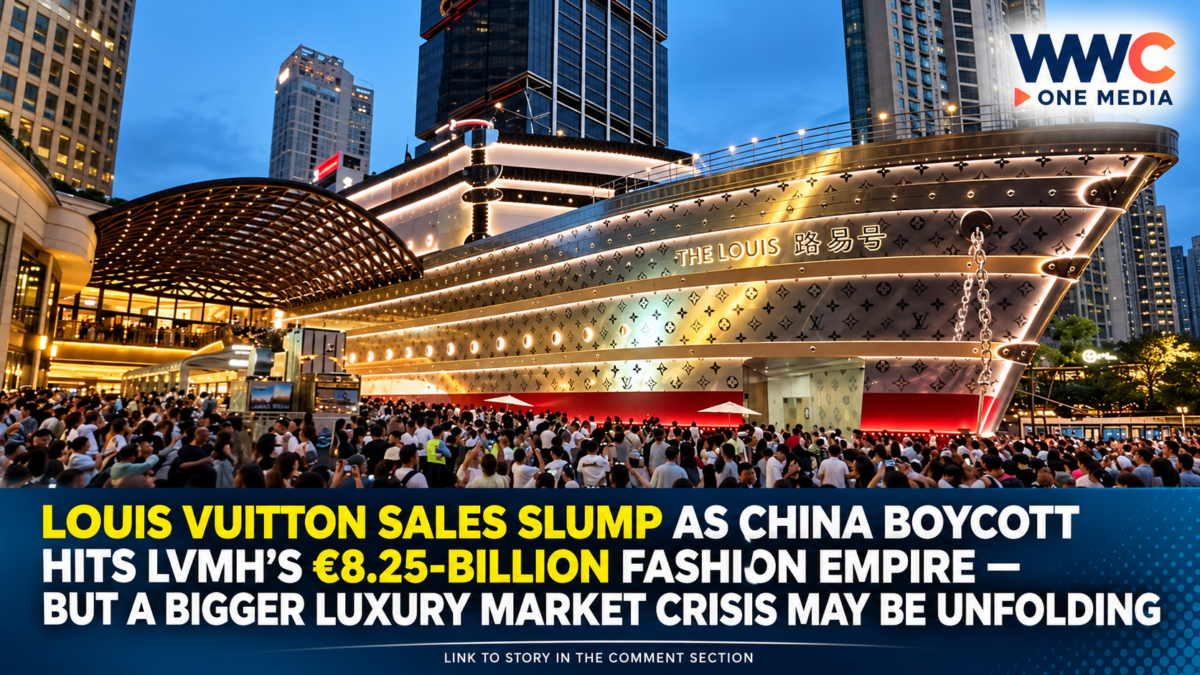
PARIS, France — October 14, 2026 — The world’s largest luxury goods company, LVMH Moët Hennessy Louis Vuitton, is facing renewed pressure after sales at its flagship fashion and leather goods division fell sharply in the third quarter, exposing the luxury industry’s growing dependence on an increasingly cautious Chinese consumer market.
The French conglomerate reported a 5% decline in organic sales at its fashion and leather goods division during the three months ended September 30, significantly worse than analysts’ expectations for a decline of approximately 1.6% to 1.8%.
The division, home to globally recognized brands including Louis Vuitton, Christian Dior, Fendi, Celine, Loewe and Loro Piana, generated approximately €8.25 billion in quarterly revenue, down from €8.50 billion a year earlier.
The disappointing performance came as China’s economic difficulties weighed on high-end consumer spending, while Louis Vuitton faced a separate backlash involving a trademark dispute with Chinese tea company Molly Tea.
Despite growth in other businesses, LVMH’s overall quarterly organic revenue increased just 1%, below market expectations.
The results have intensified concerns that the global luxury industry’s prolonged slowdown could continue into 2027.
But as Louis Vuitton struggles to regain momentum in China, an even bigger question is emerging: Can the world’s most powerful luxury brands defend their premium prices when wealthy consumers are increasingly reluctant to spend?
LVMH Fashion and Leather Goods Sales Fall 5%
LVMH’s third-quarter results revealed a significant deterioration in its most important business division.
According to the company’s October 12 financial announcement, fashion and leather goods revenue reached €8.245 billion, compared with €8.497 billion in the corresponding quarter of 2025.
On an organic basis, which adjusts for currency movements and changes in the company’s business structure, sales declined 5%.
The result was considerably weaker than analysts expected.
Bloomberg reported that the market had anticipated an organic contraction of approximately 1.57%, while Reuters cited a forecast decline of around 1.8%.
The disappointing performance is particularly important because fashion and leather goods account for nearly half of LVMH’s total revenue.
Louis Vuitton and Christian Dior are among the most recognizable brands in the group’s portfolio and play a central role in its financial performance.
The division had returned to modest organic growth during the second quarter of 2026, raising hopes that the luxury industry’s downturn was beginning to ease.
However, the third-quarter reversal suggests that the recovery remains fragile.
LVMH Q3 2026 Financial Results: Which Businesses Grew and Which Declined?
LVMH reported total group revenue of €18.504 billion during the third quarter of 2026.
That represented 1% organic growth compared with the same period last year.
However, the performance varied significantly across the conglomerate’s business divisions.
LVMH THIRD-QUARTER 2026 REVENUE
| Business Division | Revenue | Organic Growth |
|---|---|---|
| Fashion and Leather Goods | €8.25 billion | -5% |
| Wines and Spirits | €1.43 billion | +6% |
| Perfumes and Cosmetics | €2.01 billion | +1% |
| Watches and Jewelry | €2.50 billion | +6% |
| Selective Retailing | €4.07 billion | +8% |
| Other Activities and Eliminations | €251 million | Not specified |
| Total LVMH Group | €18.50 billion | +1% |
The figures show that the decline was concentrated in LVMH’s fashion and leather goods business.
Other divisions, including selective retailing, watches and jewelry, and wines and spirits, recorded positive organic growth.
For the first nine months of 2026, LVMH generated €57.1 billion in revenue, representing 2% organic growth.
Nevertheless, the weak performance of its biggest division overshadowed improvements elsewhere.
China’s Economic Troubles Hit Louis Vuitton’s Biggest Growth Opportunity
China has historically been one of the most important drivers of global luxury consumption.
An expanding middle class, rising household wealth and growing demand for designer products helped brands such as Louis Vuitton, Dior, Gucci and Hermès establish a strong presence in the country.
However, economic conditions have changed.
China’s prolonged property market downturn, weaker consumer confidence and uncertainty surrounding household wealth have made some shoppers more cautious.
Even affluent consumers are reassessing purchases of expensive handbags, clothing and accessories.
According to Reuters, LVMH experienced a 5% sales decline in its Asia region excluding Japan during the third quarter.
By comparison, sales in the United States rose approximately 5%.
The contrasting performances highlight how luxury consumption trends are diverging across major markets.
LVMH said its United States, European and Japanese businesses maintained positive momentum, but China’s weaker environment affected overall performance.
For the luxury industry, the challenge is that slower Chinese demand cannot always be offset quickly by growth elsewhere.
Louis Vuitton Faces Chinese Consumer Backlash Over Molly Tea Dispute
Adding to the difficulties is a controversy involving Louis Vuitton and Chinese beverage company Molly Tea.
According to Bloomberg reporting republished by The Edge Malaysia, Louis Vuitton faced criticism from Chinese consumers after prevailing in a trademark dispute against the smaller tea brand.
The dispute generated negative reactions online, with some consumers accusing the luxury company of acting unfairly toward a domestic Chinese business.
Reports indicated that Louis Vuitton’s sales in China were particularly weak during July and August.
The controversy came at a sensitive time for international luxury brands competing for the attention of Chinese shoppers.
Consumer sentiment and brand reputation are especially important in an industry where purchasing decisions are influenced by prestige, identity and emotional attachment.
However, the precise financial effect of the Molly Tea controversy has not been separately quantified in LVMH’s official financial disclosures.
It would therefore be inaccurate to attribute the entire 5% fashion division decline to the boycott.
The broader economic slowdown in China remains a major contributing factor.
LVMH Shares Lose More Than 40% in 2026
The weaker sales performance has added pressure to LVMH’s shares.
According to Bloomberg and Reuters reporting, LVMH had lost more than 40% of its market value during 2026, making it one of the worst-performing major European luxury stocks.
Its decline reflects concerns over slowing earnings growth, weaker Chinese demand and uncertainty surrounding the industry’s recovery.
The company has also suffered as investors reassess the valuations they are willing to pay for businesses traditionally considered highly profitable and resilient.
For years, major luxury brands commanded premium market valuations because of their strong margins, pricing power and global brand recognition.
However, those advantages become less valuable to investors if sales stagnate or consumers resist further price increases.
The selloff has also affected the wealth associated with LVMH’s controlling Arnault family.
Bernard Arnault, the group’s chairman and chief executive, has seen the market value of his holdings decline alongside the company’s shares.
Nevertheless, share-price losses do not directly measure operating losses or cash disappearing from LVMH’s businesses.
They reflect changes in investors’ assessment of the company’s future financial value.
European Luxury Giants Face a Wider Market Collapse
LVMH is not alone.
Reuters reported on October 13 that Europe’s major luxury groups had collectively lost approximately $350 billion in market capitalization during the sector’s downturn.
Companies affected include Hermès, Kering and Richemont.
The scale of the decline demonstrates how dramatically investor sentiment has changed toward an industry that benefited from strong demand following the pandemic.
Luxury groups previously relied on a combination of wealthy Western customers, Chinese consumers and international tourism to support expansion.
However, the industry’s recovery has been challenged by weak economic confidence, geopolitical uncertainty and changing consumer habits.
Hermès has also experienced substantial share-price pressure, while Kering continues to face challenges involving its Gucci business.
Richemont, the owner of Cartier and Van Cleef & Arpels, has shown comparatively stronger resilience in certain periods, supported by jewelry demand.
The divergent results demonstrate that not all luxury categories are responding in the same way.
Watches and Jewelry Offer LVMH Some Relief
Although fashion and leather goods disappointed, LVMH’s watches and jewelry division remained a source of growth.
The segment generated approximately €2.50 billion in third-quarter revenue, with organic sales increasing 6%.
The division includes globally recognized brands such as Bulgari, Tiffany & Co., TAG Heuer and Hublot.
Jewelry demand has proved relatively resilient compared with some categories of designer clothing and handbags.
However, even this business is showing signs of slower momentum.
Reuters reported that watches and jewelry growth moderated from approximately 9% in the first half of 2026 to 6% in the third quarter.
The slowdown suggests that consumers may be becoming more selective even when purchasing products traditionally associated with enduring value and prestige.
For LVMH, stronger jewelry performance provides diversification, but it cannot fully offset weakness in the much larger fashion and leather goods business.
Sephora and Selective Retailing Deliver Stronger Growth
LVMH’s selective retailing business delivered one of the strongest performances in the quarter.
Organic revenue increased 8%, supported by the division that includes Sephora and other retail operations.
The result highlights the different spending patterns emerging within the luxury and premium consumer market.
Beauty products can attract a broader customer base than expensive designer handbags or couture clothing.
Consumers unwilling to purchase a luxury handbag may still spend on premium cosmetics, skincare or fragrance.
This difference can make beauty retail comparatively resilient during periods of slower discretionary spending.
For LVMH, Sephora’s performance offers an important source of revenue diversification.
However, the overall group remains heavily dependent on fashion and leather goods for its financial strength.
Dior, Loro Piana and Louis Vuitton Continue Product Innovation
Despite the slowdown, LVMH is continuing to invest in its brands.
In its official third-quarter announcement, the company highlighted the creative development of Louis Vuitton, Christian Dior and Loro Piana.
Louis Vuitton has been celebrating the 130th anniversary of its iconic Monogram, introducing updated interpretations of its traditional designs.
The brand has also continued promoting ready-to-wear collections designed by Nicolas Ghesquière and its men’s collections led by Pharrell Williams.
Christian Dior reported positive interest in designs by Jonathan Anderson, particularly in ready-to-wear and leather goods.
The company also opened a new Dior flagship store on Milan’s Via Monte Napoleone in September.
Meanwhile, Loro Piana continued to expand its premium fashion offering and invested in manufacturing capabilities in Italy.
These initiatives are intended to maintain brand desirability and attract customers through design, craftsmanship and distinctive retail experiences.
However, their financial benefits will depend on consumer demand and the ability of each brand to convert interest into profitable sales.
Why LVMH Is Unlikely to Cut Louis Vuitton Prices
One possible response to weaker demand would be to reduce prices.
But discounting presents particular risks for luxury brands.
Louis Vuitton and Dior depend on exclusivity, perceived quality and strong brand positioning to justify premium prices.
Broad price reductions could undermine that positioning and create expectations of further markdowns.
According to Reuters, LVMH’s finance leadership indicated that the company was not seeking a quick recovery through price cuts.
Instead, the group is focusing on innovation, product quality and brand appeal.
The strategy reflects a fundamental principle of luxury retail: maintaining brand desirability can be more important than maximizing short-term sales volume.
Nevertheless, resisting discounts may also mean accepting a slower recovery if consumers remain reluctant to spend.
For investors, this raises the question of how long LVMH can sustain premium positioning without stronger revenue growth.
Chinese Consumer Confidence Becomes the Luxury Industry’s Biggest Test
The future of the luxury market remains closely linked to China’s economic recovery.
A sustained improvement in household confidence could support demand for international luxury brands.
However, challenges involving the property market, employment expectations and consumer wealth could continue affecting discretionary purchases.
Affluent Chinese consumers may also be changing how they evaluate luxury products.
Some shoppers are becoming more selective about design, brand reputation and perceived value.
Local Chinese brands are competing more actively for consumer attention, while international companies must navigate cultural sensitivities and changing preferences.
For Louis Vuitton, restoring momentum will therefore require more than waiting for economic conditions to improve.
The brand must maintain relevance in a market where consumers have become increasingly demanding.
Middle East Conflict Adds Another Challenge for Luxury Tourism
Geopolitical tensions are creating additional uncertainty for luxury retailers.
The prolonged Middle East conflict has affected international travel patterns and contributed to volatility in energy prices.
Luxury brands often rely on international tourists purchasing high-end products while visiting major shopping destinations.
Changes in travel flows can influence sales across European luxury capitals and other major retail centers.
The broader economic effects of high energy prices can also weaken discretionary spending.
However, the impact varies across countries and customer groups.
The October 12 LVMH results do not establish that Middle East disruptions were the primary cause of the group’s fashion and leather goods decline.
China’s slowdown was the more clearly identified pressure in the official announcement.
What the LVMH Slump Means for Asia’s Luxury Market
Asia remains critically important to the global luxury industry.
International brands operate extensive retail networks across China, Japan, South Korea, Singapore, Thailand and other major consumer markets.
The region also serves as a manufacturing and distribution hub for parts of the global fashion and accessories supply chain.
Weak Chinese demand can influence international retail expansion plans, store investment and marketing strategies.
However, growth in other Asian economies may provide opportunities for luxury companies seeking to diversify their customer base.
Southeast Asia’s expanding affluent population remains relevant to long-term luxury retail strategies.
But there is no verified evidence that the latest LVMH results will directly cause store closures or major employment cuts in the Philippines.
Any local impact would depend on company-specific investment and operating decisions.
What Investors Should Watch Next
The next stage of the luxury industry’s recovery will depend on several developments.
China’s economic recovery: Improving consumer confidence and household wealth could support demand for luxury goods.
Louis Vuitton sales: Investors will monitor whether the flagship brand returns to organic growth.
Luxury pricing power: Companies must demonstrate that customers remain willing to pay premium prices.
Holiday-season demand: The final quarter of 2026 will be important for evaluating consumer spending and product demand.
Competitor earnings: Results from Hermès, Kering, Richemont and other luxury groups will help determine whether LVMH’s weakness reflects a broader industry pattern.
Brand reputation: Consumer sentiment and public controversies may continue influencing purchasing decisions.
Profit margins: Investors will assess whether luxury companies can protect profitability while sales growth remains subdued.
These developments will help determine whether the industry stabilizes or faces another difficult year in 2027.
The Bigger Question: Is Luxury Losing Its Pricing Power?
LVMH’s disappointing third-quarter performance has raised questions about one of the most important assumptions behind the global luxury business model.
For years, investors believed that prestigious brands could maintain demand through economic cycles by combining exclusivity, craftsmanship and powerful marketing.
China’s expanding consumer market reinforced that belief.
But the latest results suggest that even the strongest luxury brands are not immune to changes in consumer confidence.
Louis Vuitton remains one of the world’s most recognizable fashion houses.
Yet its parent company’s largest division is recording declining sales while the broader luxury sector faces severe market pressure.
LVMH continues to benefit from its diversified businesses, including jewelry, cosmetics, wines and spirits, and retailing.
However, its future growth will depend heavily on whether its flagship fashion brands can regain momentum.
Louis Vuitton’s sales decline is more than a disappointing quarterly result. It is a warning that the global luxury industry may be entering a new era in which prestige alone is no longer enough to guarantee growth — and the biggest test could come if China’s wealthy consumers remain unwilling to return to their old spending habits.