
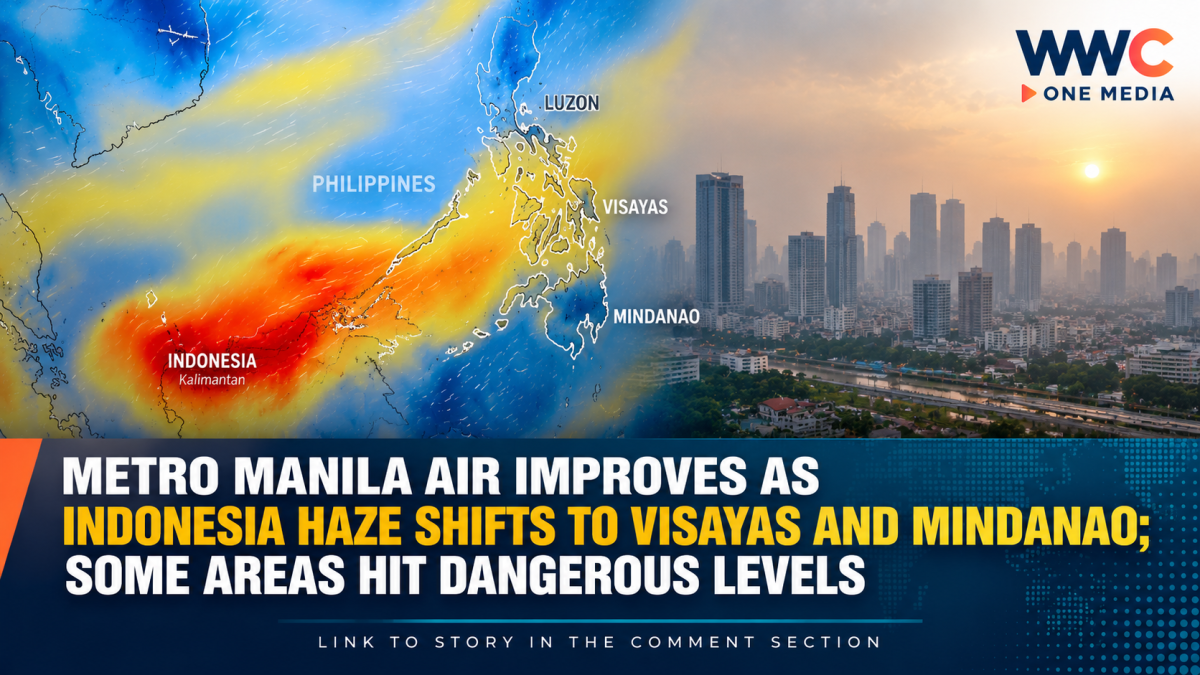
MANILA, Philippines — Residents in Metro Manila may finally have some relief from the recent haze, but the country’s air-quality problem is far from over.
The Department of Environment and Natural Resources–Environmental Management Bureau (DENR-EMB) reported that air quality in the National Capital Region has improved, with the latest monitoring showing generally good conditions at listed monitoring stations.
However, the improvement in Luzon has been accompanied by worsening conditions in parts of the Visayas and Mindanao, where elevated levels of fine particulate matter, particularly PM2.5, have been recorded.
The haze has been linked by environmental authorities to smoke from forest and land fires in Kalimantan, Indonesia, with winds associated with the southwest monsoon, or habagat, helping carry the pollutants toward parts of the Philippines.
Haze shifts south as NCR conditions improve
The DENR-EMB earlier said Metro Manila had experienced mostly very unhealthy to acutely unhealthy PM2.5 conditions during the height of the haze on September 1.
By September 2, however, conditions had improved considerably across much of the capital.
The environmental agency said only several NCR areas remained under the “unhealthy for sensitive groups” classification at that point, while other parts of Metro Manila had returned to good or fair conditions.
But the improvement did not mean the haze had disappeared.
Instead, authorities observed that pollution was shifting toward the central and southern portions of the country.
That shift has become increasingly evident in the latest monitoring reports.
Parts of Visayas and Mindanao now facing unhealthy air
As of Friday morning, September 4, DENR-EMB monitoring showed very unhealthy air quality at stations in Bacolod City and La Castellana in the Negros Island Region.
Several other locations recorded acutely unhealthy conditions, including Talisay City in Cebu, San Ramon in Zamboanga City, Iligan City, Sta. Cruz in Tagoloan, Misamis Oriental, and Koronadal City.
Other monitoring stations—including areas in Iloilo, La Carlota, Toledo, Cagayan de Oro and Butuan—were classified as unhealthy for sensitive groups.
The classifications are based largely on concentrations of PM2.5, extremely small airborne particles capable of penetrating deep into the respiratory system.
The U.S. Environmental Protection Agency describes PM2.5 as fine inhalable particles measuring about 2.5 micrometers or smaller. Because of their tiny size, these particles can pose significant health risks when concentrations become elevated.
Cebu remains a major hotspot
Metro Cebu has been among the areas most visibly affected by the haze.
Regional monitoring previously showed the PM2.5 Air Quality Index in Metro Cebu climbing above 250, placing it in the “acutely unhealthy” category.
Local environmental officials warned that air quality could deteriorate further if wildfire activity in Indonesia continued and prevailing weather conditions continued to transport pollutants toward the Philippines.
Health authorities in Central Visayas have consequently heightened preparations in hospitals and other medical facilities for a possible increase in respiratory complaints.
DOH-7 said there had been no reported surge of respiratory illnesses directly attributed to the haze as of September 3, but hospitals were advised to prepare equipment, medicines and emergency capacity should conditions worsen.
Indonesia fires remain the major concern
Environmental officials have repeatedly linked the current haze episode to forest and peatland fires in Kalimantan, Indonesia.
Smoke generated by those fires can travel long distances, and prevailing winds associated with the southwest monsoon can carry the particles across national boundaries.
PAGASA specialists have also said wind direction has favored the movement of pollutants toward the Visayas and Mindanao, while rainfall can help reduce airborne pollution by washing particles out of the atmosphere.
This means the situation remains highly dynamic.
A location experiencing unhealthy air today could improve as winds or rainfall change, while another area could deteriorate as the haze moves.
Kanlaon ash may add to pollution in Negros
The situation in Negros is complicated further by volcanic activity.
The Environmental Management Bureau in the Negros Island Region said ash from Kanlaon Volcano may also be contributing to elevated particulate matter in portions of Negros.
Authorities said the haze observed in the region may therefore have more than one contributing source: transboundary smoke from Indonesia and volcanic emissions from Kanlaon.
Recent monitoring showed very unhealthy conditions in Bacolod and acute unhealthy conditions in La Castellana, while La Carlota was classified as unhealthy for sensitive groups.
What should Filipinos do?
Health authorities are urging the public to pay attention to local air-quality advisories, particularly when haze is visible or the AQI reaches unhealthy levels.
People should avoid prolonged or strenuous outdoor activities when air quality deteriorates. Children, older adults and people with respiratory or cardiovascular conditions are considered particularly vulnerable.
For those who need to go outside in areas affected by haze, health authorities have recommended wearing a properly fitting mask, with N95-type masks providing stronger protection against fine particles than ordinary masks. Outdoor workers are also advised to take regular breaks indoors when conditions become unhealthy.
Residents are likewise encouraged to avoid adding more pollutants to the air by refraining from burning garbage and other materials.
The bigger picture
The latest developments underscore an important point: the improvement in Metro Manila does not necessarily mean the haze episode is over.
Instead, monitoring indicates that the affected areas have shifted.
While much of Luzon is now seeing better conditions, parts of the Visayas and Mindanao are confronting elevated PM2.5 levels, with some locations already reaching very unhealthy or acutely unhealthy classifications.
For now, environmental and health authorities continue to monitor the movement of the haze and changing weather conditions.
And the next major factor could be something Filipinos cannot control: the direction of the wind—and whether rain arrives soon enough to clear the air.



Leave a Reply