
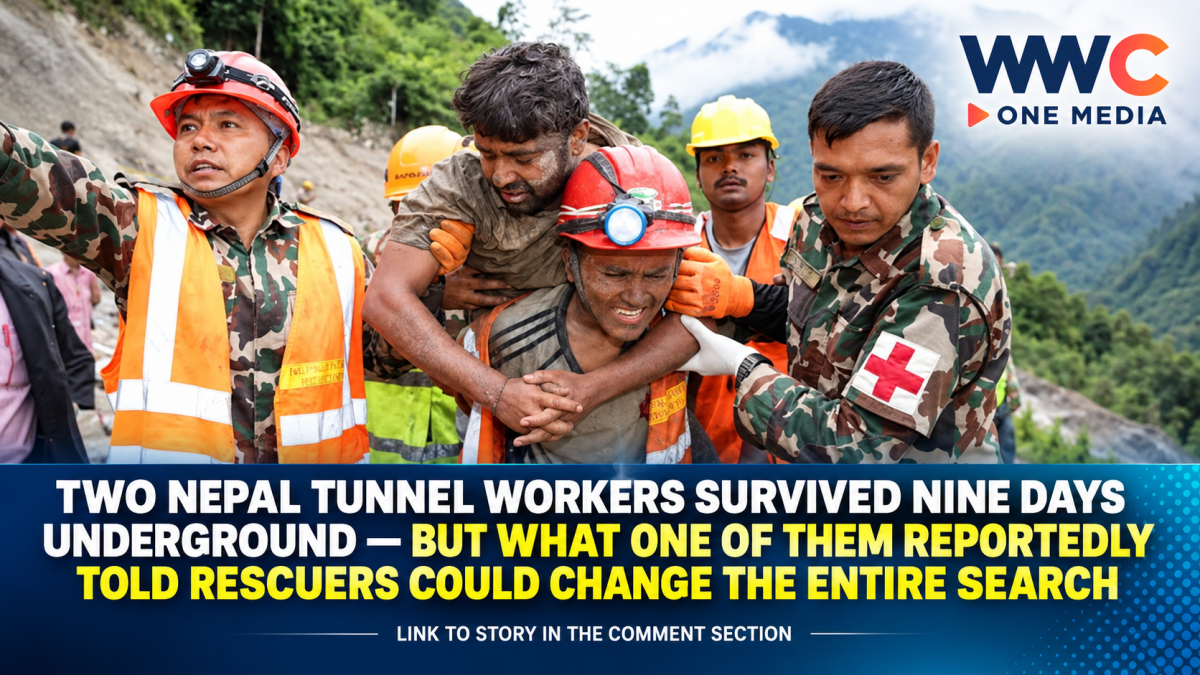
KATHMANDU, Nepal — Nine days after a catastrophic wall of water, rock and mud tore through Nepal’s Trishuli Valley, rescuers pulled two hydropower workers alive from a tunnel that had been buried beneath massive amounts of debris — a dramatic breakthrough in a disaster that has killed more than 1,200 people.
The two men, identified as Sanjay Sah, 30, a mechanical foreman, and Kabir Maharjan, 45, a mechanical supervisor, emerged from the Upper Trishuli 3A hydropower project on Friday, September 4, providing the strongest evidence yet that people may have survived for days inside the region’s extensive underground tunnel network.
Video released by Nepal’s energy authorities showed rescuers helping one survivor through a mud-covered opening before carrying him toward evacuation. Images of the second worker showed him covered in mud as emergency teams moved him from the disaster zone.
The breakthrough came after days in which hope of finding survivors had steadily diminished.
And the rescue may have changed the calculation.
Six Days Just to Reach the Tunnel
The August 26 disaster was triggered after a massive collapse of ice, rock and debris in the Himalayan region near Nepal’s border with China sent a devastating surge down the Trishuli Valley.
Roads, bridges, communities and hydropower facilities were overwhelmed.
At Upper Trishuli 3A, rescuers reportedly needed almost six days simply to reach the tunnel entrance because it had been buried beneath debris, according to Reuters. Heavy machinery then worked through huge boulders and compacted material while rescuers attempted to push oxygen through pipes toward possible air pockets underground.
Australian tunnel-rescue specialist Arnold Dix, who advised on the 2023 operation that freed 41 workers from India’s Silkyara tunnel, had been assisting the Nepal effort remotely.
Earlier Friday, rescuers believed they had detected a faint response after calling into the tunnel.
Teams then pushed through roughly 50 to 60 metres of accumulated debris.
Less than an hour later, two men came out alive.
The Rescue Mission Has an Unusual Weapon: WhatsApp
Behind the helicopters, excavators and military rescue teams is another tool that has become unexpectedly important: a WhatsApp group.
Reuters reported that a group originally created by engineers before the disaster has expanded to more than 500 members, with experts sharing engineering drawings, tunnel layouts, access routes and other technical information with rescuers.
In some areas, the disaster changed the terrain so dramatically that simply locating the original entrances to hydropower tunnels became difficult.
The flood deposited an estimated 2.2 million tonnes of mud and debris along the valley, according to Reuters.
Officials searching facilities such as Chilime and Rasuwagadhi have used project drawings and information from current and former workers to determine where underground chambers may still exist.
That matters because some tunnels contain areas where trapped workers could potentially have access to air — and, in certain facilities, supplies of food and water.
Around 900 Hydropower Workers Have Been Reported Missing
Nepalese authorities have been particularly focused on the country’s hydropower infrastructure.
Reuters reported that around 900 people connected with six hydropower facilities were reported missing, with officials believing some workers may have survived by remaining inside or fleeing into tunnels when the flood struck.
CNA, citing AFP, reported that at least 12 hydropower projects were damaged or destroyed by the disaster.
The economic consequences could also be significant.
Reuters reported that the flood wiped out approximately 10% of Nepal’s electricity generation capacity, damaging part of a hydropower network that supplies the country and supports growing electricity exports.
One Survivor Reportedly Brought an Even Bigger Message
Hours after the rescue, Nepal News reported a potentially major development.
Citing the Nepal Electricity Authority, the local outlet said Sanjay Sah told rescuers that the workers still trapped with him inside the tunnel were safe and waiting to be brought out.
That report could significantly increase hopes of additional rescues.
However, the claim had not yet been independently confirmed in the Reuters or CNA reporting reviewed at the time of publication, so the number and condition of any additional survivors remain uncertain.
Search-and-rescue operations were continuing.
Conflicting Early Reports on the Survivors’ Conditions
Officials said both workers were receiving medical attention after their extraction.
Local Nepalese reporting described both men as stable after examinations by an army medical team.
Reuters, however, reported earlier that Kabir Maharjan was having difficulty moving his hands and legs while Sah’s injuries were not considered critical. Both men were being transported for further treatment in Kathmandu.
The difference may reflect assessments made at different stages of their evacuation.
For Maharjan’s family, simply learning he was alive was extraordinary after more than a week without certainty.
A Disaster Stretching Across Nepal and Tibet
The tunnel rescue represents a rare moment of hope amid an enormous regional catastrophe.
As of September 4, Nepal’s disaster authority had recorded 1,259 bodies recovered and 5,083 people missing, according to CNA. Chinese state media reported another 21 deaths and 541 people missing in Tibet, bringing the combined reported toll to at least 1,280 dead and more than 5,600 missing.
More than 800 foreign nationals from at least 34 countries were also reported missing across Nepal and Tibet.
The scale of the destruction has made relief operations exceptionally difficult. Entire sections of settlements along the river have disappeared, roads and bridges have been destroyed and some communities remain isolated.
United Nations officials have warned that access remains one of the biggest obstacles to delivering assistance, with unconventional options including cargo drones and porters being considered for cut-off communities.
The Trishuli Tunnels Are Now the Centre of Hope
For more than a week, Nepal’s rescue operation had increasingly become a race against time.
The discovery of Sah and Maharjan changes that — at least temporarily.
People survived inside one of the buried tunnels for nine days.
Engineers now have better information about what conditions may exist underground. Rescue crews have demonstrated they can break through enormous deposits of mud and rock. And one rescued worker has reportedly told authorities that others remained alive behind him.
But hundreds of families are still waiting.
Across the Trishuli Valley, excavators continue digging, engineers continue studying tunnel diagrams and rescuers continue searching underground chambers that disappeared beneath millions of tonnes of debris.
Two men have made it out.
The question now is how many more may still be waiting inside.




Leave a Reply