
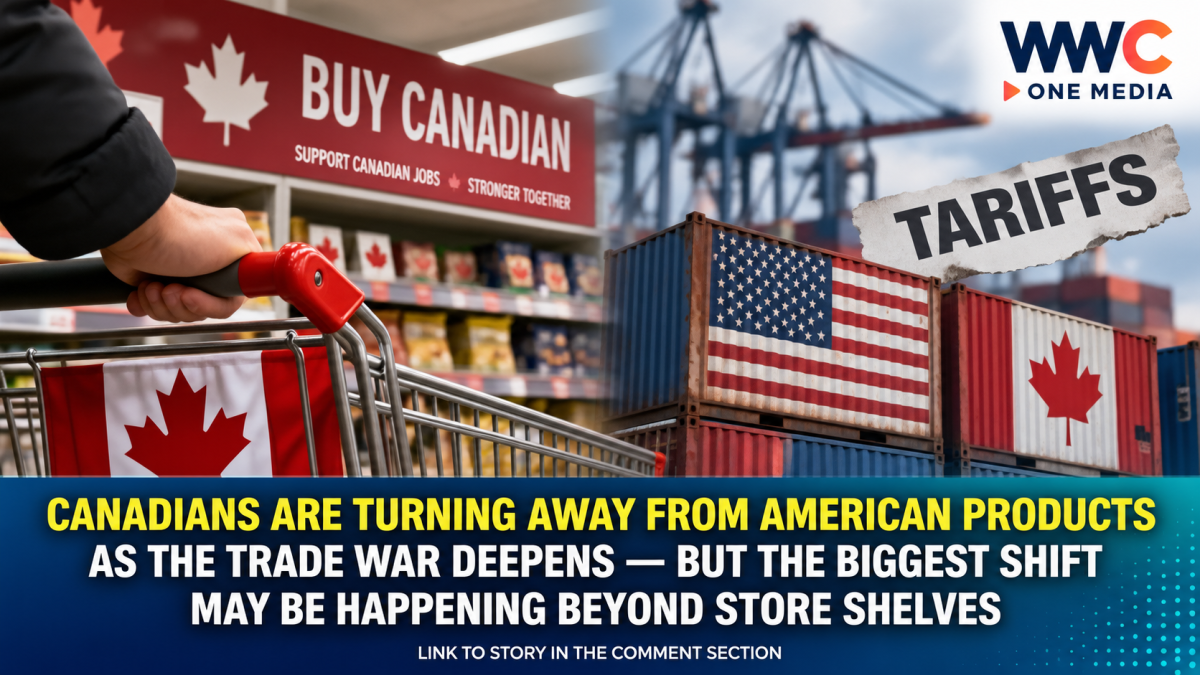
WINDSOR, Canada — What began as another dispute over tariffs between two of the world’s closest trading partners is increasingly turning into something more personal for Canadians.
From supermarket aisles to corporate supply chains, Canadians are reconsidering how much they buy from the United States as the latest Canada-U.S. trade war fuels a renewed wave of economic patriotism.
At grocery stores in Windsor, Ontario — a city whose economy and identity are closely linked to neighbouring Detroit — Canadian flags and maple-leaf labels are increasingly being used to help shoppers identify domestic products.
Some consumers are going even further, deliberately checking labels and avoiding American-made goods altogether.
CNA reported that workers at Windsor’s La Stella supermarket have seen customers asking more questions about where products come from, while the store itself is trying to source more Canadian and locally produced alternatives.
But the movement now extends well beyond groceries.
Reuters reported this week that Canadian companies are actively looking for ways to reduce their dependence on U.S. suppliers as relations between Ottawa and Washington deteriorate. Chapman’s Ice Cream, for example, is working toward cutting its U.S. imports by about 70% by mid-2027.
That suggests the trade dispute could be producing a much longer-lasting transformation than either government originally anticipated.
CANADA PREPARES C$27.6 BILLION TARIFF RESPONSE
The immediate trigger is a renewed escalation in the trade conflict.
The United States imposed 50% tariffs on C$27.6 billion worth of Canadian goods beginning August 22 after another attempt to negotiate a settlement collapsed.
Ottawa responded with plans to match Washington’s action dollar-for-dollar.
Beginning September 8, 2026, Canada will impose tariffs of 15%, 25% and 50% on C$27.6 billion worth of U.S. imports, according to Canada’s Department of Finance.
The products targeted include goods in sectors such as steel, dairy, appliances, agricultural equipment, electronics, pulp and paper.
Global News reported that more than 700 categories of American products are included in Canada’s retaliatory tariff package. Canadian Industry Minister Mélanie Joly has simultaneously urged consumers to support Canadian-made goods, arguing that purchasing domestically helps protect Canadian jobs.
The confrontation follows the failure of intensive negotiations in August.
The Associated Press reported that the latest U.S. tariffs rely partly on Section 338 of the Tariff Act of 1930, an obscure provision whose modern use raises legal questions because it has never previously been tested in this way in court.
That adds another layer of uncertainty for businesses trying to decide whether the current tariffs are temporary bargaining tools or the beginning of a fundamentally different North American trading relationship.
CARNEY SAYS CANADA IS STILL WILLING TO TALK
Despite the escalating retaliation, Canadian Prime Minister Mark Carney has not ruled out returning to negotiations.
Speaking in Thunder Bay on September 3, Carney said Canada remains prepared to strike an agreement with the United States — provided that any deal offers stability, credibility and genuine benefits for both countries.
He also suggested Washington’s position had recently become more flexible, potentially creating room for negotiations to restart.
That was a notable change in tone.
Just days earlier, Carney had said Washington needed to approach negotiations more seriously before talks could resume following their collapse in late August.
The political disagreement, however, remains significant.
U.S. officials have argued that Canada rejected a favourable agreement, while the Canadian government says some American demands would have undermined Canadian economic interests and sovereignty.
For now, there is no new comprehensive deal.
CANADIAN PATRIOTISM IS MOVING INTO THE ECONOMY
What makes this confrontation unusual is the way the dispute has moved from government negotiating rooms into ordinary consumer behaviour.
CNA found Canadian shoppers describing their purchasing decisions in explicitly national terms, with some saying they now check every product to determine whether it was made in the United States.
There was already evidence that this movement could endure.
An Ipsos survey published in September 2025 found that 56% of Canadians surveyed said they had bought more Canadian products or investments because of Canada-U.S. tensions, while 58% said they had avoided American products, services, investments or travel.
Among respondents who had changed their behaviour, 82% said they expected to continue doing so even after the Canada-U.S. dispute ended.
The renewed tariff battle in 2026 has given that sentiment another powerful catalyst.
Reuters reported this week that more than 70% of Canadians supported Carney’s decision to suspend trade negotiations with Washington, even though a prolonged confrontation could carry substantial economic costs.
The anger is also not entirely one-sided.
A Reuters/Ipsos survey of 1,023 U.S. adults found only 20% supported the latest tariffs on Canada, while 57% opposed them.
TRAVEL TELLS A MORE COMPLICATED STORY
Canadian frustration has also affected travel, although the latest numbers reveal a more nuanced picture than a simple permanent boycott.
Statistics Canada reported that Canadians made 5.5 million trips involving visits to the United States during the first quarter of 2026, down 10.6% from the same period a year earlier.
Spending by Canadians travelling in the U.S. declined even more sharply, falling 13.6% year over year to C$5 billion.
At the same time, Canadian travel to overseas destinations increased 6.2%.
Yet preliminary July data showed Canadian return trips from the United States rising 10.2% compared with July 2025.
The important comparison is with the period before the political rupture.
Canadian return trips from the U.S. by air and automobile totalled roughly 2.28 million in July 2026. That remained far below the approximately 3.19 million recorded in July 2024.
In other words, cross-border travel has begun recovering from its sharp 2025 decline, but it has not returned to earlier levels.
THERE IS ONE BIG PROBLEM WITH “BREAKING UP” WITH AMERICA
For all the talk about economic independence, Canada’s dependence on its southern neighbour remains enormous.
That may ultimately be the most important number in this entire dispute.
In July, the United States still received 66.35% of all Canadian exports, Reuters reported.
Canadian exports to the U.S. fell 6.6% that month while imports from the U.S. increased 1.8%, causing Canada’s trade surplus with its neighbour to shrink by more than 40%.
There are signs of diversification: Canada’s U.S. share of exports has fallen to about 68% so far this year from roughly 73% previously, while exports to non-U.S. destinations rose 7.4% in July.
But decades of economic integration cannot be undone by changing brands at the grocery store.
Automobile plants, energy networks, agricultural markets and manufacturing supply chains routinely cross the Canada-U.S. border, sometimes multiple times before a finished product reaches a customer.
That means an escalating tariff battle can eventually raise costs on both sides.
THE BIGGER QUESTION IS WHAT HAPPENS AFTER THE TARIFFS
Trade disputes usually end with governments signing agreements.
Consumer attitudes are harder to reverse.
Canadian companies that establish new suppliers in Europe, Asia or within Canada may have little incentive to immediately return to American vendors once those relationships are established.
Consumers who discover Canadian alternatives may keep buying them.
And travellers who replace trips to Florida, New York or California with destinations elsewhere may establish entirely new habits.
That is why this dispute may leave a much deeper mark than the value of the tariffs themselves.
Canada and the United States remain economically intertwined on a scale few neighbouring countries can match, and both governments continue to signal that negotiations could eventually restart.
But the argument is already changing how Canadians think about that relationship.
For decades, the assumption was that the world’s longest peaceful border also represented one of its most dependable economic partnerships.
The tariffs can eventually be removed with the stroke of a pen.
Restoring that assumption may prove much harder.




Leave a Reply