
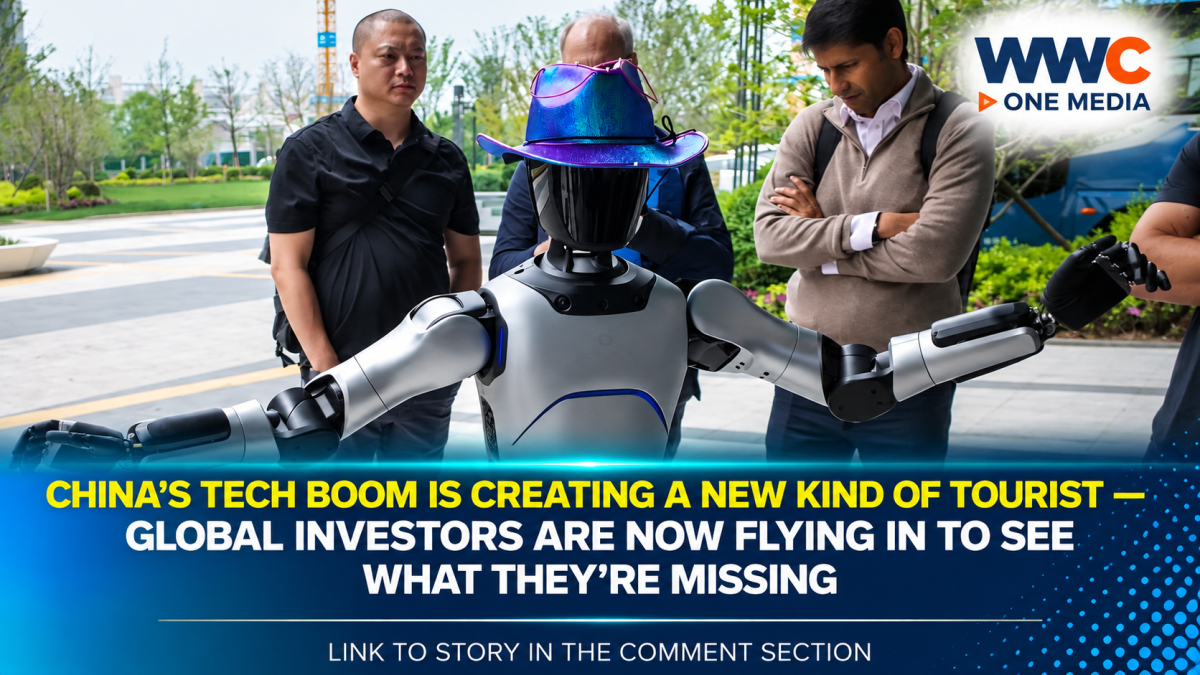
BEIJING — Forget the Great Wall and traditional sightseeing. A growing number of foreign investors, entrepreneurs and technology executives are travelling to China for a very different reason: to see its factories, AI companies, robots and electric vehicles up close.
The trend is turning China’s technology ecosystem into an unlikely tourism attraction, with some visitors paying thousands of dollars for curated tours designed to get them inside factories and technology companies that are normally difficult to access.
And behind the trend is a growing fear among business leaders that China may be moving faster than expected in artificial intelligence, robotics, electric vehicles and advanced manufacturing.
The new “tech pilgrimage”
For years, Silicon Valley was the destination for entrepreneurs wanting to understand the future of technology.
That is changing.
According to Reuters, investors and executives are increasingly travelling to Beijing, Shenzhen, Shanghai, Hangzhou and Hefei to study China’s technology ecosystem firsthand. Some organised programmes cost as much as US$15,000 for five days, with roughly half of the participants in one organiser’s tours coming from Southeast Asia.
Robert Wu, chief executive of Shanghai-based research firm Baiguan, described the change as a relatively new phenomenon: visitors are increasingly treating China as an object of study and learning, rather than simply a manufacturing destination.
The visitors are not necessarily coming to admire China.
Many are coming because they are worried about falling behind it.
Why are Western executives looking toward China?
China’s rise in electric vehicles, batteries, robotics and AI has created a new question for companies around the world:
What if the next major technological advantage is already being built in China?
Reuters described the growing concern as a potential “China shock 2.0”, reflecting fears that Chinese companies could gain an edge in advanced manufacturing and emerging technologies.
The tours offer executives something they cannot get from a presentation or market report: the opportunity to stand inside a working factory and see the production process for themselves.
Bertrand Chen, chief executive of the Global Shipping Business Network, said seeing China’s manufacturing capabilities firsthand provides a perspective that is difficult to obtain remotely.
Shenzhen is becoming the centre of the movement
If one Chinese city represents this new wave, it is Shenzhen.
Once best known primarily as a manufacturing centre, Shenzhen has developed into one of China’s most important technology and hardware ecosystems.
The city is home to major technology companies, electronics manufacturers, robotics businesses and the massive Huaqiangbei electronics market.
Foreign visitor numbers in Shenzhen rose 70% in 2025, while arrivals increased by more than 30% during the first quarter of 2026, according to Reuters. More than 5 million entries were recorded through August this year.
Foreign entrepreneurs are increasingly using the city to locate manufacturers, source components and develop prototypes.
Some are even taking advantage of China’s 10-day visa-free entry policy to make short exploratory trips.
AI, robots and EVs are becoming tourist attractions
The technology-tourism trend isn’t limited to wealthy investors.
China is increasingly turning industrial sites into visitor attractions.
Beijing has designated more than 140 official industrial-tourism demonstration sites, while factories are increasingly opening their doors to visitors. Some factory tours cost around US$60.
Xiaomi’s electric-vehicle factory in Beijing has attracted more than 250,000 visitors since March 2024, according to Reuters. Demand has reportedly become so strong that entry slots awarded through an online lottery have appeared on resale markets for as much as 2,000 yuan.
Xiaomi told Reuters that visits are determined through an online lottery and tickets cannot be transferred.
The phenomenon is also being seen beyond business circles.
China Daily reported that nearly 30 South Korean university students travelled to Hangzhou in July and chose technology companies and an EV factory as part of their itinerary instead of focusing solely on conventional tourist attractions.
Hangzhou is another technology magnet
Hangzhou has emerged as another major destination for people interested in China’s technology sector.
CNA recently described the city as China’s “new Silicon Valley,” highlighting its concentration of AI startups, engineering talent, investment and technology infrastructure. The city is home to more than 500 AI companies, according to CNA, including firms associated with the so-called “Six Little Dragons” of Hangzhou’s technology scene.
AI is also increasingly visible outside research laboratories.
Technology is being deployed in areas ranging from healthcare and logistics to manufacturing, robotics and public services, giving visitors a chance to see how AI is being integrated into everyday life.
The trend is bigger than business tourism
This is where the story gets particularly interesting.
Foreign visitors are not simply travelling to China to inspect factories.
They are increasingly building entire trips around technology.
Rest of World reported in May that curated China tech tours can cost as much as US$9,000, with itineraries covering EV factories, robotaxis, AI companies and robotics firms.
The report noted that some visitors were using the tours to reassess their assumptions about Chinese manufacturing and global competitiveness.
There are even technology-focused experiences for ordinary tourists, including tours featuring robotaxis, drone food deliveries and AI-enabled consumer products.
China’s tech-tourism push is also deliberate
Beijing has increasingly recognised that technological achievements can serve another purpose: showing the world what China can build.
Chinese authorities have promoted industrial tourism, while companies benefit from the publicity generated when foreign visitors share factory visits and technology demonstrations online.
That creates a powerful cycle:
A visitor sees an impressive robot or factory.
They post the experience online.
Millions see it.
More people become curious.
And some eventually travel to China to see it themselves.
Rest of World described this cycle as part of the growing perception of China as a serious technological power, regardless of whether observers believe China’s advantage is as large as it appears online.
But China has not “won” the technology race
This is an important distinction.
The growing number of foreign visitors does not prove that China has overtaken the United States or Europe in every area of technology.
Reuters quoted Rui Ma, founder of Tech Buzz China, cautioning against overstating China’s advantage. Non-Chinese technology companies still hold much of the world’s market share, advanced intellectual property and profits.
There are also major areas where China remains dependent on foreign technology or faces restrictions.
For example, a senior executive at German semiconductor supplier Zeiss said this week that China could still be around 15 years behind in developing extreme-ultraviolet lithography machines, a critical technology for the most advanced chip manufacturing.
So the picture is far more complicated than simply “China has surpassed the West.”
What is really changing?
The most significant development may be psychological.
Foreign business leaders are no longer asking only what China can manufacture cheaply.
Increasingly, they want to know:
- How quickly can Chinese companies develop new products?
- How does China scale technology so rapidly?
- What can Western companies learn from Chinese manufacturing?
- How are AI and robotics being deployed in the real economy?
- Which Chinese companies could become global competitors?
- Where are the next investment opportunities?
That shift alone represents a major change in how China’s technology sector is perceived internationally.
And it explains why entrepreneurs who once made pilgrimages to Silicon Valley are now adding Shenzhen, Hangzhou and Shanghai to their technology itineraries.
The bigger story
China’s biggest technological achievement may not simply be the robots, EVs or AI models being built inside its factories.
It may be that foreign entrepreneurs are now willing to spend thousands of dollars just to see how those technologies are being made.
The global technology race is no longer something companies can watch from a distance.
Increasingly, executives want to get inside the factory floor — because they fear that by the time they understand what China is building, their competitors may already be using it.
WWC ONE MEDIA J.M.D


Leave a Reply