
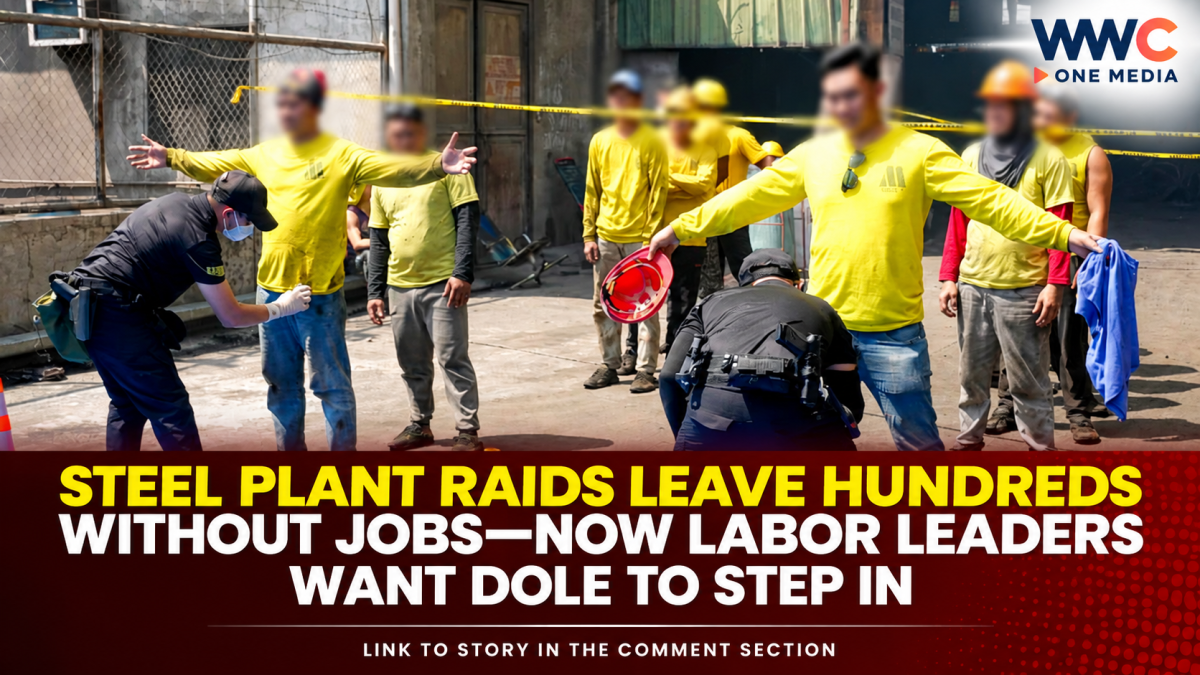
MANILA, Philippines — The government’s expanding crackdown on steel manufacturers accused of violating safety, labor and product regulations is now facing a new question: Who will protect the workers left behind when the factories shut down?
Federation of Free Workers (FFW) president Sonny Matula is urging the Department of Labor and Employment (DOLE) to take a more active role in government operations involving steel plants, particularly when raids result in workers being displaced.
Matula said workers should not be left to shoulder the economic consequences of alleged violations committed by their employers.
“Workers have rights to job security, livelihood and immediate support in the event of company closure,” Matula said in a statement Friday, according to Inquirer.
He added that if undocumented workers are among the concerns prompting government raids, DOLE officials should be present during such operations to ensure workers’ rights and welfare are addressed.
The Davao raid that intensified the controversy
The call came after the August 13 inter-agency raid on Davao Mighty Steel Corp. in Barangay Ilang, Bunawan, Davao City.
Authorities said the operation uncovered suspected radioactive materials and reinforcing steel products that allegedly failed mandatory standards.
The operation resulted in the removal of 174 Filipino workers from the facility. Authorities said the workers were taken out because of concerns over possible occupational exposure to radioactive-bearing materials, dust, fumes, wastes and production residues.
The Philippine Nuclear Research Institute reportedly detected radioactive isotopes including uranium-238, thorium-228, thorium-232 and radium-226 in materials associated with the facility. Authorities also said the company did not have the required authorization to possess or handle radioactive materials.
At the same time, product testing raised concerns about the quality of steel already sold in the market.
Authorities said four of eight Davao Mighty Steel reinforcing-steel samples, or 50 percent, purchased from hardware stores in Mindanao failed the mandatory mass-variation requirement under PNS 49:2020.
Officials have nevertheless cautioned against automatically linking the company’s steel to structural collapses. The presence of Davao Mighty Steel bars in the rubble of buildings damaged by the June 8 Mindanao earthquake does not by itself establish that the steel caused those collapses, authorities said.
The issue is bigger than one factory
The Davao operation appears to be part of a broader government investigation.
The NBI said around 20 other steel plants nationwide were under surveillance for possible violations involving product quality and workplace safety. The bureau said the facilities were identified through reports and intelligence information.
The NBI previously said five steel facilities had been raided—in Pampanga, Bulacan, Misamis Oriental and Davao—as authorities expanded their investigation.
In Misamis Oriental, authorities earlier raided Philippine Sanjia Steel Corp. in Tagoloan, where the PNP said 69 Chinese nationals and one Filipino were allegedly found working illegally. Authorities also reported detecting radioactive materials at the facility. The PNP denied accusations that the operation was discriminatory, saying the raid was based on a court-issued warrant and complaints involving immigration, labor and public-safety violations.
More than 900 workers could be affected
The labor issue has now expanded beyond Davao.
The Daily Tribune reported that labor groups were seeking assistance for around 900 workers affected by the closure of three steel factories: Philippine Sanjia Steel Corp. in Misamis Oriental, Chuang Xing Steel Corp. in Pampanga, and Davao Mighty Steel Corp.
Matula argued that workers should not become “collateral damage” in enforcement actions targeting alleged violations by companies.
He urged DOLE to determine whether workers were adequately protected, whether occupational safety requirements were followed, and what assistance—including wages, benefits or alternative employment—could be provided during shutdowns.
He also cited Republic Act No. 11058, the Occupational Safety and Health Standards Law, in arguing that DOLE has a role in workplace inspection and enforcement.
Authorities say workers are not the target
The PAOCC, meanwhile, has defended the raids, saying they were conducted to enforce Philippine law and protect workers and the public.
PAOCC officials said the Davao operation was supported by a court-issued search warrant and followed an investigation into alleged substandard steel and radioactive materials.
The agency emphasized that workers were not the target of the operation.
Following the Davao raid, PAOCC officials also said they were willing to coordinate with affected workers to help them obtain benefits and find employment opportunities. Government agencies including DOLE, the Department of Social Welfare and Development and the Office of Civil Defense were also cited as potential sources of assistance.
A delicate balance between enforcement and workers’ rights
The controversy now places the government in a difficult position.
Authorities face pressure to crack down on allegedly unsafe steel products, radioactive materials and possible labor and immigration violations. But labor groups argue that enforcement should not leave hundreds of ordinary employees without income or adequate support.
The debate also extends to foreign workers.
Matula said Chinese workers involved in the affected facilities should likewise receive due process and labor protections, stressing that labor rights should apply regardless of nationality.
Meanwhile, the government maintains that its operations are directed at alleged violations—not at a particular nationality—and says investigations must proceed according to evidence and due process.
For now, the steel-plant crackdown appears far from over. With roughly 20 additional facilities reportedly under surveillance, the next challenge for authorities may be just as consequential as the raids themselves: ensuring that efforts to protect the public do not leave thousands of workers struggling to survive after their workplaces are shut down.

Leave a Reply