
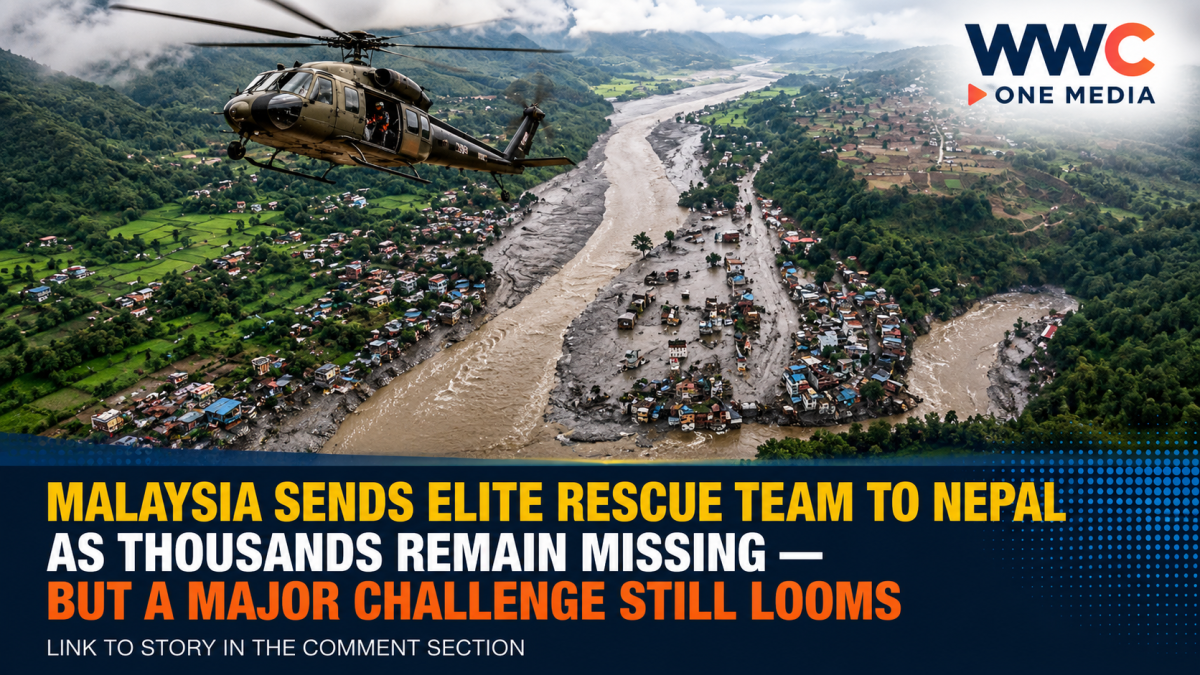
KUALA LUMPUR — Malaysia is moving to send its elite disaster rescue personnel to Nepal as the devastating Himalayan flood crisis continues to worsen, with thousands of people still missing and authorities warning that fresh flooding remains possible.
Prime Minister Datuk Seri Anwar Ibrahim announced on Sunday, Aug. 30, that Malaysia has decided to deploy the Special Malaysia Disaster Assistance and Rescue Team (SMART) to assist with relief and search-and-rescue efforts following the catastrophic floods.
The mission carries an urgent additional objective: helping locate, assist and potentially bring home Malaysians affected by one of the region’s worst recent natural disasters.
Malaysia will also contribute US$1 million toward Nepal’s disaster relief and post-disaster recovery efforts.
Deployment Being Coordinated With Nepal
The National Security Council (MKN), National Disaster Management Agency (NADMA) and the Foreign Ministry have been tasked with coordinating with Nepalese authorities to facilitate the SMART team’s deployment as soon as possible.
The team is also expected to work alongside the Malaysian Embassy in Kathmandu to support affected Malaysians and coordinate assistance on the ground.
The announcement comes amid growing concern over Malaysians who remain uncontactable in the disaster zone. Malaysian authorities previously reported that 55 Malaysians in Nepal were still uncontactable, while a further 36 were listed as uncontactable in China’s Tibet region, according to reports carried by AsiaOne.
Disaster Toll Continues to Climb
The scale of the disaster has grown dramatically in recent days.
The catastrophic flooding began after a major collapse involving rock and glacier ice high in the Himalayan region, sending a destructive torrent of water, mud and debris through communities and river valleys in Nepal and Tibet.
According to the latest Associated Press reporting on Sunday, Nepalese authorities said 788 people had died in Nepal, with 2,502 still missing, while Chinese authorities reported additional deaths and hundreds missing on the Tibetan side of the border. The figures remain fluid as rescue teams reach devastated and previously inaccessible areas.
Entire communities have been damaged or cut off, while roads, bridges, homes and critical infrastructure have been destroyed. Poor weather and difficult terrain have also complicated rescue operations.
Authorities have warned residents in vulnerable areas to remain vigilant after rising water levels raised fears of possible additional flooding.
A Complicated International Rescue Effort
Malaysia’s decision to send SMART personnel comes as international assistance efforts continue to evolve.
Reuters reported on Aug. 28 that Nepal had said it did not require foreign search-and-rescue assistance “for now,” stating that its own security agencies were managing operations. However, Malaysia has since announced that its agencies are coordinating directly with the Nepalese government to facilitate the SMART deployment.
That distinction could prove crucial as the humanitarian crisis continues to change rapidly.
Malaysia’s latest move signals both a humanitarian response and an urgent effort to account for its citizens caught in the disaster.
Race Against Time
With thousands still missing, rescue workers are battling unstable conditions, damaged infrastructure and the threat of further flooding.
For Malaysian authorities, the mission is now about more than delivering aid.
It is a race against time to find those still unaccounted for.
As Malaysia’s elite SMART team prepares to help in Nepal, one question remains at the heart of the unfolding tragedy: how many more survivors can still be reached before time — and the mountains — run out?




Leave a Reply