
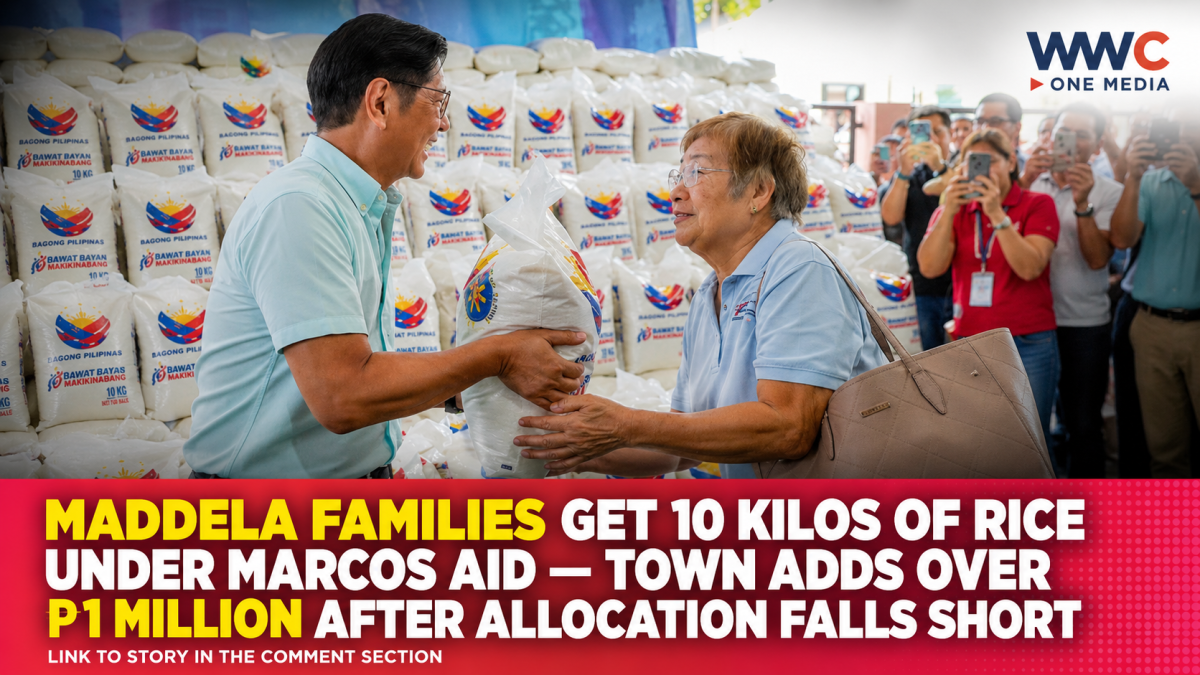
MADDELA, Quirino — Families in Maddela have begun receiving 10 kilograms of rice each under President Ferdinand Marcos Jr.’s nationwide rice assistance initiative, but the local rollout came with a notable development: the municipality had to put in more than ₱1 million of its own funds after the available allocation was not enough to cover all qualified families.
Maddela Mayor Rimel C. Tolentino said the municipal government realigned local funds to augment the assistance and allow more eligible households to receive their 10-kilo allocation. The Philippine Information Agency reported the distribution on August 29.
The report did not disclose the exact number of families who received rice in Maddela, how many would have been excluded without the additional municipal funding, or the total value of the original national allocation. Those unanswered figures are important when assessing how far the national subsidy can stretch in individual communities.
What exactly is the Bawat Bayan Makikinabang rice program?
The distribution is part of the administration’s Bawat Bayan Makikinabang, or BBM, initiative, which channels assistance through local governments using the Local Government Support Fund-Financial Assistance to Local Government Units, or LGSF-FALGU.
The funding mechanism is covered by DBM-DILG Joint Circular No. 1, series of 2026, dated February 19, which sets guidelines for the government’s Assistance to Indigent Individuals or Families-Food Assistance-Rice Distribution Project under the 2026 national budget.
Under the program, LGUs identify qualified beneficiaries and handle local distribution. Government guidelines have generally envisioned 10 kilograms of rice per family per distribution round, with six rounds initially planned. However, official government reporting has also clarified that the actual number of rounds can vary depending on the price of rice and available funds, and LGUs may supplement national allocations with local money.
That provision helps explain what happened in Maddela: rather than limiting assistance to the number of households the original allocation could cover, the municipality chose to add more than ₱1 million from its own resources.
Maddela is not the only LGU putting in additional money
The funding issue is not unique to Quirino.
In Santa Rosa City, Laguna, the city government also expanded the program through additional local funding so more households could receive assistance, according to an Inquirer report on the broader national rollout. During his July 2026 State of the Nation Address, Marcos said the administration ultimately wanted the rice assistance to reach eight million families.
A similar funding challenge emerged in Palawan, where the provincial government added ₱57 million after officials said an initial ₱146-million national allocation would not be enough for an updated beneficiary list covering more than 300,000 families.
These cases illustrate one of the program’s central implementation questions: national funding provides the base, but the number of families ultimately covered in some areas may also depend on whether local governments have enough resources to augment it.
Rice aid being rolled out across the country
Independent news organizations have documented similar distributions elsewhere.
GMA News reported in May that 13,571 families in Makati City were targeted to receive 10 kilograms of rice every two months under Bawat Bayan Makikinabang.
Inquirer reported on August 17 that 2,230 beneficiaries—including farmers, fisherfolk, vendors, laborers and other low-income earners—in Dumaguete City received 10-kilo allocations during a Negros Oriental rollout. The administration has described the intended schedule there as once every two months, or six times annually.
The Philippine Star has also reported that the broader initiative is financed through the LGSF, whose 2026 allocation was about ₱57.88 billion, although that fund supports more than just this particular rice distribution activity.
The bigger question is coverage
For families facing high household expenses, 10 kilograms of rice can provide immediate relief. But Maddela’s experience also highlights a more consequential policy issue: What happens when the number of qualified households is larger than what the national allocation can finance?
In Maddela, the municipal government responded by spending more than ₱1 million locally. Mayor Tolentino said the additional funding helped extend the assistance to more families, while expressing hope that the municipality would continue receiving support and other programs from the Office of the President.
What remains unclear from the available Maddela report is exactly how many qualified families exceeded the original allocation, how much rice was ultimately purchased, and whether the local government will need to provide additional funds again in future distribution rounds.
Those figures will determine whether Maddela’s ₱1-million augmentation was a one-time adjustment—or a sign of a broader funding challenge as the nationwide rice program expands.


Leave a Reply