
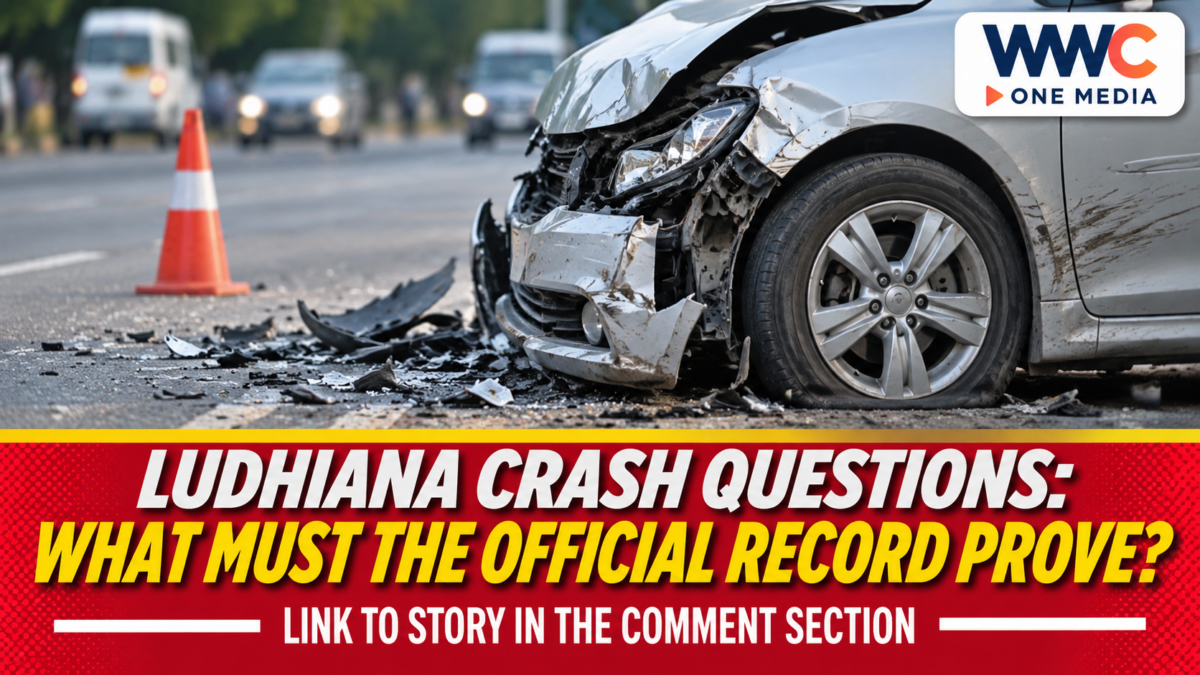
INDIA — Nov. 22, 2026. Questions surrounding a reported road collision in Ludhiana have drawn attention to how casualty figures, vehicle movements and possible traffic violations should be verified. An accessible, incident-specific police report or hospital casualty statement has not been established in this review, so the reported deaths, injuries and sequence of events cannot yet be presented as independently confirmed facts.
India’s Motor Vehicles Act, 1988, provides a framework for examining the legal questions that can arise when vehicles collide on a public road. But a law describing an offence does not establish that any particular driver or vehicle owner committed it. That distinction is essential before publishing a finding about responsibility.
Ludhiana Crash Questions: Why the Primary Record Matters
A responsible account of a road incident needs more than a headline and a preliminary number. It needs a dated police record identifying where the event occurred, the vehicles involved and the status of the investigation. Hospital documentation may be needed to reconcile the number of people examined, admitted, transferred or discharged.
A first emergency report and a later hospital update can count different things. A casualty total could change when patients move between facilities, when an initial estimate is corrected or when police complete their enquiries. None of those possibilities establishes what happened in Ludhiana; they explain why a single unsupported figure should not be treated as settled.
A separate WWC analysis of a reported Kanpur pilgrim-bus collision explored similar verification difficulties. Its facts cannot be transferred to another incident, but its distinction between early accounts and authenticated records is relevant to the editorial process.
What India’s Law Says About Parked Vehicles
Section 122 of the Motor Vehicles Act addresses leaving a vehicle in a dangerous position. Its concern is whether a vehicle is left at rest in a public place in circumstances likely to create danger, obstruction or undue inconvenience for other road users or passengers.
That rule does not mean every roadside stop is unlawful. Location, positioning, visibility and surrounding conditions matter to the application of the provision. A useful incident review would establish precisely where the stationary vehicle stood and whether its position created a legally relevant hazard.
Section 126 separately addresses precautions for stationary vehicles, including steps to prevent unintended movement. It serves a different purpose from determining whether a parked vehicle obstructed traffic.
Investigators therefore need evidence about the actual setting, not simply the fact that one vehicle may have been stationary. Roadside photographs, site measurements and official findings could clarify the legal questions, if they become available.
Passenger Transport Requires Its Own Review
The Motor Vehicles Act also distinguishes different uses of transport vehicles. Section 66 generally links the use of transport vehicles in public places to applicable permits and conditions, subject to the Act’s exceptions. Whether a particular journey complied with those conditions depends on the vehicle’s registration, permit and actual use.
Passenger numbers alone are not enough to establish an offence. The authorised capacity, seating arrangements and applicable regulatory classification would have to be checked against vehicle documents and the relevant law.
Section 123 addresses people riding on running boards or otherwise outside the body of a vehicle. Section 125 addresses circumstances in which passengers or objects obstruct a driver’s control. These provisions illustrate different hazards; neither can be applied to the reported Ludhiana event without case-specific evidence.
WWC’s Antipolo truck-safety analysis likewise separated possible mechanical and operational issues from what investigators had actually established. That approach helps prevent a road-safety discussion from turning into an unsupported accusation.
Speed and Driver Conduct Cannot Be Presumed
Section 112 deals with speed limits, while Section 184 deals with dangerous driving. They provide legal context for reviewing vehicle operation, but an allegation of excessive speed is not itself proof of a violation or proof that speed caused a collision.
A proper reconstruction could consider road conditions, sight distance, vehicle condition, movement before impact and reliable witness evidence. Which of those matters proves significant is for investigators to determine. The statutory framework cannot replace an examination of the actual scene.
That distinction also protects the fairness of the report. Drivers and owners should not be described as responsible merely because a crash occurred. Even when a formal complaint has been registered, the allegations and any judicial determination must be distinguished.
WWC’s earlier report on a Tampines road-crash case provides another example of why legal status and case-specific documents matter. Singapore’s laws and facts are distinct from those of India; the comparison concerns verification, not legal equivalence.
Why an Accurate Casualty Count Matters
A news report can inadvertently exaggerate an incident by treating a preliminary headcount, an injury estimate and a confirmed hospital register as interchangeable. A high-quality update should identify which agency produced each number and when the number was recorded.
The same applies to names and ages. Without an authenticated official record, printing personal details creates an avoidable risk of misidentification. Even when disclosure is legally permissible, editors should consider whether the information is essential to explaining the public-safety issue.
The better course is to describe what is known from a reliable document and leave unsupported claims out. If later records change an initial count, the update should say what changed and why, rather than quietly replacing a number.
What Happens Next
For the Ludhiana tip to become a verified incident report, the key missing material is an original police statement or authenticated incident record, together with a reliable casualty update. Vehicle documents, road-scene evidence and any investigation findings would be necessary before assigning a cause or discussing a specific legal breach.
Analysis: The public interest lies in establishing what happened and whether any preventable risk was identified, not in deciding blame ahead of the evidence. Until official incident records can be checked, the responsible editorial outcome is to keep the collision-specific account on hold while explaining the laws that could guide a later investigation.
Frequently Asked Questions
Has the Ludhiana casualty figure been independently verified?
Not through an accessible incident-specific primary record in this review. An authenticated police or hospital statement is needed.
Does India prohibit all roadside parking?
No. Section 122 concerns vehicles left in positions or circumstances that create, or are likely to create, specified risks or obstruction.
Does a pickup carrying passengers automatically violate the law?
Not on that description alone. The vehicle’s registration, permit conditions, authorised capacity and actual use must be examined.
Has the cause of the reported collision been established?
No incident-specific official finding was available for this review. It would be premature to state that speed, visibility or parking caused it.










