
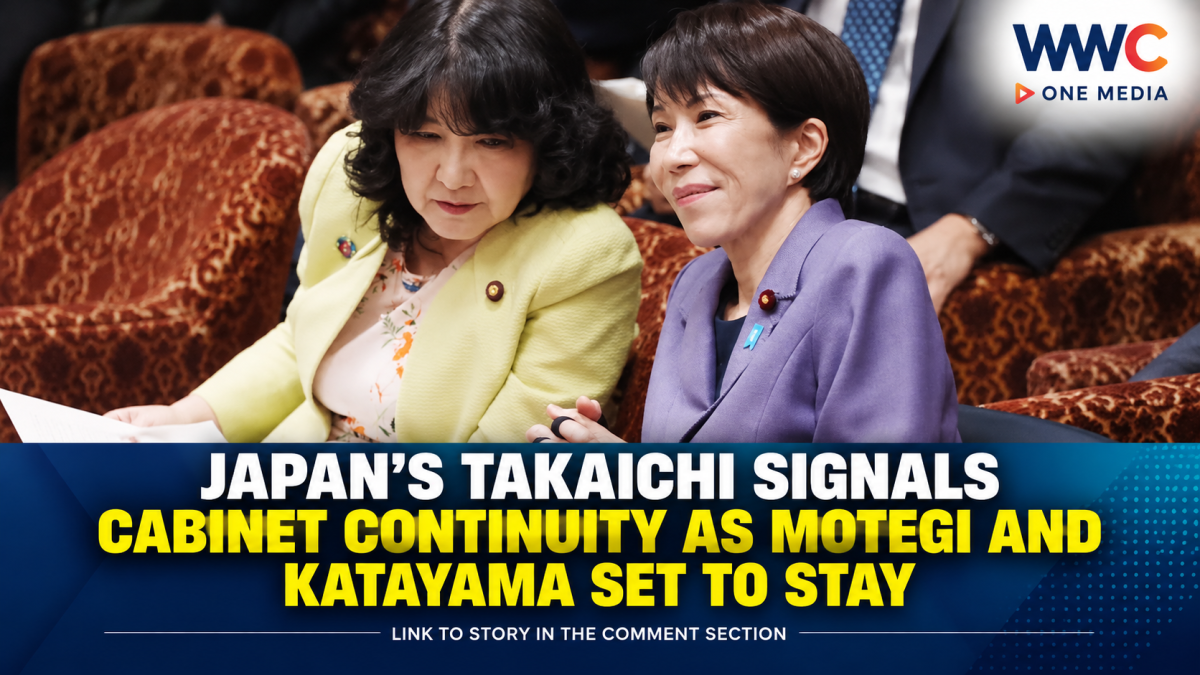
TOKYO — Japanese Prime Minister Sanae Takaichi is considering keeping Foreign Minister Toshimitsu Motegi and Finance Minister Satsuki Katayama in their posts as she prepares for a Cabinet reshuffle expected in mid-September, according to Japanese government sources.
The possible decision is emerging as Takaichi seeks to strengthen her political base while maintaining continuity on two fronts that are increasingly important to Japan: foreign policy and economic management.
The move could also carry significant implications for Japan’s relations with the United States, the yen, financial markets and Takaichi’s political ambitions heading into next year’s Liberal Democratic Party leadership contest.
Takaichi weighs keeping two key ministers
According to reporting by The Japan Times and Jiji Press, Takaichi is considering retaining Motegi as foreign minister and Katayama as finance minister.
The expected reshuffle would take place around the middle of September, although the precise timing and final lineup have not been formally announced.
The reported plan is part of a broader effort to preserve key members of Takaichi’s government and the leadership of the ruling Liberal Democratic Party.
For Takaichi, retaining experienced ministers could reduce disruption at a politically sensitive moment while allowing her administration to concentrate on its economic and diplomatic priorities.
Why Motegi’s position matters
Motegi has remained an important figure inside the LDP despite having competed against Takaichi in the party’s leadership election last October.
He lost in the first round but backed Takaichi in the runoff. Since becoming foreign minister, he has traveled extensively and held repeated meetings with U.S. Secretary of State Marco Rubio as Tokyo works to maintain close relations with President Donald Trump’s administration.
That diplomatic experience could be particularly valuable as Japan manages a complicated international environment involving relations with the United States, China, the Middle East and Russia’s war against Ukraine.
Motegi also retains political support among members of the intraparty faction he previously led and maintains good relations with LDP Vice President Taro Aso, an important supporter of the Takaichi administration.
His continued presence would therefore serve both a foreign-policy and internal-party purpose.
Katayama is becoming even more important
The potential retention of Katayama may be even more closely watched by financial markets.
Japan’s finance minister has become a central figure in the government’s efforts to deal with the weak yen, rising bond yields and relations with Washington.
Reuters previously reported that Takaichi intended to retain Katayama, citing four government sources familiar with the matter. Those sources said Takaichi valued Katayama’s role in the rare joint U.S.-Japan yen intervention and her close working relationship with U.S. Treasury Secretary Scott Bessent.
Katayama and Bessent have held roughly 10 discussions, according to earlier comments from the Japanese finance minister.
Her departure at this point could therefore have been interpreted by investors as a significant policy change, particularly while Japan is under pressure over currency movements and government bond yields.
The yen problem hasn’t disappeared
The Cabinet reshuffle is unfolding against a turbulent economic backdrop.
Japan has already worked with the United States on a rare coordinated yen-buying intervention. But the intervention has not produced a lasting reversal of the yen’s weakness.
The yen recently moved close to the psychologically important ¥160-per-dollar level before recovering as markets increased expectations of a Bank of Japan rate hike.
Japan’s top currency diplomat Atsushi Mimura has reiterated that Tokyo remains alert to excessive currency moves and is prepared to act if necessary.
At the same time, Bessent has publicly argued that Japan’s relatively low interest rates have contributed to the yen’s undervaluation.
Katayama, however, has pushed back against suggestions that Washington directly pressured her over Japanese monetary policy, saying that such decisions fall under the jurisdiction of the Bank of Japan.
Japan’s bond market adds another layer of pressure
The currency problem is occurring alongside mounting concerns over Japan’s public finances.
The benchmark 10-year Japanese government bond yield recently moved above 3% for the first time since 1996, reflecting investor concerns about inflation, fiscal sustainability and the possibility of faster monetary tightening.
At the same time, Japanese ministries submitted a combined ¥143 trillion in budget requests, an all-time record, according to reporting cited by Reuters and the Financial Times.
That creates a difficult balancing act for Katayama.
Takaichi wants stronger economic growth and has pursued an expansive fiscal strategy, while Katayama must convince investors that Japan can maintain fiscal credibility.
The finance minister has repeatedly emphasized the need to pursue economic growth while maintaining fiscal sustainability.
The reshuffle is about more than replacing ministers
The timing of Takaichi’s reshuffle is politically significant.
The Japan Times has reported that the expected changes could come as early as September 16 and may represent Takaichi’s last major opportunity to reshape her Cabinet before next year’s LDP presidential leadership contest.
Japanese Cabinet reshuffles are often used not only to change policy personnel but also to manage rivalries inside the ruling party and strengthen a prime minister’s political position.
Takaichi therefore faces a delicate calculation: reward loyalty, preserve experienced ministers and keep potential rivals close without destabilizing the government.
Keeping Motegi could help maintain party balance while preserving diplomatic continuity.
Keeping Katayama could reassure markets that Tokyo does not intend to abruptly change its approach to the yen, fiscal policy or negotiations with Washington.
What happens next could matter even more
The reported decision is not yet a formal Cabinet announcement. The final lineup remains subject to Takaichi’s political decisions later this month.
But the direction is already becoming clearer.
Takaichi appears to be favoring continuity among several influential figures while positioning her administration for the next stage of its economic and political agenda. Earlier reporting indicated that Chief Cabinet Secretary Minoru Kihara and LDP Vice President Taro Aso were also expected to remain, while the future of other senior officials remained under scrutiny.
For investors, however, Katayama may be the name to watch most closely.
Her continued presence would give Tokyo an experienced intermediary at a time when the yen is volatile, Japanese bond yields are climbing and Washington is taking a much closer interest in Japan’s economic policy.
And that makes the September reshuffle about much more than Cabinet appointments.
It could reveal how Takaichi intends to balance her ambitious spending agenda with market confidence — and how much room Japan believes it has to chart its own economic course while Washington watches closely.
WWC ONE MEDIA M.J.E

Leave a Reply