
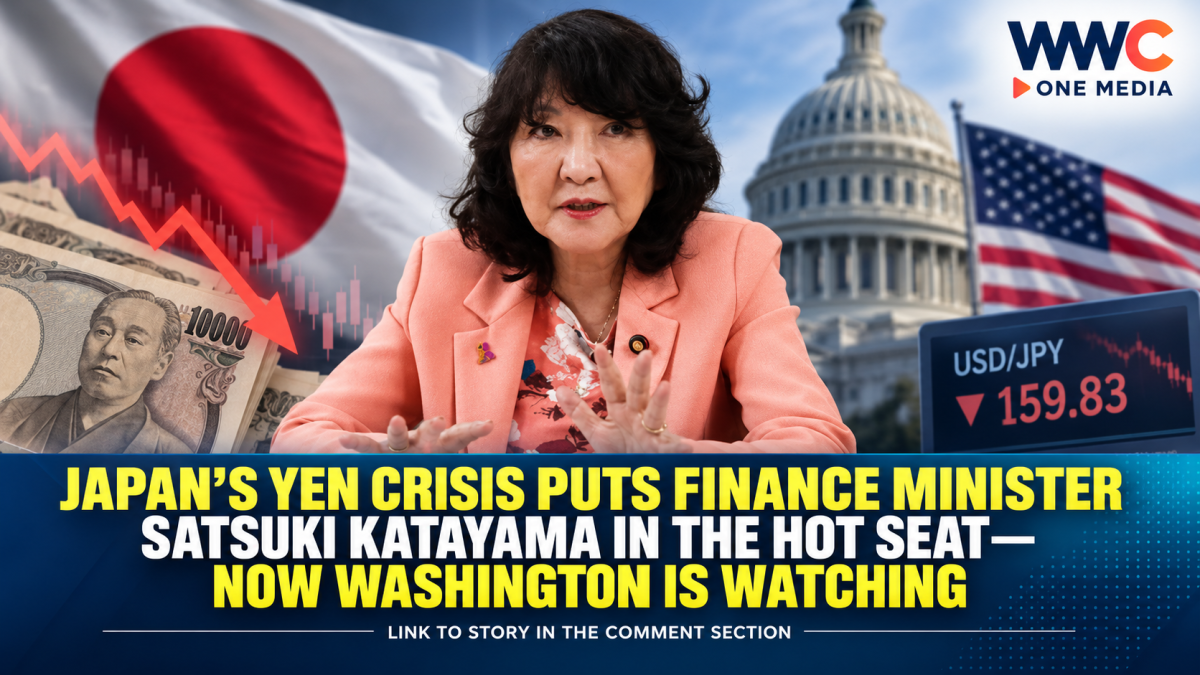
TOKYO — Japan’s battle to strengthen the yen has placed Finance Minister Satsuki Katayama at the center of an increasingly complicated economic showdown involving Tokyo, Washington and the Bank of Japan.
Katayama is facing pressure on several fronts: the yen remains vulnerable despite a massive government intervention, U.S. officials are calling for stronger action against the currency’s weakness, and Prime Minister Sanae Takaichi’s expansionary fiscal policies are raising concerns about Japan’s debt and bond markets.
The stakes are rising just weeks after Japan and the United States carried out a rare coordinated intervention to support the yen.
A bridge between Tokyo and Washington
Katayama has become an important intermediary between the Takaichi government and U.S. Treasury Secretary Scott Bessent.
The two officials have held a series of discussions about financial markets and the yen, including a face-to-face meeting during the Group of 20 finance ministers’ gathering in Asheville, North Carolina.
After that meeting, Katayama said Japan and the United States agreed that orderly currency movements were important for global financial stability.
But she rejected suggestions that Bessent had directly demanded that Japan raise interest rates.
Katayama said there was no discussion of Japanese monetary policy during their bilateral meeting, while acknowledging Bessent’s long-standing view that the yen is undervalued partly because of the large interest-rate gap between Japan and the United States.
That distinction matters because responsibility for monetary policy rests with the Bank of Japan, while Japan’s Finance Ministry has jurisdiction over foreign-exchange policy.
Japan already spent a record amount defending the yen
Tokyo has already committed enormous resources to stopping the yen’s slide.
Japanese authorities spent approximately ¥15.39 trillion on foreign-exchange intervention between late July and late August, according to Finance Ministry data reported by the Japan Times.
The intervention included a rare coordinated yen-buying operation involving Japan and the United States on July 31, when the currency had weakened toward levels not seen in decades.
The action initially pushed the yen sharply higher, but the improvement did not last. The dollar subsequently climbed back toward the psychologically important ¥160 level, demonstrating how difficult it is for intervention alone to reverse the currency’s broader trend.
Reuters reported that the July intervention failed to establish a lasting floor under the yen.
That leaves Japanese policymakers facing a difficult question: How much more can intervention accomplish if the underlying economic forces pushing the yen lower remain in place?
The Bank of Japan is now under the microscope
One of those forces is the interest-rate gap between Japan and the United States.
Japan has been gradually tightening monetary policy, but its interest rates remain substantially below U.S. rates. That difference can encourage investors to borrow in yen and invest in higher-yielding assets elsewhere, putting continuing pressure on the Japanese currency.
The situation has become even more politically sensitive after Bessent publicly expressed strong support for the Bank of Japan taking “decisive” monetary steps to address the yen’s undervaluation.
He also highlighted the contribution of yen weakness to Japan’s domestic inflation.
Markets have consequently been watching the BOJ’s next policy meeting closely. Reuters reported that expectations for a September rate increase had become very strong following a series of more hawkish signals from the central bank.
But raising interest rates is not a simple solution.
Higher rates could support the yen by making Japanese assets more attractive, but they could also increase borrowing costs and complicate the government’s efforts to stimulate economic growth.
Katayama’s other problem: Japan’s huge fiscal ambitions
The currency fight is unfolding alongside a broader debate over Japan’s fiscal policy.
Takaichi’s government has pursued an expansionary economic strategy aimed at supporting growth through increased government spending and investment.
That approach has alarmed some investors because Japan already carries one of the world’s heaviest public-debt burdens.
The New York Times reported that Katayama, a former Finance Ministry official with a reputation for fiscal discipline, has found herself balancing the prime minister’s spending ambitions against concerns about the yen and government bonds.
The tension became particularly visible as Japanese government bond yields climbed sharply. Reuters reported that the 10-year Japanese government bond yield recently moved above 3%, a level not seen since the 1990s.
For investors, the combination of a weak currency, higher inflation, rising bond yields and aggressive government spending creates a particularly difficult policy environment.
The yen’s latest move offers a warning
The yen briefly strengthened by roughly 2% this week as investors increased expectations for a Bank of Japan rate hike.
Japan’s top currency diplomat, Atsushi Mimura, nevertheless warned that authorities remained alert to exchange-rate movements and were maintaining their readiness to respond to excessive yen depreciation.
After Mimura’s comments, the dollar briefly fell to around ¥155.30 before the yen surrendered part of its gains.
Reuters said the move illustrated the currency’s continuing vulnerability despite expectations of tighter Japanese monetary policy.
The market is therefore watching not only the level of the yen but also the speed and nature of its movements.
Tokyo has repeatedly stressed that it is prepared to respond to disorderly currency moves, but U.S. officials have recently indicated that they do not currently regard the yen’s movements as sufficiently disorderly to warrant another joint intervention.
Katayama’s balancing act could become even more important
Katayama’s position has become unusually important because she sits at the intersection of three competing forces.
At home, she must work with a prime minister pushing for stronger economic growth and greater government spending.
In financial markets, she must reassure investors that Japan can maintain fiscal credibility while dealing with elevated bond yields and inflation.
In Washington, she must maintain cooperation with Bessent while making clear that Japanese monetary policy remains a matter for Japanese institutions.
The New York Times described Katayama as a crucial bridge between Japanese and American economic policymakers, while Reuters reported that Takaichi intends to retain her as finance minister in an upcoming cabinet reshuffle.
That decision itself could be significant for markets because Katayama has become a familiar point of contact between Tokyo and Washington during the yen crisis.
What happens next?
The immediate focus will be on the Bank of Japan, the yen and whether Japanese authorities believe currency movements have become disorderly enough to justify another intervention.
But the bigger question is whether Tokyo can achieve a lasting strengthening of the yen without relying repeatedly on foreign-exchange intervention.
Japan’s previous intervention demonstrated that authorities can move the currency dramatically in the short term. What remains uncertain is whether they can change the underlying forces driving the yen.
For Katayama, that means the currency fight is about far more than an exchange rate.
It is a test of how Japan balances economic growth, inflation, fiscal discipline, monetary-policy independence and relations with the United States—all at the same time.
And with the yen still vulnerable and markets increasingly focused on the Bank of Japan’s next move, Katayama’s toughest decisions may only be beginning.
WWC ONE MEDIA M.J.E




Leave a Reply