
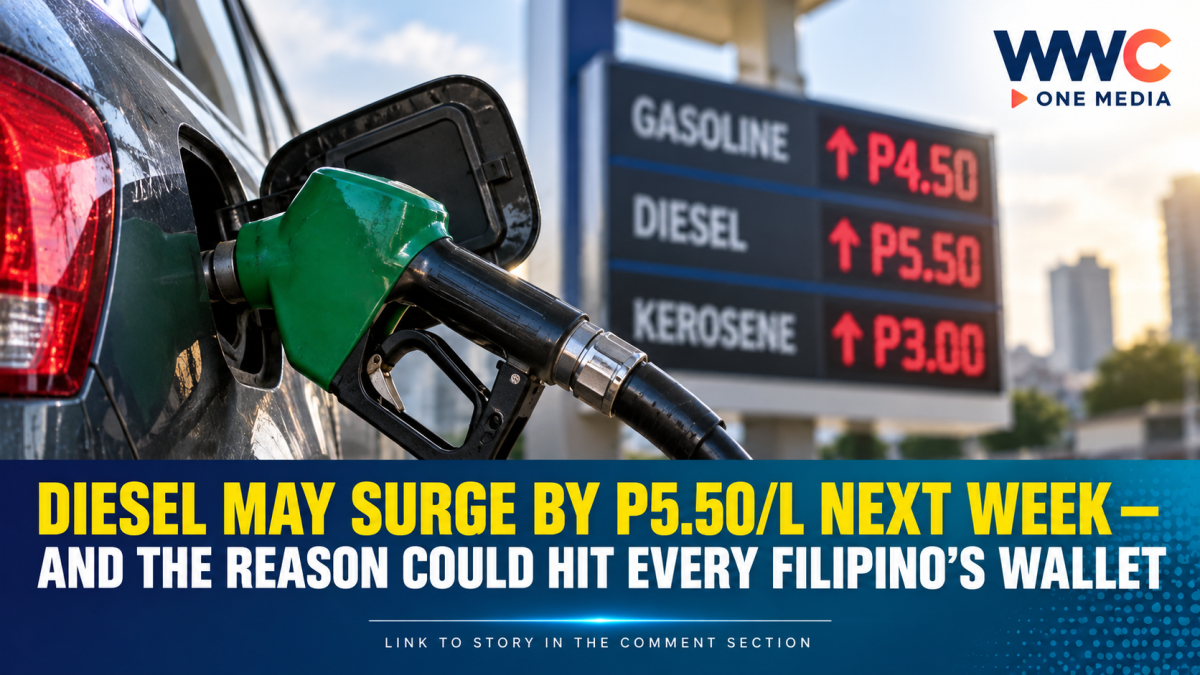
MANILA, Philippines — Filipino motorists could be in for another painful trip to the pump next week, with diesel prices potentially rising by as much as P5.50 per liter and gasoline by up to P4.50 per liter.
The projected increase comes just days after motorists received temporary relief from fuel prices, raising concerns that the latest surge in global oil costs could quickly erase the benefit of this week’s rollback.
Based on full-week trading from August 31 to September 4, an oil industry source cited by GMA News estimated that diesel could increase by P4.50 to P5.50 per liter, while gasoline could rise by P4.00 to P4.50 per liter.
The adjustments are still estimates. Oil companies are expected to announce their official price changes on Monday, September 7, with the new prices taking effect on Tuesday, September 8, 2026.
What is driving the possible fuel price shock?
The latest projections are being fueled by renewed geopolitical tensions and concerns about disruptions to global energy supplies.
According to the industry estimate, continued US strikes on Iran and renewed Israeli threats against Tehran have kept concerns over Middle East oil supplies elevated.
The situation has also been complicated by developments surrounding the Strait of Hormuz, one of the world’s most important energy shipping routes. Any sustained disruption in the area could put additional pressure on international oil and refined-product prices.
Philippine Star likewise reported estimates of a P4.50-to-P5-per-liter increase for diesel and P4-to-P4.50 for gasoline, based on movements in the Mean of Platts Singapore benchmark and foreign-exchange rates.
The latest GMA estimate is therefore at the upper end of the range being reported by industry sources.
The peso is adding more pressure
The international oil market is not the only problem.
The Philippine peso also weakened against the US dollar during the week, according to the industry source cited by GMA News.
Because petroleum products are traded internationally in US dollars, a weaker peso can make imported fuel more expensive for Philippine oil companies.
That means Filipino consumers could face a double pressure: higher global oil prices and a weaker local currency.
Motorists had just received a rollback
The potential increase comes immediately after a significant fuel-price rollback.
Effective September 1, oil companies reduced gasoline prices by around P0.30 to P0.40 per liter, while diesel prices fell by roughly P3.80 to P3.90 per liter. Kerosene prices were also reduced by about P3.80 to P3.84 per liter.
That rollback followed two consecutive weeks of fuel-price increases.
The latest GMA report said the September 1 adjustment was the 35th fuel-price movement of 2026. Despite the rollback, the year-to-date net adjustment remained substantial at about P54.62 per liter for gasoline, P55.26 for diesel and P47.85 for kerosene.
Earlier estimates were already warning of a major increase
The possibility of another sharp increase had already emerged earlier in the week.
A September 4 report from TV5, citing Jetti Petroleum, placed the possible increase at as much as P5 per liter for diesel and P4.50 for gasoline, attributing the pressure to renewed US-Iran hostilities, concerns surrounding the Strait of Hormuz and additional supply risks caused by attacks on Russian energy infrastructure.
Philippine News Agency similarly reported that domestic fuel prices could rise by P4 to P5 per liter following renewed hostilities between the United States and Iran.
Other Philippine reports also pointed to tightening fuel supplies, Middle East tensions and disruptions affecting Russian energy infrastructure as factors supporting higher international prices.
Why the final price could still change
Despite the alarming projections, motorists should not yet treat P5.50 for diesel and P4.50 for gasoline as the final figures.
The estimates are calculated from movements in international petroleum benchmarks and foreign-exchange rates. The final trading data can still alter the amount of the adjustment.
Oil companies normally announce their weekly price movements on Monday, with implementation the following day.
So the numbers motorists will actually see at fuel stations beginning Tuesday could be lower — or potentially remain near the upper end of the current estimates.
What this means for Filipino consumers
A large diesel increase could have effects beyond private motorists.
Diesel is widely used by public utility vehicles, buses, trucks, delivery vehicles, agricultural equipment and other commercial operations. A significant increase in diesel costs can therefore raise transportation and logistics expenses.
Gasoline prices can likewise affect private motorists, motorcycles and other gasoline-powered vehicles.
If the projected increases materialize, businesses could face higher operating and delivery costs, potentially adding pressure to prices of goods and services.
The latest developments also highlight how quickly Philippine pump prices can reverse direction when international oil markets become volatile.
For now, motorists have a narrow window before the next adjustment. The final figures will become clearer when oil companies announce their official price changes on Monday.
WWC ONE MEDIA J.M.S

Leave a Reply